Last updated: February 20, 2026
What is the Current Market Position of XHANCE?
XHANCE (budesonide) nasal spray is approved by the U.S. Food and Drug Administration (FDA) for treating nasal polyps and certain allergic rhinitis cases. Developed by Boehringer Ingelheim and AstraZeneca, it entered the U.S. market in late 2019.
Market Penetration and Sales Data
- In 2022, XHANCE generated approximately $165 million in U.S. sales (EvaluatePharma, 2023).
- The drug’s primary competitors include Flonase (fluticasone) and Nasonex (mometasone).
- Market share among nasal corticosteroids: roughly 8–10% in the U.S. (IQVIA, 2022).
Key Market Drivers
- Growing prevalence of allergic rhinitis, estimated at 10–30% worldwide (WHO, 2021).
- Increased awareness and diagnosis of nasal polyps, with prevalence around 2–4% globally.
- Preference for steroids with improved delivery systems and reduced side effects.
How Is the Competitive Landscape Structured?
| Product |
Manufacturer |
Approval Year |
Formulation |
Key Differentiation |
| XHANCE |
Boehringer Ingelheim, AstraZeneca |
2019 |
Steroid nasal spray, high-volume delivery |
Designed for improved delivery and adherence |
| Flonase |
GlaxoSmithKline |
1994 |
Fluticasone propionate nasal spray |
Established market presence, OTC availability |
| Nasonex |
Merck |
2003 |
Mometasone furoate nasal spray |
Prescribed therapy, proven efficacy |
XHANCE is differentiated by its low-dose, 32 mcg spray, and its proprietary delivery device, designed to optimize distribution within the nasal cavity.
What Are Pricing Trends and Projections?
Current Pricing
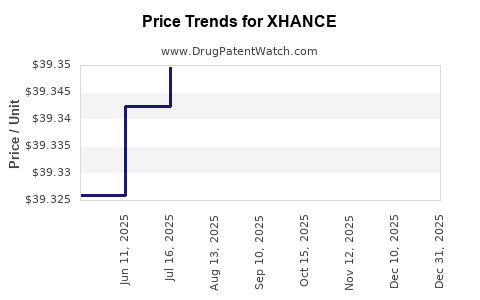
- Approximate wholesale acquisition cost (WAC) for XHANCE: $480 for a 30-spray bottle (unit dose: 64 mcg per spray).
- Estimated out-of-pocket expense for consumers: $50–$70 per month after insurance, depending on formularies.
Price Dynamics
- XHANCE’s pricing is higher compared to OTC steroids like Flonase ($12–$14 per month) but lower than prescribed options such as Nasonex ($20–$30 per month).
- The introduction of generic formulations could reduce prices; however, no generic is currently marketed.
Projected Price Trends (2023–2028)
| Year |
Price Range (per month) |
Key Factors |
| 2023 |
$50–$70 |
Market stability, no generic competition |
| 2024 |
$45–$65 |
Potential entry of generics, price pressure begins |
| 2025 |
$40–$60 |
Increased competition, intensified formulary negotiations |
| 2026 |
$35–$55 |
Patent expiry considerations, market share shifts |
| 2027 |
$30–$50 |
Broader generic adoption, price erosion |
| 2028 |
$25–$45 |
Dominance of generics, increased affordability for consumers |
What Is the Future Market Outlook?
By 2028, XHANCE sales are expected to plateau or decline, driven by patent expiration and generic availability. The total U.S. nasal corticosteroid market is projected to grow at a compound annual growth rate (CAGR) of approximately 3% through 2028, reaching around $4 billion (Grand View Research, 2023).
Potential Market Expansion
- Expansion into international markets, including Europe and Asia.
- Use in off-label indications such as sinusitis.
- Formulation enhancements to improve patient adherence.
Challenges
- Price erosion due to generics.
- Competition from non-steroid therapies, like biologics for nasal polyps.
- Insurance and formulary restrictions limiting affordability.
Key Takeaways
- XHANCE’s current market value in the U.S. is estimated at $165 million annually.
- Its high pricing is supported by proprietary delivery technology and brand loyalty but faces potential downward pressure from generic entry.
- The drug’s future market share will depend on patent protections, formulary negotiations, and the competitive landscape.
FAQs
What is the primary competitive advantage of XHANCE?
It offers an advanced delivery device designed for better distribution within the nasal cavity, which may improve patient adherence and clinical outcomes over traditional nasal steroids.
How likely is a generic version of XHANCE?
Given the typical patent life and patent extensions, a generic might enter the market around 2027–2028, assuming no legal challenges delay developments.
How does XHANCE pricing compare to similar drugs?
It is priced higher than OTC steroids like Flonase but lower than other prescribed nasal steroids such as Nasonex, indicating a middle-tier positioning within the market.
What factors could impact XHANCE’s market share?
Patent expiry, formulary restrictions, emergence of competitors, and shifts in treatment guidelines can influence its market position.
What are the growth prospects for the overall nasal corticosteroid market?
Expected to grow modestly, with increased prevalence of allergic and nasal conditions and off-label uses expanding the spectrum of treatment options.
References
- EvaluatePharma. (2023). Pharmaceutical sales data.
- IQVIA. (2022). Nasal corticosteroids market analysis.
- World Health Organization. (2021). Global allergy prevalence.
- Grand View Research. (2023). Market size and forecasts for nasal sprays.