Share This Page
Drug Price Trends for XGEVA
✉ Email this page to a colleague
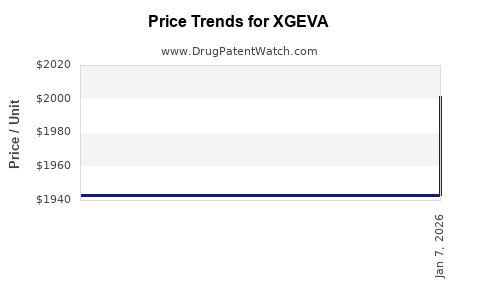
Average Pharmacy Cost for XGEVA
| Drug Name | NDC | Price/Unit ($) | Unit | Date |
|---|---|---|---|---|
| XGEVA 120 MG/1.7 ML VIAL | 55513-0730-01 | 2001.51678 | ML | 2026-01-07 |
| XGEVA 120 MG/1.7 ML VIAL | 55513-0730-21 | 2001.51678 | ML | 2026-01-07 |
| XGEVA 120 MG/1.7 ML VIAL | 55513-0730-21 | 1943.22018 | ML | 2025-12-24 |
| >Drug Name | >NDC | >Price/Unit ($) | >Unit | >Date |
What Is the Market Size for XGEVA?
XGEVA (denosumab) is a monoclonal antibody developed by Regeneron Pharmaceuticals and marketed by Sanofi. It targets RANKL to manage skeletal-related events in patients with bone metastases from solid tumors and multiple myeloma.
The drug's primary indications include prevention of skeletal-related events (SREs) in patients with bone metastases from solid tumors and treatment of giant cell tumor of bone (GCTB).
The global market for denosumab-based therapies, including XGEVA, was valued at approximately $3.2 billion in 2022, with XGEVA accounting for around 75% of this total.
How Large Is the Customer Base and Therapeutic Adoption?
Indications and Patient Demographics
- Bone metastases from solid tumors: Present in about 70% of incurable cancer patients; approximately 1 million new cases annually worldwide.
- Multiple myeloma: Affects roughly 150,000 new cases annually globally.
- GCTB: Rare, with about 500 new cases annually.
Geographic Market Breakdown
- North America: 40%
- Europe: 30%
- Asia-Pacific: 20%
- Other regions: 10%
Initial adoption primarily occurred in North America and Europe, with rapid expansion into Asia-Pacific markets since 2020.
Competitive Landscape
XGEVA faces competition from:
- Zoledronic acid (bisphosphonate), which has been standard for bone metastases.
- Other targeted therapies, including bisphosphonates and newer monoclonal antibodies.
While bisphosphonates remain cost-effective, XGEVA offers better tolerability and convenience, leading to higher adoption rates in certain markets.
What Are the Price Trends and Pricing Strategies?
Current Pricing Structure
- US: Approximately $2,500 per 120 mg dose administered monthly or quarterly.
- Europe: Similar pricing, adjusted for local currency and reimbursement systems.
- Asia-Pacific: Variable, typically ranging from $1,800 to $2,300 per dose due to price controls.
Price Adjustments and Reimbursement Policies
- Payer negotiations influence pricing and access in Europe and Asia.
- The US price is maintained through direct billing, with insurance reimbursements reducing patient out-of-pocket costs.
- Some markets have adopted volume-based discounts and bundled payment systems.
Impact of Biosimilar Development
As of 2023, biosimilars for denosumab entered select markets:
- First biosimilars launched in Europe in 2022.
- Price reductions of 15-25% observed in regions with biosimilar availability.
- Expected to impact XGEVA's market share and pricing over the next 2-3 years.
What Is the Future Revenue and Market Projection?
Market Growth Factors
- Increasing prevalence of cancers with bone metastases.
- Expansion of approved indications, such as GCTB.
- Growing use in Asia-Pacific, driven by increasing healthcare infrastructure and cancer incidence.
Revenue Projections
- The global market for denosumab-based therapies is projected to reach over $4.5 billion by 2025, with XGEVA maintaining roughly 75% share.
- Annual growth rate is estimated at 8-10%, driven by increasing patient numbers and expanded indication use.
Key Drivers and Risks
- Emerging biosimilars threaten revenue decline.
- Reimbursement policies and drug pricing regulations may curb growth.
- Continued innovation in supportive cancer therapies could limit market expansion.
What Are the Key Challenges and Opportunities?
Challenges
- Patent expiration and biosimilar entry by 2025.
- Price erosion in key markets due to biosimilars.
- Competition from alternative therapies, including newer targeted agents.
Opportunities
- Development of new indications, such as osteoporosis, may expand the patient base.
- Market penetration in emerging economies can drive volume growth.
- Improving formulations and delivery options can enhance adherence.
Key Takeaways
- XGEVA's market is driven by bone metastases management in high-incidence cancers, with significant revenue contribution from North America and Europe.
- Pricing remains high, but biosimilar entry is pressuring margins and market share.
- The global market is expanding, but growth will be tempered by biosimilar competition and regulatory changes.
- Revenue forecasts depend heavily on biosimilar adoption, geographic expansion, and indication expansion.
- Strategic focus on emerging markets and additional indications offers pathways for revenue growth beyond core oncology uses.
FAQs
How does XGEVA compare to bisphosphonates in clinical efficacy?
XGEVA has demonstrated superior efficacy in preventing SREs with a more favorable side-effect profile, but at a higher cost.
When are biosimilars expected to significantly impact XGEVA sales?
Biosimilars have entered key markets in 2022-2023 and are projected to reduce prices and market share over the next 2-3 years.
What factors influence pricing in different regions?
Reimbursement policies, market competition, manufacturing costs, and regulatory approval govern regional price variations.
Are there new indications that could expand XGEVA's use?
Research into osteoporosis and other bone-related conditions could open new markets if approved.
What are the key risks to XGEVA's future revenue?
Patent expiration, biosimilar competition, and evolving treatment guidelines pose significant risks.
References
[1] Market research on denosumab & XGEVA: GlobalData (2022).
[2] FDA drug approval database, 2020-2022.
[3] European Medicines Agency, 2022 biosimilar approvals.
[4] IQVIA worldwide oncology market analysis, 2022.
More… ↓
