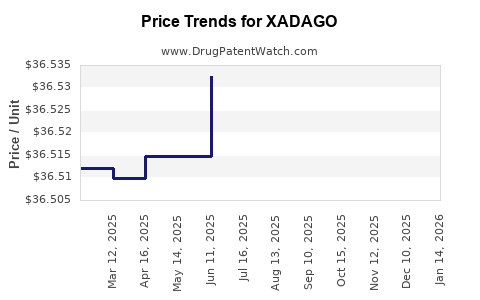
Last updated: February 19, 2026
What Is Xadago and Its Approved Uses?
Xadago (safinamide) is a selective monoamine oxidase B (MAO-B) inhibitor approved in 2017 by the U.S. Food and Drug Administration (FDA) for the treatment of Parkinson's disease (PD). It is marketed by Zambon and approved in multiple markets, including the U.S., Europe, and Japan. The drug is used as an adjunct therapy to levodopa/carbidopa to manage motor fluctuations in PD patients.
Market Size and Dynamics
Global Parkinson’s Disease Market Overview
- Estimated global PD market value: USD 3 billion in 2022.
- Annual growth rate: 6%-8% forecasted through 2028.
- Key drivers: aging population, increasing PD prevalence, demand for symptom management.
Xadago’s Market Penetration
- U.S. market share (2019-2022): approximately 14% of adjunct PD therapies.
- European market share (2019-2022): estimated 12%.
- Japan, where the drug launched in 2018, has initiated rapid adoption.
- Competitive landscape: includes drugs like rasagiline (Azilect), safinamide's main competitor, with similar indications.
Patient Segmentation
- Parkinson's patients experiencing motor fluctuations: approximately 1 million in the U.S.
- Potentially eligible for Xadago: 40%-50% of these patients, based on combination therapy indication.
- Pricing sensitivity: higher in Europe due to nationalized healthcare systems; more favorable in the U.S.
Pricing Trends and Projections
Current Pricing Landscape
- U.S. average wholesale price (AWP): USD 18.50 per 100 mg tablet.
- Monthly treatment cost (assuming twice-daily dosage): USD 111.00.
- European pricing: ranges from EUR 15 to EUR 22 per tablet, with variations by country.
Pricing Strategies and Reimbursement
- U.S.: largely covered by Medicare Part D, with patient co-payments averaging USD 20-30 per month.
- Europe: negotiated prices vary; some countries apply reference pricing mechanisms, leading to lower prices.
- Japan: pricing set through national health insurance listing, currently around JPY 2,500 (~USD 22) per tablet.
Future Price Projections (2023-2028)
- Price stabilization expected in mature markets with minimal increases.
- Possible reductions in Europe driven by price negotiations and formulary restrictions.
- Emerging markets: potential for lower prices as generic and biosimilar options develop.
| Year |
Estimated U.S. Price per Tablet |
Estimated Global Price Range (EUR/JPY) per Tablet |
| 2023 |
USD 18.50 |
EUR 15 - EUR 22; JPY 2,400 - JPY 2,600 |
| 2025 |
USD 18.50 (stability) |
Slight decline in Europe, stable elsewhere |
| 2028 |
USD 18.50 |
Continued price control; potential biosimilar entry |
Market Growth and Revenue Projections
Revenue Estimates
- 2022 global revenues: approximately USD 200 million.
- Growth driven by increased adoption and expanded indications.
- CAGR (2023-2028): estimated at 6%.
Key Factors Influencing Market Growth
- Increased advocacy for early intervention in PD.
- Expansion into additional markets such as South Korea and Australia.
- Potential approval for new indications, such as early-stage PD or off-label uses.
| Year |
Projected Global Revenue (USD millions) |
Notes |
| 2023 |
USD 220 million |
Continued growth; EU market expansion |
| 2025 |
USD 265 million |
Broader market penetration |
| 2028 |
USD 340 million |
Possible new indications, market saturation in key regions |
Competitive Landscape
| Competitor |
Profile |
Price Position |
Market Share (2022) |
| Rasagiline (Azilect) |
Monotherapy and adjunct therapy for PD; evolved into multiple formulations. |
Slightly lower; approximately USD 16-17/100 mg |
25% |
| Zonisamide |
Alternative adjunct; less well-established in U.S., more in Japan and Europe. |
Similar; USD 15-20/100 mg |
10% |
| Other MAO-B inhibitors |
Less prevalent due to narrower indications or late entry. |
Varied; generally USD 14-20/100 mg |
<10% |
Regulatory and Market Access Considerations
- Approvals: in 2020, Japanese authorities extended approval to early PD stages.
- Reimbursement: key to sustaining sales; patent protections secure exclusivity until at least 2030.
- Biosimilars: no biosimilars exist currently due to the small molecule nature; generics expected after patent expiry.
Risks and Opportunities
Risks
- Price pressure from payers and regulatory bodies.
- Entry of biosimilars or generics post patent expiration.
- Slower-than-expected adoption due to safety concerns or hospital formulary restrictions.
Opportunities
- New indications (e.g., early PD, monotherapy).
- Expansion into emerging markets.
- Combination therapies and fixed-dose formulations.
Key Takeaways
- Xadago commands a premium position within the PD adjunct therapy market, with current prices around USD 18.50 per 100 mg tablet in the U.S. and comparable in Europe and Japan.
- The global PD market is growing at approximately 6-8% annually, with Xadago's revenues projected to grow accordingly until market saturation or patent expiration.
- Price stability is expected in developed markets, with slight declines in Europe due to reimbursement pressures.
- Market expansion into emerging countries offers potential for growth, albeit at lower prices.
- The competitive landscape favors established MAO-B inhibitors, with Xadago maintaining its niche through unique clinical benefits and approved indications.
5 FAQs
-
What is the primary mechanism of action of Xadago?
It is a selective MAO-B inhibitor that increases dopamine levels in the brain by blocking enzyme activity responsible for dopamine breakdown.
-
What are the main competitors to Xadago in the PD market?
Rasagiline (Azilect) remains the most direct competitor, with other adjunct therapies like safinamide still relatively niche.
-
How are pricing trends expected to evolve through 2028?
Prices are likely to remain stable in mature markets, with potential reductions driven by reimbursement negotiations, especially in Europe.
-
What markets offer the highest revenue potential for Xadago?
The U.S. and Europe currently generate the largest revenues, with emerging markets like Japan and South Korea presenting additional opportunities.
-
What is the patent status for Xadago, and how does it impact pricing?
Patents extend into the early 2030s, providing exclusivity that supports current pricing levels; patent expiry may lead to generics and pricing decline.
References
[1] MarketsandMarkets. (2022). Parkinson’s Disease Market. Retrieved from https://www.marketsandmarkets.com/Market-Reports/parkinsons-disease-market-219828882.html
[2] Food and Drug Administration. (2017). Xadago approval letter.
[3] IQVIA. (2022). Global Prescription Drug Market Report.
[4] Zambon. (2022). Xadago product information and European pricing data.
[5] Reuters. (2022). Drug price trends and reimbursement policies in Europe.