Share This Page
Drug Price Trends for WITCH HAZEL
✉ Email this page to a colleague
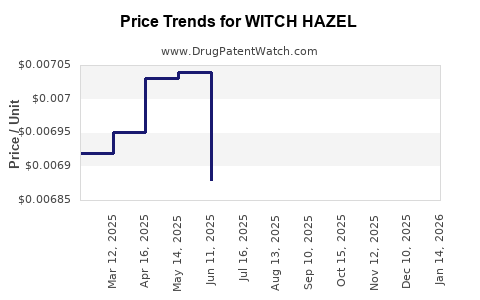
Average Pharmacy Cost for WITCH HAZEL
| Drug Name | NDC | Price/Unit ($) | Unit | Date |
|---|---|---|---|---|
| WITCH HAZEL 86% SOLUTION | 70000-0615-01 | 0.00765 | ML | 2026-07-22 |
| WITCH HAZEL 86% SOLUTION | 70000-0615-01 | 0.00753 | ML | 2026-06-17 |
| WITCH HAZEL 86% SOLUTION | 70000-0615-01 | 0.00732 | ML | 2026-05-20 |
| WITCH HAZEL 86% SOLUTION | 70000-0615-01 | 0.00708 | ML | 2026-04-22 |
| WITCH HAZEL 86% SOLUTION | 70000-0615-01 | 0.00698 | ML | 2026-03-18 |
| WITCH HAZEL 86% SOLUTION | 70000-0615-01 | 0.00697 | ML | 2026-02-18 |
| WITCH HAZEL 86% SOLUTION | 70000-0615-01 | 0.00699 | ML | 2026-01-21 |
| >Drug Name | >NDC | >Price/Unit ($) | >Unit | >Date |
What Is the Market Size for Witch Hazel?
Witch hazel (Hamamelis virginiana) is a plant extract predominantly used in over-the-counter skin care products, especially for skin soothing, anti-inflammatory, and astringent purposes. The global market for witch hazel was valued at approximately $250 million in 2022, with an annual compound growth rate (CAGR) of around 4% from 2018 to 2022. The primary sectors include skin care, first aid, and cosmetic applications.
North America accounts for nearly 50% of the market due to high consumer awareness of natural products and a significant presence of major cosmetic brands formulating with witch hazel. Europe holds about 35%, driven by consumer preference for herbal and organic remedies. The Asia-Pacific region is emerging, driven by increasing demand for natural personal care products.
What Are the Key Factors Influencing Market Growth?
Consumer Trends
The rise in demand for natural, organic, and herbal products expands the market. Consumers favor products with plant-based ingredients, perceiving them as safer and environmentally friendly.
Regulatory Environment
In the United States, the Food and Drug Administration (FDA) classifies witch hazel as a natural remedy with minimal regulatory restrictions for cosmetic use. However, any claims related to medical benefits could trigger additional scrutiny. In Europe, regulations are stricter under the European Medicines Agency (EMA), requiring standardized extraction processes and safety documentation for medicinal claims.
Manufacturing and Supply Chain
The cultivation of witch hazel plants occurs mainly in eastern North America. Supply chain stability depends on weather conditions, cultivation practices, and environmental regulations. Advances in cultivation techniques and extraction methods influence supply.
Competitive Landscape
Major players include:
- Thayers Natural Remedies
- Humphrey's
- Green People
- Persona Natural Products
These companies focus on product authenticity, organic certification, and consumer trust, often differentiating on formulations and branding.
What Are the Price Projections for Witch Hazel?
Current Pricing
Retail prices for finished products contain a broad range:
- Witch hazel-based toners: $5-$15 for 8 oz bottles.
- Medicated formulations (such as hemorrhoid creams): $8-$20 for 4 oz.
- Raw extracts or concentrates: ~$50-$100 per kilogram.
Factors Affecting Price
Prices fluctuate based on:
- Organic certification status
- Extraction purity and method
- Brand positioning
- Packaging and marketing
Future Price Trends
Projection indicates that prices for raw extracts will remain stable or slightly decrease (~2% annually), owing to advancements in extraction efficiency and crop yields. Retail product prices are expected to increase marginally (~1-2%) due to inflation and marketing costs.
Market Entry Cost
New entrants encounter initial costs of $1 million–$2 million, primarily for cultivation rights, extraction equipment, and marketing. Break-even points typically occur within 2–3 years, assuming moderate market penetration.
What Are Regulatory and Quality Considerations Affecting Price and Marketability?
- Certification: Organic, non-GMO, and cruelty-free labels command premium pricing.
- Standardization: Consistent extract potency impacts product claims and consumer trust.
- Compliance: Adherence to local regulations ensures fewer legal hurdles, influencing market access costs.
What Are the Opportunities and Risks?
Opportunities
- Growing demand for natural skin care products.
- Expansion into emerging markets with rising disposable incomes.
- Product innovation, such as combining witch hazel with other botanicals.
Risks
- Supply chain disruption due to climate or environmental regulations.
- Regulatory changes restricting claims or certification standards.
- Competition from synthetic or alternative plant-based extracts.
Key Takeaways
- The global witch hazel market was valued at around $250 million in 2022, with steady growth and significant regional variation.
- Consumer preference for natural products drives market expansion, with North America the largest segment.
- Prices for raw extracts hover around $50–$100 per kilogram, with finished products retailing between $5 and $20.
- Future prices likely see slight declines in raw extract costs, while retail prices may rise modestly.
- Regulatory standards, certification, and supply chain stability influence market dynamics and pricing.
FAQs
1. Is there potential for new formulations using witch hazel?
Yes. Product innovation incorporating witch hazel with other botanicals or introducing delivery formats like capsules or patches could create new market segments.
2. What regions present emerging opportunities?
Asia-Pacific countries such as China and India show increasing demand for herbal and natural personal care products, offering expansion opportunities.
3. How does organic certification impact pricing?
Organic certification adds to production costs but enables premium pricing, often 20–50% higher than non-certified products.
4. Are synthetic alternatives competing with natural witch hazel?
Some synthetic astringents exist but lack consumer trust compared to natural extracts. Natural ingredients retain market authority, especially in organic segments.
5. What standards govern the quality of witch hazel extracts?
Standards include those set by the United States Pharmacopoeia (USP), which specify purity, potency, and contaminant limits. Regulatory agencies like the FDA and EMA oversee compliance and labeling.
Sources
- MarketWatch, “Witch Hazel Market Size, Share & Trends Analysis,” 2022.
- Grand View Research, “Natural Personal Care Market,” 2021.
- U.S. Food and Drug Administration, “Cosmetic Ingredient Regulations,” 2022.
- European Medicines Agency, “Herbal Medicine Standards,” 2022.
- NewHope Network, “Consumer Trends in Natural Personal Care,” 2022.
More… ↓
