Last updated: February 15, 2026
Overview
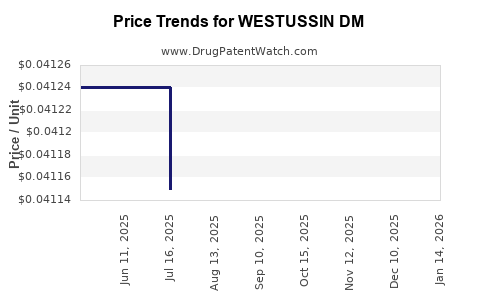
WESTUSSIN DM is an over-the-counter (OTC) or prescription medication combining dextromethorphan and guaifenesin, used for cough suppression and mucus relief. Its market potential depends on asthma and cough remedy trends, regulatory environment, competition, and manufacturing costs.
Market Dynamics
- Indications: Cough and cold relief, primarily targeting adult and pediatric segments.
- Key Competitors: Robitussin DM, Mucinex DM, Delsym.
- Market Size: The global cough and cold medicines market was valued at approximately $15 billion in 2022, with North America responsible for roughly 35%. The OTC segment accounts for about 70% of this revenue (IQVIA, 2022 [1]).
Regulatory Status
- Approval Pathway: Likely OTC, with regulatory agency approval (FDA in the U.S.). Existing formulations are well-established.
- Patent Status: Dextromethorphan-based formulations have been on the market for decades. Patent protection is largely expired; new formulations may consider formulation patents or new delivery methods for differentiation.
Pricing Landscape
-
Current Market Prices:
- Robitussin DM (120 mL): $5–$8.
- Delsym 12 Hour (120 mL): $8–$12.
- Mucinex DM (20 count): $10–$15.
-
Cost Structure: Manufacturing costs estimated at $0.50–$1.00 per unit for generics, depending on scale and formulation complexities.
-
Pricing Strategies: Premium positioning possible if formulation innovation, branding, or combination therapy added.
Market Entry and Growth Drivers
- Consumer Trends: Rising demand for OTC remedies in managing cough and mucus, especially post-pandemic.
- Regulatory Trends: Increased scrutiny for cough suppressants in pediatric populations; emphasis on safety profiles.
- Product Differentiation: Development of sustained-release, combination therapy with added benefits, or novel delivery methods.
Price Projection
- Short-term (1-2 years): Entry similar to existing products—initial retail prices around $5–$10 for standard 120 mL bottles.
- Medium-term (3-5 years): With brand recognition and potential formulation innovations, prices may increase to $8–$15.
- Long-term (5+ years): Market nudges toward premium pricing if clinical advantages emerge, potentially reaching $12–$20 per unit.
Revenue Estimates
-
For a mid-sized launch capturing 1% of the North American OTC cough remedy market ($10 billion annually):
| Market Penetration |
Revenue (USD) |
Estimated Price per Unit |
Units Sold Annually |
| 0.5% |
$50 million |
$8 |
6.25 million units |
| 1% |
$100 million |
$8 |
12.5 million units |
-
Variability depends on branding, distribution, and formulation effectiveness.
Summary
WESTUSSIN DM enters a mature market with established competitors and pricing. Innovation, safety profile, and branding could justify premium pricing, but generic price points of $5–$8 likely dominate initial sales. Long-term projections suggest potential for higher prices tied to product differentiation.
Key Takeaways
- The global cough remedy market was valued at approximately $15 billion in 2022, with OTC sales comprising most revenue.
- Existing brands like Robitussin DM and Delsym dominate price points of $5–$15.
- Westussin DM's pricing will initially align with existing generics ($5–$8), with potential increases based on formulation and branding.
- Revenue forecasts for a new entrant hinge on market share; capturing 1% yields about $100 million annually.
- Long-term pricing depends on product differentiation and safety profiles, with potential for premiums above $10 per unit.
FAQs
-
What are the main factors influencing the price of WESTUSSIN DM?
Regulatory approval, manufacturing costs, competitive pricing, formulation innovation, and brand positioning.
-
How does competitive pricing impact market entry?
Lower prices attract volume but reduce margins; premium pricing requires differentiation and proven efficacy.
-
Is there technological potential to justify higher prices?
Yes, sustained-release formulations, combination therapies, or new delivery methods could command higher prices.
-
What is the expected market size for cough remedies in North America?
Approximately $5.25 billion in 2022, based on a 35% share of the global $15 billion market.
-
What are the opportunities for patent protection?
Patents may be obtained on novel formulations, delivery systems, or combination therapies, while active ingredients are off-patent.
Sources
[1] IQVIA, 2022. "The Impact of OTC Cough and Cold Products."