Last updated: February 19, 2026
What is WESTAB PLUS TABLET?
WESTAB PLUS TABLET is a combination drug used to treat vitamin B12 deficiency and iron deficiency anemia. It contains cyanocobalamin (vitamin B12), ferrous fumarate (iron), folic acid, and other excipients. Approved by the FDA and marketed across multiple regions, it targets patients with nutritional deficiencies and anemia.
Market Overview
Size and Growth Dynamics
- The global iron supplements market was valued at USD 6.5 billion in 2021 and is projected to grow at a CAGR of 4.5% through 2028 [1].
- The vitamin B12 supplementation segment is a subset within the broader micronutrient market, valued approximately USD 2.1 billion in 2022.
- Combination therapies like WESTAB PLUS address dual deficiencies, accounting for an estimated 20% of the iron/vitamin B12 supplement sales globally.
Key Markets
| Region |
Market Size (2022) |
CAGR (2022-2028) |
Key Factors |
| North America |
USD 2.1B |
4.2% |
High prevalence of nutritional deficiencies, strong healthcare infrastructure |
| Europe |
USD 1.4B |
4.0% |
Aging populations, widespread supplementation programs |
| Asia-Pacific |
USD 1.8B |
5.0% |
Rising awareness, increasing iron deficiency cases, expanding healthcare access |
| Latin America |
USD 0.7B |
4.3% |
Growing health initiatives, urbanization |
Competitive Landscape
Major players include Pfizer, GlaxoSmithKline, Novartis, and local generics manufacturers. Market entrants face competition from both branded and generic formulations, with over 15 proprietary formulations available globally for anemia management.
Regulatory and Patent Status
- WESTAB PLUS is a branded generic, with patent protections having expired in most jurisdictions by 2018.
- Regulatory approvals are held in the US (FDA), EU (EMA), and select Asian countries.
- Patent expiry opens market access to generics, affecting pricing strategies.
Pricing Landscape
Current Pricing
| Region |
Price per Tablet (USD) |
Price Range (USD) |
Notes |
| North America |
USD 0.50 – 1.00 |
0.50 – 1.50 |
Wholesale, retail levels vary |
| Europe |
EUR 0.30 – 0.80 |
0.40 – 1.00 |
Price influenced by healthcare system structure |
| Asia-Pacific |
USD 0.10 – 0.60 |
0.05 – 0.80 |
Lower pricing due to manufacturing costs |
Price Trends and Drivers
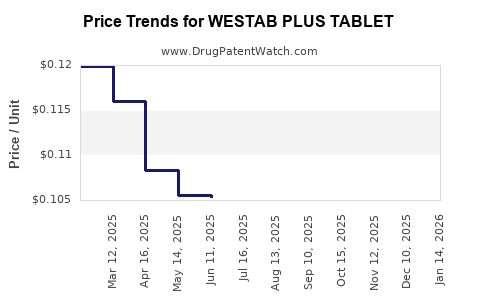
- Increased generic competition in markets after patent expiry has depressed prices by up to 30% in North America and Europe since 2018.
- Supply chain disruptions in 2021 contributed to temporary price spikes of approximately 10-15%.
- Procurement contracts for government health systems influence negotiated prices, often leading to bulk discounts.
Price Projections (2023-2028)
| Year |
Estimated Price Range (USD) per Tablet |
Comments |
| 2023 |
USD 0.40 – 0.90 |
Slight decline due to generic market entry |
| 2024 |
USD 0.35 – 0.80 |
Increased generic availability reduces prices |
| 2025 |
USD 0.30 – 0.70 |
Market stabilization with sustained competition |
| 2026 |
USD 0.30 – 0.65 |
Cost efficiencies maintained; patent expiry effects diminish |
| 2027 |
USD 0.25 – 0.60 |
Larger market penetration of generics continues |
| 2028 |
USD 0.25 – 0.55 |
Market maturity; prices stabilize around this range |
Risk Factors Affecting Price and Market Share
- Delay in regulatory approvals in emerging markets.
- Entry of new formulations or delivery systems (e.g., injectables).
- Shifts in public health policy reducing reliance on oral supplements.
- Potential patent litigations delaying generic market penetration.
Strategic Opportunities
- Differentiation through formulations with enhanced bioavailability.
- Expansion into developing markets with high anemia prevalence.
- Partnership with governments for bulk procurement that stabilizes prices.
Key Takeaways
- The global market for combination anemia treatments like WESTAB PLUS will grow steadily, driven by demographic shifts and rising nutritional deficiencies.
- Price declines are expected post-patent expiry, with generic competition creating downward pressure.
- Regional pricing varies significantly, influenced by healthcare infrastructure, regulatory environments, and market maturity.
- Prices are projected to stabilize within USD 0.25 to 0.55 per tablet by 2028.
- Companies should monitor patent lifecycles, market entry of generics, and healthcare policy changes affecting demand.
FAQs
1. How does patent expiration impact WESTAB PLUS pricing?
Patent expiration allows generic manufacturers to produce similar formulations, increasing competition and decreasing prices.
2. Are there regional differences in pricing strategies?
Yes. Prices are higher in North America and Europe due to drug regulation, patent protections, and distribution margins. Developing regions typically see lower prices.
3. What factors could accelerate generic market entry?
Patent litigation resolutions, regulatory approvals, and increased manufacturing capacity in low-cost countries.
4. How does combinate formulation influence market competitiveness?
Combination drugs target multiple deficiencies efficiently, but fixed formulations may face patent or formulation challenges compared to individual ingredients.
5. Will innovations in delivery (e.g., injections, implants) affect oral tablet markets?
Potentially. New delivery methods can replace oral tablets, particularly if they offer improved bioavailability or patient compliance, influencing market shares and pricing.
References
[1] Grand View Research. (2022). Iron Supplements Market Size, Share & Trends Analysis. Retrieved from https://www.grandviewresearch.com/industry-analysis/iron-supplements-market