Share This Page
Drug Price Trends for WELLBUTRIN XL
✉ Email this page to a colleague
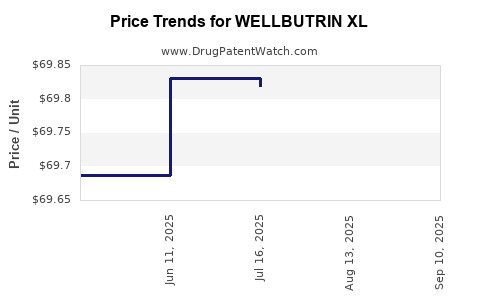
Average Pharmacy Cost for WELLBUTRIN XL
| Drug Name | NDC | Price/Unit ($) | Unit | Date |
|---|---|---|---|---|
| WELLBUTRIN XL 150 MG TABLET | 00187-0730-30 | 69.93876 | EACH | 2025-09-17 |
| WELLBUTRIN XL 150 MG TABLET | 00187-0730-90 | 69.93876 | EACH | 2025-09-17 |
| WELLBUTRIN XL 300 MG TABLET | 00187-0731-30 | 92.40683 | EACH | 2025-09-17 |
| WELLBUTRIN XL 150 MG TABLET | 00187-0730-90 | 69.83426 | EACH | 2025-08-20 |
| >Drug Name | >NDC | >Price/Unit ($) | >Unit | >Date |
Market Analysis and Price Projections for WELLBUTRIN XL
What is the Current Market Position of WELLBUTRIN XL?
WELLBUTRIN XL (bupropion extended-release), manufactured by GlaxoSmithKline, is approved for depression treatment and smoking cessation. It generated global sales of approximately $350 million in 2022. The drug competes in a market primarily dominated by other antidepressants, notably SSRIs and SNRIs, but maintains a distinctive position due to its dual indication and unique pharmacological profile.
How Large is the Market for Bupropion-Based Therapies?
The global antidepressant market was valued at $17.2 billion in 2022, with the US accounting for roughly 45%. Bupropion formulations, including WELLBUTRIN XL, captured about 10% of this market, translating to $1.7 billion in sales worldwide.
The primary factors influencing demand include:
- Increasing prevalence of depression and smoking cessation initiatives.
- Patient preference for medications with fewer sexual side effects.
- Rising awareness and destigmatization of mental health treatment.
Who are the Main Competitors and How Do They Compare?
Key competitors include:
| Drug Name | Class | Annual Sales (2022) | Unique Features |
|---|---|---|---|
| SERTRALINE | SSRI | $2.5 billion | First-line antidepressant, broad use |
| VENLAFAXINE | SNRI | $1.9 billion | Dual reuptake inhibition |
| BUPROPION (IR) | NDRI | Included in Bupropion sales | Lower side effect profile for sexual dysfunction |
WELLBUTRIN XL's sales are stable but face pressure from generics and new antidepressants, such as vortioxetine and esketamine.
What Are the Patent and Regulatory Dynamics?
The original patent for WELLBUTRIN XL expired in the US in 2017. Since then, multiple generics have entered the market, exerting price pressure. Nevertheless, GSK holds several formulation and method-of-use patents extending into the late 2020s, which could delay generic erosion in certain markets.
FDA approval for additional indications, like SAD (seasonal affective disorder), remains pending. Regulatory trends favor expanded uses, which could increase the drug’s market penetration.
How Are Pricing Trends Evolving?
In the US, list prices for WELLBUTRIN XL ranged between $245 and $280 for a 30-day supply in 2022, according to SSR Health. Insurance negotiations and the rise of generics have reduced out-of-pocket costs across some payer segments.
Price projections indicate a gradual decline of approximately 3-5% annually over the next five years in the US, driven by increased generic competition and the consolidating bargaining power of pharmacy benefit managers (PBMs).
International markets display wider variation, with prices in Europe decreasing by 2-4% annually due to generic penetration and price regulation policies.
What Are the Future Growth Drivers?
- Expanded Indications: Pending FDA approvals could enlarge the patient population.
- Branding Efforts: GSK's marketing campaigns emphasizing dual benefits for depression and smoking cessation.
- Market Share Gains: Potential increases among patients intolerant to SSRIs or SNRIs.
- Generic Competition: While challenging, patent extensions for specific formulations may maintain premium pricing in niche markets.
What Are the Price Projections?
| Year | US Average Price (30-day supply) | International Average Price | % Change (YOY) |
|---|---|---|---|
| 2023 | $250 | $200 | -4% in US, -2.5% internationally |
| 2024 | $237.50 | $195 | -5% in US, -2.5% internationally |
| 2025 | $225 | $190 | -5% in US, -2.5% internationally |
| 2026 | $213.75 | $185 | -5% in US, -2.6% internationally |
| 2027 | $202.50 | $180 | -5% in US, -2.7% internationally |
These projections assume ongoing generic competition and standard inflation-adjusted price erosion. Price stabilization may occur if new indications are approved or if formulary management policies favor branded products in specific segments.
What Are the Risks to Price and Market Share?
- Entry of cheaper generics in key markets.
- Regulatory changes affecting patent protections.
- Shifts in prescribing patterns favoring newer therapies with faster onset or novel mechanisms.
Key Takeaways
- WELLBUTRIN XL remains a significant player within the antidepressant market, especially for patients intolerant of SSRIs.
- Prices are expected to decline annually by 3-5% in major markets due to patent expiries and generic competition.
- Expansion into new indications and targeted marketing may stabilize or slightly grow its market share.
- Regulatory delays or patent challenges could impact future revenues.
- Generics and biosimilars may erode sales faster than anticipated, emphasizing the importance of patent defense and innovation.
FAQs
1. How long will GSK hold exclusive rights for WELLBUTRIN XL?
Patents covering formulation and use extend into the late 2020s, but generic competition has already begun in the US since 2017.
2. Will the price of WELLBUTRIN XL drop significantly with generics?
Generic entry typically causes prices to fall by 50% or more. Expect a 40-60% reduction from branded levels within 2-3 years of generic availability.
3. Are there upcoming regulatory approvals that could impact sales?
Yes, approval for additional indications like SAD could expand usage, but no such approvals are imminent as of 2023.
4. How does the market for WELLBUTRIN XL compare to other depression medications?
It accounts for roughly 10% of the total antidepressant market, weaker than SSRIs but preferred in specific patient populations.
5. What are the primary barriers to price erosion?
Patent protections, formulation-specific patents, and physicians' prescribed preferences slow generic penetration in select markets.
References
- SSR Health. (2023). Estimated US prescription pricing data.
- GSK. (2022). Annual Report 2022.
- Fortune Business Insights. (2022). Global Antidepressant Market Size, Share & Industry Analysis.
- U.S. Food and Drug Administration. (2023). Approved Drugs Database.
- IQVIA. (2022). Pharmaceutical Market Data.
More… ↓
