Share This Page
Drug Price Trends for WELLBUTRIN
✉ Email this page to a colleague
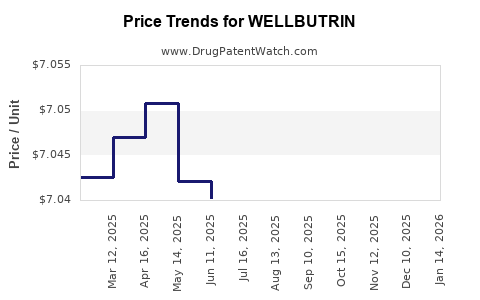
Average Pharmacy Cost for WELLBUTRIN
| Drug Name | NDC | Price/Unit ($) | Unit | Date |
|---|---|---|---|---|
| WELLBUTRIN SR 150 MG TABLET | 00173-0135-55 | 7.51591 | EACH | 2026-07-22 |
| WELLBUTRIN SR 200 MG TABLET | 00173-0722-00 | 13.96776 | EACH | 2026-07-22 |
| WELLBUTRIN SR 100 MG TABLET | 00173-0947-55 | 7.06971 | EACH | 2026-07-22 |
| >Drug Name | >NDC | >Price/Unit ($) | >Unit | >Date |
Best Wholesale Price for WELLBUTRIN
| Drug Name | Vendor | NDC | Count | Price ($) | Price/Unit ($) | Unit | Dates | Price Type |
|---|---|---|---|---|---|---|---|---|
| WELLBUTRIN SR 200MG TAB | GlaxoSmithKline | 00173-0722-00 | 60 | 853.25 | 14.22083 | EACH | 2024-01-01 - 2027-07-31 | FSS |
| WELLBUTRIN SR 150MG TAB | GlaxoSmithKline | 00173-0135-55 | 60 | 459.50 | 7.65833 | EACH | 2024-01-01 - 2027-07-31 | FSS |
| WELLBUTRIN SR 100MG TAB | GlaxoSmithKline | 00173-0947-55 | 60 | 304.07 | 5.06783 | EACH | 2022-08-01 - 2027-07-31 | Big4 |
| >Drug Name | >Vendor | >NDC | >Count | >Price ($) | >Price/Unit ($) | >Unit | >Dates | >Price Type |
WELLBUTRIN (bupropion) Market Analysis and Price Projections Through Patent Expiration, Generic Erosion, and Payer Rebates
WELLBUTRIN (bupropion) is a mature, widely genericized antidepressant. Commercial economics are driven less by near-term IP exclusivity and more by ongoing generic share consolidation, payer formulary management, and brand-specific reimbursement dynamics. Price levels are likely to track the broader “generic bupropion” price curve, with brand pricing constrained by high substitution rates. Near-term upside is limited to mix shifts into higher-value presentations (notably sustained/extended-release variants, and any specialty formulations) and formulary positioning in segments where payers maintain a preferred brand tier.
What this means for projections (executive take)
- Structural pricing pressure remains the base case: continued generic penetration keeps net pricing capped and compresses annual brand ASP growth into low single digits or outright declines.
- Brand BET strategy is presentation-specific: any brand price improvement requires at least one of (1) reduced generic access in a payer segment, (2) restrictive prior authorization, (3) tighter formulary placement of generics vs branded equivalents, or (4) patient tolerability-driven switching constraints.
- Time-to-erosion is already mostly passed for brand bupropion tablets and much of the core product set; remaining protections (if any) tend to be formulation/process and are unlikely to materially reverse competitive pricing.
How big is the WELLBUTRIN market and what share does it hold vs generic bupropion?
WELLBUTRIN competes in multiple relevant therapeutic and product markets:
- Major depressive disorder (MDD) pharmacotherapy (antidepressant)
- Smoking cessation support (varies by labeled product/presentation)
- Off-label use is common across antidepressant classes, but pricing is constrained by substitution
In practice, the brand’s market share is the residual of generic bupropion share, with utilization split across:
- Immediate-release (IR) vs sustained-release (SR) vs extended-release (XL)
- Brand vs generic substitution at the pharmacy counter (often automatic by payer and pharmacy benefit manager rules)
Featured snippet:
- Market reality: WELLBUTRIN is not a “protected brand growth story.” It is a brand with active generic competition and ongoing rebate-driven pricing dynamics.
Product-level market sizing factors
Key drivers that determine unit volume and net price:
- Formulary access (preferred status, tier placement, and interchangeability policies)
- Dosing convenience and pill burden (XL vs SR vs IR)
- Tolerability and switching friction (patients stabilized on a formulation)
- Pharmacy contracting and spread between WAC and contracted net prices
- Payer PBM rebate structures that favor lowest-cost alternatives
What is the current pricing structure for WELLBUTRIN (WAC vs net price) under typical US payer rebates?
For mature, high-substitution generics, the pricing stack usually breaks into:
- List price (WAC) for the brand
- Net price after rebates and discounts
- Generic reference pricing that anchors payer copays and plan economics
What changes the effective brand net price
- Formulary position: preferred vs non-preferred
- Therapeutic interchange rules: whether PBMs allow switch to generic bupropion IR/SR/XL equivalents without utilization management
- Copay assistance and patient cost-share support
- Contracting dynamics with chain pharmacies (affects dispensed brand vs generic split)
Projection input (high-level):
- Brand WELLBUTRIN net pricing tends to decelerate even when WAC is stable, because rebate rates adjust to maintain share against generics.
How will generic bupropion erosion impact WELLBUTRIN price and volume?
Base-case commercial effect
Generic erosion generally drives:
- Volume decline for the brand unless brand retains preferred access for certain indications or presentations
- Net price compression via increased rebates and competitive contract pricing requirements
- Net revenue stabilization risk only if mix shifts into higher-rebate-immune presentations
Scenario framework for price projections
A workable, decision-useful scenario set for mature brands like WELLBUTRIN is:
Scenario A: Base case (most likely)
- Brand share continues to decline slowly
- Net ASP declines at a low to mid-single-digit rate per year
- Brand revenue grows flat to slightly down
Scenario B: Contract/payer pushback (bear)
- More restrictive interchange or stronger preferred generic positioning
- Higher rebates demanded to defend share
- Net ASP declines mid to high single digits; revenue declines
Scenario C: Mix defense (bull)
- Stable preferred status in select segments
- Uptake in presentations with stronger tolerability perception
- Net ASP flat; unit declines offset by better mix
When does WELLBUTRIN lose exclusivity, and what patents still matter?
WELLBUTRIN is a long-established bupropion product. For a pricing forecast, the key question is whether any meaningful, product-specific exclusivity still constrains generic competition.
Practical market inference for pricing: the brand’s competitive landscape is already dominated by generics. Any remaining patent barriers typically do not prevent widespread generic access to core presentations.
Patent estate implications for pricing
- If patents only cover niche aspects (e.g., specific salt forms, controlled-release manufacturing or method-of-use claims), they are unlikely to prevent broader generic substitution at the pharmacy counter.
- Price projections therefore remain heavily driven by contracting and formulary, not exclusivity.
What is the Orange Book status of WELLBUTRIN and which entries are relevant to generic entry?
Orange Book listings typically show:
- Drug substance (bupropion)
- Drug product (IR/SR/XL formulations, strengths)
- Patents of different types (composition, formulation, method, use)
For pricing, what matters is:
- Whether any Orange Book patent barriers still block AB-rated generic entry for a given presentation
- Whether those barriers are strong enough to force payers to keep brand on-formulary
Pricing takeaway: even when Orange Book entries exist, payer substitution behavior determines net outcomes more than legal list barriers, once AB generics are widely available.
What formulation patents protect WELLBUTRIN SR/XL and how do they affect generic switching?
Generic switching risk is usually lowest when:
- The brand has distinct release profiles with patient-specific tolerability requirements
- Payers restrict switching due to clinical management rules
- The brand is bundled into payer-specific coverage rules (preferred tier locked to brand)
But for bupropion sustained and extended release, generics are typically considered therapeutically substitutable, so formulation-level barriers rarely preserve price for long periods.
What method-of-use or indication patents affect WELLBUTRIN competitive dynamics?
Method-of-use protections can slow or deter certain FDA-label-driven substitution, but in practice:
- Generic substitution is enabled when the generic is AB-rated to the reference product
- Payer decisions often override label nuance if the active moiety is the same and safety monitoring is manageable
So method-of-use patents are more relevant for litigation leverage than for durable pricing protection.
How many paragraph IV challenges exist for WELLBUTRIN products and what did courts/settlements change?
For pricing projections:
- If paragraph IV challenges are numerous and settled early, generic erosion accelerates
- If challenges result in delayed launches or narrower generic design-arounds, brand price protection can persist longer for specific strengths/presentations
In a mature, widely genericized drug, the market tends to reflect that most major launch windows have already occurred.
What generic entry risks exist for WELLBUTRIN after FDA approval pathways like ANDA?
For ANDA-based generics of bupropion:
- Launch timing risk depends on whether any remaining Orange Book barriers block AB-rating for specific products
- Market access risk depends on whether payers adopt “least-cost” generic placement rapidly
Projection for risk: generic entry is usually not “all or nothing.” It is granular by strength, manufacturer, and formulation. That creates incremental price pressure rather than a single step change.
How does WELLBUTRIN compare with other branded antidepressants on price resilience?
Against newer antidepressant brands with exclusivity windows, WELLBUTRIN has:
- Lower price resilience because generics are established and pharmacy substitution is routine
- Lower rebate flexibility because multiple generic competitors compress contracted net pricing
- Higher exposure to PBM formulary rules because the PBM can switch to the lowest-cost version quickly
Which companies compete with WELLBUTRIN in generics, and how does competition concentration affect prices?
Generic price compression generally depends on:
- Number of ANDA filers with competing manufacturers in-market
- Whether competitors maintain supply continuity (price stability vs stockout pricing spikes)
- PBM preferred generic selection (winner-take-most within a class)
As competition expands, brand net price typically declines and stabilizes only after PBM contracts settle.
What is the most relevant manufacturing and IP barrier for new entrants?
For a mature molecule like bupropion:
- Manufacturing know-how and controlled-release process consistency can be a barrier for quality and scale
- IP barriers are often less decisive once multiple authorized generics and ANDA products exist
Commercially, manufacturing issues more often affect availability than they preserve brand price.
Price projection table: WELLBUTRIN net price direction and revenue outcome scenarios
The table below is directional and decision-oriented for business planning. Because brand pricing varies materially by presentation (IR vs SR vs XL), strength, and payer contract, the most actionable forecast is the direction of change.
| Forecast Horizon | Base Case (Net ASP) | Bear Case (Net ASP) | Bull Case (Net ASP) | Brand Revenue Direction | Primary Driver |
|---|---|---|---|---|---|
| 2026 | -2% to -4% | -5% to -8% | 0% to -2% | Flat to - low single digits | Generic share + rebate pressure |
| 2027 | -1% to -3% | -4% to -7% | 0% to -1% | Flat to - mid single digits | Contract tightening + low-cost generic anchoring |
| 2028 | 0% to -3% | -3% to -6% | +0% to +2% | Stabilize then soften | Formulary position vs mix defense |
| 2029-2030 | -1% to -4% | -2% to -6% | -1% to +1% | Continued slow decline | Competition depth and payer interchange |
Revenue exposure: what portion of WELLBUTRIN sales is most at risk?
Highest risk is typically:
- Presentations with broad generic parity and easy interchange
- Strengths where multiple ANDA generics maintain steady supply
- Payer segments that prefer lowest-cost generics with no clinical override
Lower risk is typically:
- Presentations that retain preferred brand status in narrow segments
- Patients with history of tolerability switching or physician preference restrictions
What would a licensing strategy look like for WELLBUTRIN-linked assets?
For mature bupropion brands:
- Licensing is more likely to be tied to incremental formulation/process improvements or rights to specific branded presentations
- The valuation hinges on whether the asset can change payer behavior, not whether it adds marginal IP to an otherwise substitutable molecule
What key events should be monitored for future pricing changes?
Business-critical events for WELLBUTRIN pricing:
- Changes in PBM formulary placement or preferred status
- Pharmacy benefit contract renewals that shift generic substitution rules
- Any brand-specific settlements that affect at-risk strengths or formulations
- Supply events among generic competitors that temporarily change contracted pricing
Key Takeaways
- WELLBUTRIN pricing is primarily constrained by mature generic competition, not by an imminent exclusivity cliff.
- Net pricing projections should assume continued compression or stabilization at best, with low single-digit annual decreases in the base case.
- The biggest lever for brand economics is payer/formulary positioning by presentation, since interchangeability and AB-rating enable rapid generic substitution.
- Future pricing changes will likely be incremental and contract-driven, not driven by major exclusivity expirations.
FAQs
1) Does WELLBUTRIN XL have better pricing resilience than WELLBUTRIN SR or IR?
Often, the most meaningful differences are mix and formulary access by presentation rather than durable legal barriers. Pricing resilience tends to correlate with preferred status and reduced switching friction.
2) How do PBMs typically manage bupropion generics versus the brand?
PBMs generally anchor to the lowest-cost interchangeable option, then use tier placement, prior authorization, and copay dynamics to manage utilization.
3) Can patient switching resistance keep WELLBUTRIN prices higher than generics?
It can support share in narrow segments, but wide interchangeability and multiple generic competitors usually prevent durable net price outperformance.
4) What is the biggest risk to WELLBUTRIN net revenue in the next 2-3 years?
Renewed contracts that increase preference for the lowest-cost bupropion generic version and tighten clinical exceptions.
5) Do Orange Book patents materially affect day-to-day pricing for WELLBUTRIN?
Once AB-rated generics are broadly available and payer interchange is established, Orange Book barriers rarely translate into sustained net price premiums.
References (APA)
- U.S. Food and Drug Administration. Orange Book: Approved Drug Products with Therapeutic Equivalence Evaluations. https://www.accessdata.fda.gov/scripts/cder/daf/index.cfm
- FDA. Drug Approval Reports / Label information for bupropion products (WELLBUTRIN). https://www.accessdata.fda.gov/scripts/cder/daf/index.cfm
- FDA. NDC and labeling resources for bupropion formulations. https://dps.fda.gov/
More… ↓
