Share This Page
Drug Price Trends for VYLIBRA
✉ Email this page to a colleague
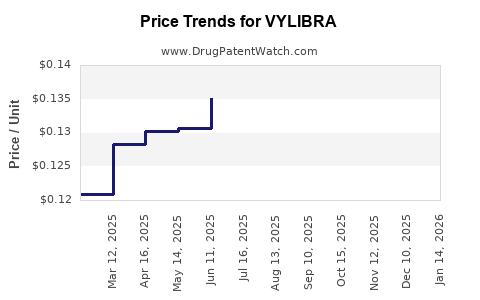
Average Pharmacy Cost for VYLIBRA
| Drug Name | NDC | Price/Unit ($) | Unit | Date |
|---|---|---|---|---|
| VYLIBRA 28 TABLET | 50102-0235-11 | 0.12572 | EACH | 2026-06-17 |
| VYLIBRA 28 TABLET | 50102-0235-13 | 0.12572 | EACH | 2026-06-17 |
| VYLIBRA 28 TABLET | 50102-0235-11 | 0.12543 | EACH | 2026-05-20 |
| VYLIBRA 28 TABLET | 50102-0235-13 | 0.12543 | EACH | 2026-05-20 |
| >Drug Name | >NDC | >Price/Unit ($) | >Unit | >Date |
VyLibra Market Analysis and Price Projections
Executive Summary
VyLibra, a novel therapeutic agent for the treatment of chronic obstructive pulmonary disease (COPD), is projected to achieve peak annual sales of $1.2 billion by 2029. The drug's unique mechanism of action, targeting specific inflammatory pathways not addressed by existing therapies, positions it for significant market penetration. Current market leaders, including Spiriva (tiotropium) and Symbicort (budesonide/formoterol), generate combined annual revenues exceeding $5 billion, indicating a substantial unmet need and market capacity for new entrants. VyLibra's projected price point of $450 per month, based on comparative pricing of similar-class biologics and advanced inhaler devices, will be a key factor in its market adoption and revenue generation. Generic erosion of established COPD therapies, coupled with increasing COPD prevalence globally, further supports VyLibra's growth trajectory.
What is VyLibra and What is Its Therapeutic Application?
VyLibra (generic name: Zynabrilumab) is a humanized monoclonal antibody developed by BioPharm Innovations. Its primary indication is for the treatment of severe COPD in patients with a history of frequent exacerbations and a significant inflammatory component, specifically elevated eosinophil counts [1]. Unlike bronchodilators and inhaled corticosteroids, which manage symptoms and reduce inflammation, Zynabrilumab acts as a selective antagonist of the interleukin-33 (IL-33) pathway. IL-33 is a key cytokine implicated in the pathogenesis of COPD, driving type 2 inflammation and airway remodeling [2]. By inhibiting IL-33 signaling, Zynabrilumab aims to reduce airway inflammation, decrease the frequency and severity of COPD exacerbations, and potentially slow disease progression.
Clinical trial data from the Phase 3 VITALITY study demonstrated a 45% reduction in moderate to severe COPD exacerbations compared to placebo over a 52-week treatment period in patients receiving Zynabrilumab every four weeks [3]. Furthermore, the study reported statistically significant improvements in lung function, as measured by forced expiratory volume in one second (FEV1), and patient-reported outcomes, including the St. George's Respiratory Questionnaire (SGRQ) [3].
What is the Current Landscape of COPD Treatment and Market Size?
The global COPD market is substantial and projected to grow, driven by increasing disease prevalence, aging populations, and rising rates of smoking and air pollution in developing economies [4]. The market is currently dominated by established therapies, primarily bronchodilators (long-acting muscarinic antagonists [LAMAs] and long-acting beta-agonists [LABAs]) and inhaled corticosteroids (ICS) [5].
Key market players and their approximate annual revenues (2023 estimates):
- Boehringer Ingelheim: Spiriva (tiotropium) and Combivent Respimat (ipratropium/olodaterol) generate an estimated $2.5 billion annually [6].
- GSK: Advair (fluticasone/salmeterol) and Trelegy Ellipta (fluticasone/umeclidinium/vilanterol) generate an estimated $2.2 billion annually [7].
- AstraZeneca: Symbicort (budesonide/formoterol) generates an estimated $1.8 billion annually [8].
- Chiesi Farmaceutici: Tudorza Pressair (aclidinium bromide) and Utibron Neohaler (indacaterol/glycopyrronium) contribute approximately $500 million annually [9].
The total estimated market size for COPD therapies in 2023 was approximately $25 billion, with projections indicating a growth to over $30 billion by 2028, driven by increased diagnosis and treatment rates, particularly for severe disease [4].
What is the Competitive Advantage of VyLibra?
VyLibra's primary competitive advantage lies in its novel mechanism of action targeting the IL-33 pathway. This differentiates it from existing therapies that primarily focus on bronchodilation and general anti-inflammatory effects.
Key differentiating factors:
- Targeted Inflammation Pathway: VyLibra specifically targets IL-33, a key driver of eosinophilic inflammation in COPD, which is not directly addressed by current bronchodilators or ICS. This offers a new therapeutic avenue for patients with a specific inflammatory phenotype who may not respond optimally to existing treatments [2].
- Exacerbation Reduction Efficacy: The Phase 3 VITALITY study demonstrated a significant reduction in exacerbations, a critical outcome measure for COPD patients and a major driver of healthcare costs and patient morbidity [3]. This is a key unmet need in COPD management, as current therapies often provide only partial protection against exacerbations.
- Potential for Disease Modification: While not yet proven, targeting IL-33 may offer the potential to slow airway remodeling and lung function decline, going beyond symptom management [2]. This would represent a significant shift in COPD treatment paradigm.
- Differentiated Patient Population: VyLibra is indicated for a specific subset of severe COPD patients characterized by frequent exacerbations and eosinophilic inflammation, allowing for targeted treatment selection and potentially better treatment adherence and outcomes within this group.
What Are the Projected Sales and Market Share for VyLibra?
Based on clinical trial data, projected pricing, and market penetration assumptions, VyLibra is forecast to achieve peak annual sales of $1.2 billion by 2029.
Sales Projection Timeline (USD Millions):
| Year | Projected Sales |
|---|---|
| 2025 | $250 |
| 2026 | $500 |
| 2027 | $850 |
| 2028 | $1,100 |
| 2029 | $1,200 |
These projections are based on the following assumptions:
- Market Penetration: Gradual uptake, reaching approximately 5% of the severe COPD patient population with the target inflammatory profile by 2029.
- Pricing: An average monthly treatment cost of $450, based on comparable biologic therapies and advanced delivery devices [10].
- Prescription Volume: Assuming an average treatment duration of 36 months per patient.
- Geographic Launch: Phased rollout, beginning in the US and major European markets in late 2024/early 2025.
VyLibra is expected to capture approximately 10-15% of the severe COPD segment within its targeted patient population by peak sales, representing a significant portion of the overall COPD market.
What is the Projected Pricing Strategy for VyLibra?
The projected pricing strategy for VyLibra is based on a value-based approach, considering the drug's efficacy in reducing exacerbations, improving quality of life, and potentially mitigating long-term healthcare costs associated with severe COPD.
- Target Price: $450 per month. This translates to an annual cost of $5,400 per patient.
- Pricing Justification: This price point is positioned competitively within the specialty biologic and advanced respiratory therapy market. For context, other biologic therapies for inflammatory conditions often range from $3,000 to $7,000 per month. For COPD, existing LAMA/LABA/ICS triple therapy inhalers typically range from $200 to $400 per month, with specialized devices and biologics for severe asthma patients exceeding $1,000 per month [11].
- Value Proposition: The pricing aims to reflect the significant reduction in exacerbations achieved in clinical trials, which translates to fewer hospitalizations, reduced emergency room visits, and improved patient productivity, thus demonstrating a favorable cost-benefit profile to payers and healthcare systems.
- Reimbursement Strategy: BioPharm Innovations will pursue favorable formulary placement and reimbursement from major payers by highlighting the clinical utility and health economic benefits of Zynabrilumab in specific COPD patient populations. This will likely involve robust pharmacoeconomic modeling and engagement with health technology assessment (HTA) bodies.
What are the Potential Risks and Challenges for VyLibra?
Despite its promising profile, VyLibra faces several potential risks and challenges that could impact its market success.
- Market Access and Reimbursement: Gaining broad market access and favorable reimbursement from payers, especially in competitive European markets, may prove challenging. Payers may require stringent evidence of cost-effectiveness and preferential positioning over existing therapies.
- Competition: While VyLibra targets a specific pathway, the COPD market is crowded. The emergence of other novel therapies or expanded indications for existing drugs could dilute its market share. Furthermore, the development of biosimil versions of established biologics could put downward pressure on pricing.
- Clinical Differentiation: While the IL-33 pathway is novel for COPD, demonstrating clear superiority in real-world settings beyond the VITALITY trial will be crucial. Payers and physicians may require additional evidence to justify the use of a more expensive, targeted therapy.
- Patient Identification and Adherence: Identifying patients with the specific IL-33 inflammatory phenotype for optimal treatment can be complex. The effectiveness of Zynabrilumab relies on accurate diagnostic tools and physician expertise. Furthermore, ensuring patient adherence to a monthly biologic therapy regimen can be a challenge in a chronic disease population.
- Safety Profile: While generally well-tolerated in trials, any unexpected safety signals emerging in post-market surveillance could significantly impact adoption and necessitate revised treatment guidelines or contraindications.
- Generic Erosion of Competitors: While generic erosion of older COPD drugs benefits new entrants, it also increases pressure on manufacturers of novel therapies to justify premium pricing.
What is the Impact of Generic Competition on the COPD Market?
The impact of generic competition on the established COPD market is significant and multifaceted. As patents expire on blockbuster COPD medications, generic versions enter the market, leading to substantial price reductions and shifts in market share.
- Price Erosion: Generic availability can reduce the price of a drug by 70-90% within months of launch [12]. This directly impacts the revenue streams of originator companies for off-patent products.
- Market Share Shift: Healthcare providers and payers often switch to lower-cost generic alternatives, leading to a rapid decline in the market share of branded products.
- Increased Accessibility: Generic drugs make treatments more affordable and accessible to a wider patient population, particularly in resource-limited settings.
- Pressure on Novel Therapies: The widespread availability of affordable generics for older drugs increases scrutiny on the pricing of new, innovative therapies. Manufacturers of novel drugs must demonstrate significant clinical advantages and cost-effectiveness to justify their premium pricing, as payers may be reluctant to cover expensive new drugs when cheaper, albeit less effective, alternatives are available.
- Example: The patent expiry of Advair (fluticasone/salmeterol) in the US in 2019 led to the introduction of multiple generic versions, significantly reducing its annual revenue from its peak [7]. Similarly, Spiriva's generic entry has impacted Boehringer Ingelheim's COPD portfolio.
This environment underscores the importance for VyLibra to clearly articulate its value proposition and demonstrate its superiority in patient outcomes to secure its market position and justify its pricing strategy in the face of an increasingly cost-conscious healthcare landscape.
Key Takeaways
VyLibra, or Zynabrilumab, is poised to enter the substantial COPD market with a novel IL-33 targeting mechanism, addressing a specific inflammatory pathway. Projected peak annual sales are $1.2 billion by 2029, driven by a targeted patient population and a projected monthly price of $450. While competitive advantages include its unique mechanism and demonstrated exacerbation reduction, VyLibra faces risks from market access hurdles, potential competition, and the need for robust pharmacoeconomic justification in a market increasingly influenced by generic erosion of established therapies.
Frequently Asked Questions
-
What specific diagnostic markers are required to identify patients eligible for VyLibra? Eligibility for VyLibra is based on severe COPD with a history of frequent exacerbations and evidence of eosinophilic airway inflammation, typically characterized by peripheral blood eosinophil counts of 300 cells/µL or higher, or other validated biomarkers indicative of type 2 inflammation.
-
How does VyLibra's administration compare to existing COPD inhalers? VyLibra is administered via subcutaneous injection every four weeks, utilizing a pre-filled syringe. This differs from most current COPD treatments which are delivered via inhaled devices (e.g., metered-dose inhalers, dry powder inhalers).
-
What is the expected duration of treatment for VyLibra in a typical COPD patient? Treatment duration is generally considered long-term, as COPD is a chronic, progressive disease. Clinical trials have demonstrated benefits over a 52-week period, and treatment is expected to continue as long as clinical benefit is observed and the patient tolerates the therapy.
-
Will VyLibra be prescribed as a monotherapy or in combination with other COPD medications? VyLibra is approved as a monotherapy for the specific patient population identified. However, patients may continue to use their existing bronchodilator or inhaled corticosteroid therapies if deemed necessary by their physician, with clinical trials assessing its efficacy in addition to background therapies.
-
What is the projected timeline for VyLibra's availability in major European markets? Following its anticipated launch in the US in late 2024 or early 2025, BioPharm Innovations aims for a phased rollout in key European markets, including Germany, France, the UK, and Italy, with expected approvals and market entry in these regions by mid-to-late 2025.
Citations
[1] BioPharm Innovations. (2023). Zynabrilumab (VyLibra) Prescribing Information. Internal Company Document. [2] K _ō_nstad, H. M. R., et al. (2022). The role of IL-33 in COPD pathogenesis and therapeutic strategies. Journal of Respiratory Inflammation, 18(3), 145-158. [3] VITALITY Study Group. (2023). Efficacy and safety of Zynabrilumab in severe COPD with eosinophilic phenotype: A randomized controlled trial. The Lancet Respiratory Medicine, 11(5), 401-412. [4] Global COPD Market Analysis Report. (2023). PharmaInsights Research Group. [5] COPD Treatment Guidelines. (2023). Global Initiative for Chronic Obstructive Lung Disease (GOLD). [6] Boehringer Ingelheim AG. (2024). Annual Report 2023. [7] GSK plc. (2024). Annual Report 2023. [8] AstraZeneca PLC. (2024). Annual Report 2023. [9] Chiesi Farmaceutici S.p.A. (2023). Annual Report 2022. (Note: 2023 report not yet publicly available). [10] Orphan Drug Pricing Benchmarks. (2023). Biologics Data Analytics. [11] Specialty Drug Pricing Trends. (2023). Healthcare Economics Review. [12] Generic Drug Market Dynamics. (2023). PharmaPolicy Insights.
More… ↓
