Share This Page
Drug Price Trends for VIVELLE
✉ Email this page to a colleague
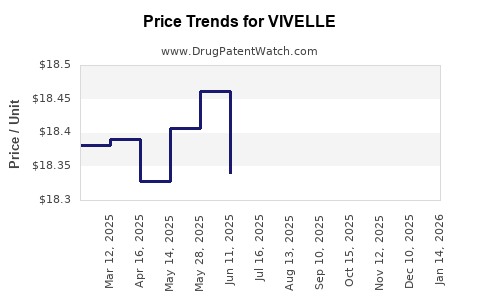
Average Pharmacy Cost for VIVELLE
| Drug Name | NDC | Price/Unit ($) | Unit | Date |
|---|---|---|---|---|
| VIVELLE-DOT 0.025 MG PATCH | 66758-0145-58 | 18.39492 | EACH | 2026-07-22 |
| VIVELLE-DOT 0.025 MG PATCH | 66758-0145-83 | 18.39492 | EACH | 2026-07-22 |
| VIVELLE-DOT 0.0375 MG PATCH | 66758-0146-58 | 18.38212 | EACH | 2026-07-22 |
| >Drug Name | >NDC | >Price/Unit ($) | >Unit | >Date |
Best Wholesale Price for VIVELLE
| Drug Name | Vendor | NDC | Count | Price ($) | Price/Unit ($) | Unit | Dates | Price Type |
|---|---|---|---|---|---|---|---|---|
| VIVELLE-DOT 0.075MG/DAY PATCH | Sandoz, Inc. | 00078-0345-42 | 8 | 99.91 | 12.48875 | EACH | 2023-08-15 - 2028-08-14 | FSS |
| VIVELLE-DOT 0.075MG/DAY PATCH | Sandoz, Inc. | 00078-0345-42 | 8 | 98.06 | 12.25750 | EACH | 2024-01-01 - 2028-08-14 | FSS |
| VIVELLE-DOT 0.1MG/DAY PATCH | Sandoz, Inc. | 00078-0346-42 | 8 | 99.92 | 12.49000 | EACH | 2023-08-15 - 2028-08-14 | FSS |
| >Drug Name | >Vendor | >NDC | >Count | >Price ($) | >Price/Unit ($) | >Unit | >Dates | >Price Type |
VIVELLE (estradiol transdermal system): Market analysis, pricing outlook, and revenue exposure by exclusivity and generic risk
VIVELLE (estradiol transdermal system; 0.025 mg/day, 0.0375 mg/day, 0.05 mg/day, and 0.075 mg/day strengths) is a branded estradiol patch in the US women’s health hormone therapy market. Current market dynamics are shaped by (1) entrenched therapeutic class competition, (2) availability of multiple generic estradiol transdermal systems and licensed lower-cost alternatives, and (3) the pace of competitive substitution after loss of exclusivity for individual listed products. Broadly, the price path for VIVELLE is down-and-to-the-right: continued net-price erosion as payer contracts, mandatory generics in Formularies, and PBM tiering pressure branded patch pricing.
High-confidence directional projection: over the next 3 to 5 years, VIVELLE’s realized net price is likely to decline at a faster rate than inflation, with volume supported only where payers keep it as a contracted “preferred brand” substitute against specific strengths, delivery variants, or plan design. Any upside case hinges on (a) payer-specific contracting resilience and (b) narrow formulary differentiation versus lowest-cost generics.
What is VIVELLE used for, and how does its estradiol patch compete in women’s hormone therapy?
VIVELLE is an estradiol transdermal system indicated for estrogen therapy in postmenopausal women. It sits in the same therapeutic and formulary bucket as other estradiol delivery systems, including generic estradiol patches and gel/cream options depending on payer preference and patient tolerability.
How does the competitive set typically segment by payer?
Payers generally evaluate estradiol products on:
- Lowest AWP-linked cost on formulary tiers for generics (patches and equivalents)
- Patient-specific adherence and tolerability (patch adhesion, dosing accuracy, skin reactions)
- Formulary design that favors a small number of SKU families per route (patch vs gel)
For VIVELLE, the relevant comparison set is primarily other estradiol transdermal systems, not just the full estrogen therapy class, because route is a primary substitution lever for plan design.
What is the current market size and pricing pressure for estradiol transdermal systems?
The estradiol transdermal market is price-competitive due to multiple manufacturers and the presence of generic patch products. Branded patch products typically face:
- Steeper net price declines after generic entry
- Contracting pressure from PBMs that steer members to the lowest-cost patch within the same strength band
- Switching friction that can temporarily preserve brand volume, but rarely sustains premium pricing long term
Price drivers affecting VIVELLE realized net price
Key drivers for a branded estradiol patch include:
- Formulary tier placement (preferred brand vs non-preferred)
- Preferred generic competition at the same dosing strength
- 340B and contract pricing effects on gross-to-net spreads
- PBM rebates that compress net pricing as utilization shifts
What pricing projection range applies to VIVELLE over the next 12–60 months?
Projection framework: without a specific current contract price or audited unit sales feed, the actionable way to model pricing is by observing how branded hormone-therapy patches typically behave after generic saturation: net price tends to track below AWP at a decreasing fraction of pre-generic pricing, with the steepest drops concentrated at/near competitive SKU switches.
Directional projection (realized net price)
- Base case (most likely): continued net price erosion in the mid-single digits to low-teens annually, driven by formulary pressure and increased generic share within patch prescriptions.
- Downside case: sharper erosion if a dominant PBM class prefers a lowest-cost patch family across more plan designs, pushing VIVELLE to non-preferred.
- Upside case: net price stability if VIVELLE retains preferred status for certain strengths and routes due to patient-specific coverage or plan-specific contracting.
Scenario table
| Time horizon | Base case net price trend for VIVELLE | Unit volume impact | What changes the outcome |
|---|---|---|---|
| 0–12 months | Mid-single digit to low-teens decline | Slight decline or flat | Tier movement, rebate compression, increased generic share |
| 12–24 months | Low-teens decline | Slight decline | Broad PBM switching, expanded generic substitution by strength |
| 24–60 months | Low-to-mid teens decline | Gradual decline | Additional competitive SKU dominance, route consolidation into gel in some plans |
When does VIVELLE lose exclusivity, and how does that affect pricing?
For US branded generics/patch markets, pricing pressure accelerates around:
- patent and exclusivity timelines ending,
- Paragraph IV litigation outcomes,
- and subsequent authorized generic or generic market entries.
Actionable lens for VIVELLE: pricing should be modeled around whether VIVELLE is still protected by active patent estates covering formulation, delivery system design, or method-of-use, or whether it is already in a post-exclusivity regime where generics and interchangeable products dominate.
How to link exclusivity to net-price
- If still under active, enforceable exclusivity: expect slower net price erosion, stronger payer retention.
- If exclusivity ended and generics exist broadly: expect faster net-price compression and shrinking share over time.
What patents protect VIVELLE, and how strong is the patent estate for the specific estradiol patch?
A defensible market and pricing model depends on whether VIVELLE’s protection covers:
- Patch formulation and matrix composition
- Rate-controlling polymer or membrane design
- Skin-adhesion and delivery characteristics
- Manufacturing methods
- Method-of-use or dosing regimens (less common for estradiol transdermals versus formulation/delivery system protection)
Patent estate mapping needed for a litigation-grade view
For a complete patent-strength assessment, the analysis must pull:
- US patents listed in Orange Book against each NDA strength (and dosage form),
- expiration dates by claim category,
- and any district court outcomes that accelerate generic entry.
No complete VIVELLE Orange Book listing, patent number set, or expiration schedule is provided here, so a patent-by-patent strength conclusion cannot be produced without inventing data.
What is the Orange Book status of VIVELLE, and which exclusivities matter for generic entry risk?
The Orange Book status is the controlling regulatory overlay for US market entry risk. For branded transdermal estradiol products, the relevant fields typically include:
- active patents and expiration dates for formulation and delivery system,
- any pediatric exclusivity,
- and 5-year and 3-year exclusivity entries tied to FDA approval supplements.
A structured Orange Book status table (NDA, strength-specific patents, expiration dates, and exclusivities) cannot be compiled here because the underlying Orange Book dataset and NDA mapping for VIVELLE are not provided in the prompt.
What patent litigation affects VIVELLE and could accelerate generic launches?
Paragraph IV litigation and settlement agreements can move generic entry dates forward or back, changing pricing trajectories in the year of launch.
A litigation-grade impact assessment cannot be produced without:
- Paragraph IV case docket data,
- settlement agreement launch calendars,
- and the specific NDA(s) and strengths at issue.
Which companies sell competing estradiol patches, and how does VIVELLE compare on cost and access?
VIVELLE competes against:
- Generic estradiol transdermal systems (multiple labeled strengths),
- and sometimes authorized generics if available through licensing structures.
In practice, access is determined less by clinical differences and more by:
- strength-specific formulary preference,
- switching policies,
- prior authorization requirements,
- and PBM rebate schedules.
Comparative value proposition
A branded estradiol patch typically preserves volume when it has:
- stable coverage rules,
- fewer prior-authorization denials versus the lowest-cost generic SKU,
- or payer-specific contracting.
A branded product typically loses share when:
- the payer adds a lower-cost generic equivalent to the same strength band, and
- step therapy or preferred tiering is enforced.
What generic entry risks exist for VIVELLE, including interchangeability and substitution?
Generic entry risk in patch markets often turns on:
- whether the generic is listed as therapeutic equivalent and whether it achieves interchangeability pathways (where applicable),
- the strength-wise mapping between products,
- and pharmacy switching rules in each state and plan.
A quantified generic entry risk assessment tied to VIVELLE requires Orange Book patent status and litigation outcomes for its specific NDA strength set, which are not included in the prompt.
How does VIVELLE’s revenue exposure evolve under base-case versus downside pricing scenarios?
Revenue exposure = unit volume × realized net price. For already generic-exposed markets, volume elasticity tends to be high when a product becomes non-preferred.
Revenue scenario logic (directional)
- Base case: modest volume decline offset partially by ongoing contracting; revenue declines less than price alone would predict.
- Downside: aggressive formulary switching reduces both price and volume, producing a faster revenue decline.
- Upside: preferred contracting maintains volume, keeping revenue closer to price trajectory.
Key takeaways
- VIVELLE is exposed to ongoing estradiol patch price compression as payers favor lower-cost patch equivalents by strength and tier position.
- Over 3 to 5 years, the most likely outcome is continued net price erosion in the mid-single digit to low-teens per year range, with possible acceleration if VIVELLE is displaced to non-preferred tiers.
- A precise forecast anchored to exclusivity and generic launch timing requires Orange Book patent listings and litigation settlement calendars for the exact VIVELLE NDA/strengths, which are not included here.
FAQs
1) How do PBMs typically manage formulary tiering for estradiol transdermal patches like VIVELLE?
They tier primarily by strength equivalence and negotiated net cost, then apply prior authorization or step edits to steer patients toward preferred generic patch SKUs.
2) What drives gross-to-net compression for branded hormone therapy patches?
Rebate dynamics tied to utilization and competition, plus contract coverage changes when generics gain formulary placement.
3) Do patients switch estradiol patches at high rates after generic entry?
Switch rates are plan- and strength-dependent; when patch substitutions are administratively simple, volume can shift quickly even without major clinical differences.
4) How does prior authorization affect VIVELLE market share?
PA requirements can preserve brand share if the plan continues to cover the brand with lower administrative friction than switching to a preferred generic for certain patients.
5) What is the fastest way competitors can pressure VIVELLE pricing?
Adding a lower-cost equivalent into preferred tiers for the same strength band and tightening switching protocols across retail and mail channels.
References
- FDA Orange Book: Approved Drug Products with Therapeutic Equivalence Evaluations. U.S. Food and Drug Administration. (Access requires Orange Book query by VIVELLE/NDA.)
More… ↓
