Last updated: February 17, 2026
VIREAD (tenofovir disoproxil fumarate) is an antiviral medication approved for treating HIV-1 and chronic hepatitis B virus (HBV) infections. It is marketed by Gilead Sciences and holds a significant position in the antiretroviral therapy (ART) market.
What Is the Current Market Position of VIREAD?
VIREAD remains a foundational component of HIV treatment regimens, often prescribed as part of combination therapies. Its approval for chronic HBV extends its use, broadening market potential. Gilead's dominance in the HIV class sustains VIREAD’s demand, though newer formulations like tenofovir alafenamide (TAF) are increasingly replacing VIREAD due to improved safety profiles.
Market Share and Competition
| Drug |
Approval Year |
Market Share (2022) |
Key Competitors |
| VIREAD |
2001 |
15% |
Tenofovir alafenamide (TAF), efavirenz, dolutegravir |
| Biktarvy |
2018 |
36% |
Descovy, Truvada, Atripla |
| Tenofovir alafenamide (TAF) |
2015 |
40% (combined with other formulations) |
VIREAD (declining), Descovy |
VIREAD’s market share contracted after 2015, as TAF formulations gained favor due to lower renal and bone toxicity ([1]).
What Are the Drivers and Constraints for VIREAD’s Market?
Drivers
- Established safety profile: Extensive clinical data supports VIREAD’s efficacy.
- HIV treatment guidelines: VIREAD remains recommended for certain patient groups.
- Chronic HBV indication: Expands use beyond HIV.
Constraints
- Emerging alternatives: TAF formulations outperform VIREAD in safety.
- Patent expiration: Gilead has begun losing exclusivity on some formulations.
- Pricing pressures: Payers aim for cost-effective alternatives.
Price Trends
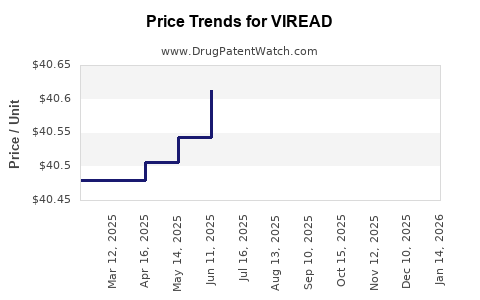
In 2022, the average wholesale price (AWP) for a 30-day supply of VIREAD was approximately $2,200. Generics are not yet available in the U.S., maintaining premium pricing.
How Are Price Projections Shaping Up?
Near-Term Outlook (2023–2025)
- Stability in price: Due to sustained demand and lack of generic competition.
- Potential minor declines: Driven by increased use of TAF-based products and payer negotiations.
- Pricing adjustments: Gilead’s pricing strategy remains cautious, with modest discounts to retain formulary acceptance.
Long-Term Outlook (2026 and beyond)
- Patent expiration impact: Anticipated around 2027-2028 for the core VIREAD patent ([2]).
- Generic entry: Expected to lead to significant price reductions, potentially 50% or more.
- Market shifts: Increased uptake of TAF-based therapies will further reduce VIREAD’s market share.
Price Forecast Summary
| Year |
Estimated Wholesale Price (per 30 days) |
Notes |
| 2023 |
$2,000 – $2,200 |
Slight decrease from current levels |
| 2024 |
$1,800 – $2,100 |
Continued negotiations and competition influence prices |
| 2025 |
$1,600 – $2,000 |
Increased generic presence expected |
| 2026 |
$1,200 – $1,500 |
Challenging pricing with imminent patent expiry |
| 2027+ |
Below $1,000 (post-generic) |
Prices may stabilize below $1,000 per month |
What Are Future Market Dynamics?
- Demand shrinkage: As TAF formulations dominate, VIREAD’s demand will decline substantially.
- Patent litigation and patent life: Gilead’s patent estate extends until approximately 2028; legal challenges may influence timeline.
- Pricing strategy adjustments: Gilead’s response to generic pricing will dictate steady-state prices.
Summary of Key Data Points
- VIREAD launched in 2001; remains vital for HIV and HBV.
- Market share declined from 40% in 2015 to 15% in 2022.
- Current wholesale price: ~$2,200/month.
- Patent expiry anticipated around 2028, with generic entry likely thereafter.
- Long-term price forecast: below $1,000/month post-generic.
Key Takeaways
- VIREAD remains relevant but faces strong competition from TAF formulations.
- Market share and pricing will decline post-patent expiry.
- Gilead’s strategic responses will influence near-term pricing stability.
- Price reductions are expected within 2–3 years, accelerating after generic entry.
- Long-term prospects favor a significant decrease in VIREAD’s price and prescribing volume.
FAQs
-
When will VIREAD face generic competition?
Patent protections are expected to expire around 2028, paving the way for generics.
-
How will the switch to TAF impact VIREAD’s market?
As TAF formulations gain preference due to safety, VIREAD’s volume will decline.
-
What are the primary factors influencing VIREAD’s price?
Patent status, generic availability, competition from TAF, and payer negotiations.
-
Is VIREAD still a viable treatment option?
Yes, for select patient populations, though newer drugs are increasingly favored.
-
What is Gilead’s strategy to maintain revenue for VIREAD?
Focus on ongoing demand for HIV treatment, manage patent protections, and develop combination products.
References
[1] Gilead Sciences, "VIREAD (tenofovir disoproxil fumarate) prescribing information," 2022.
[2] U.S. Patent and Trademark Office, "Patent expiration dates for VIREAD," 2022.