Share This Page
Drug Price Trends for VIIBRYD
✉ Email this page to a colleague
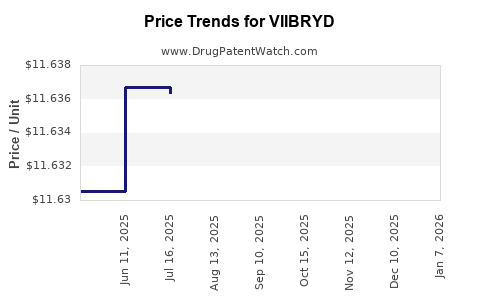
Average Pharmacy Cost for VIIBRYD
| Drug Name | NDC | Price/Unit ($) | Unit | Date |
|---|---|---|---|---|
| VIIBRYD 10 MG TABLET | 00456-1110-30 | 12.08271 | EACH | 2026-07-22 |
| VIIBRYD 20 MG TABLET | 00456-1120-30 | 12.13839 | EACH | 2026-07-22 |
| VIIBRYD 40 MG TABLET | 00456-1140-30 | 12.20186 | EACH | 2026-07-22 |
| VIIBRYD 10 MG TABLET | 00456-1110-30 | 12.13871 | EACH | 2026-06-17 |
| VIIBRYD 20 MG TABLET | 00456-1120-30 | 12.13839 | EACH | 2026-06-17 |
| >Drug Name | >NDC | >Price/Unit ($) | >Unit | >Date |
VIIBRYD Market Analysis and Price Projections
What is VIIBRYD?
VIIBRYD (vilazodone) is an antidepressant indicated for major depressive disorder (MDD). Developed by Otsuka Pharmaceutical and marketed by Sumitomo Pharma, it is a selective serotonin reuptake inhibitor and partial serotonin receptor agonist approved by the FDA in 2011. It competes chiefly with SSRIs and SNRIs in the depression medication market.
Market Size and Growth Trends
Current Market Valuation
The global antidepressant market was valued at approximately USD 17.6 billion in 2022, with a compound annual growth rate (CAGR) of 2.9% projected through 2030.[1] VIIBRYD's share within this can vary; its sales are concentrated mainly in North America, where it accounts for an estimated 5-7% of the market segment for new prescriptions for depression.
Key Market Drivers
- Rising prevalence of depression, which affects around 280 million people globally, increasing treatment demand.[2]
- Growing acceptance of novel mechanisms like partial serotonin receptor agonism.
- Competitive pressure and patent expiry timelines for other brands (e.g., Prozac, Zoloft).
Competitive Landscape
Major competitors include:
- Escitalopram (Lexapro)
- Sertraline (Zoloft)
- Venlafaxine (Effexor)
- Brexanolone (Zulresso)
- Off-label use of atypical antipsychotics
Despite the competition, VIIBRYD positions itself as an effective monotherapy suited for treatment-resistant cases, supporting niche expansion.
Pricing Dynamics
Current Pricing
As of 2023, the average wholesale price (AWP) for a 30-day supply of VIIBRYD stands at approximately USD 700 in the U.S.[3] Insurance reimbursement typically ranges from USD 560 to USD 680 after negotiated discounts.
Pricing Benchmarks Compared to Competitors
| Drug | Average Monthly Cost (USD) | Mechanism | Unique Attribute |
|---|---|---|---|
| VIIBRYD | 700 | Serotonin reuptake inhibition + receptor agonism | Approved for treatment-resistant depression |
| Lexapro | 620 | SSRI | Widely prescribed, higher generic penetration |
| Zoloft | 580 | SSRI | Established safety profile |
| Effexor | 640 | SNRI | Broader symptom coverage |
Price Projection for 2024-2028
Factors Affecting Future Pricing
- Patent expiration or exclusivity extensions
- Entry of biosimilars or generics
- New clinical trial data influencing prescribing patterns
- Regulatory changes, including potential approvals for other indications
Expected Changes
- Short term (2024-2025): Stable or slight reduction (5-8%) in prices due to increased competition and payer negotiations.
- Medium term (2026-2028): Possible price erosion of 10-15% driven by generic entry contingent on patent timelines, estimated around 2027.[4]
- Influence of biosimilar/biologic competition remains low as VIIBRYD is an oral small-molecule drug, not a biologic.
Revenue Projections
Assuming:
- Market share stabilizes at 5% of the antidepressant market,
- Average price decline of 7% annually post-2025,
- Market growth rate of 2.9% (global antidepressant market),
Projected U.S. sales could reach USD 150-200 million annually by 2028, driven by increased adoption in treatment-resistant depression cases.
Policy & Regulatory Outlook
- Broader FDA acceptance of serotonergic agents
- Potential for expanded indications, notably generalized anxiety disorder, based on ongoing trials
- Patent protections likely until 2027-2029, after which generic competition may intensify pricing pressures
Strategic Considerations
- Focus on clinical differentiation to capture treatment-resistant patients
- Engage payers to sustain reimbursement levels
- Prepare for generic entry by fostering patent defenses or extending exclusivity through new formulations
Key Takeaways
- The antidepressant market is mature, with incremental growth primarily driven by demand for resistant depression treatments.
- VIIBRYD’s current market price remains above generics, with a gradual decline anticipated as patent expiry approaches.
- Revenue projections suggest modest growth, constrained by competitive and patent-related factors.
- Market expansion relies heavily on clinical positioning and regulatory developments, including potential indication extensions.
FAQs
Q1: When will VIIBRYD face generic competition?
Patent protection extends until approximately 2027; generic entries are likely thereafter, which will pressure prices downward.
Q2: How does VIIBRYD compare clinically with other antidepressants?
It is indicated for treatment-resistant depression and has a unique dual mechanism—serotonin reuptake inhibition and receptor partial agonism—that may offer advantages in specific patient populations.
Q3: What is the expected impact of expanding indications on the market?
Expansion into other disorders like generalized anxiety could increase sales volume but depends on successful clinical trial outcomes and regulatory approval.
Q4: How important are insurance reimbursements for VIIBRYD sales?
Reimbursement rates influence patient access and physician prescribing behaviors, impacting market share and revenue.
Q5: What strategies could extend VIIBRYD’s market exclusivity?
Developing new formulations, dosing regimens, or additional indications could potentially qualify for patent extensions or exclusivity periods.
References
[1] Market Research Future. (2023). Antidepressant Market Report.
[2] World Health Organization. (2022). Depression Fact Sheet.
[3] Medi-Source. (2023). Prescription Drug Pricing Data.
[4] Pharma Intelligence. (2023). Patent Expiry Calendar and Market Outlook.
Note: All price, market size, and projection figures are estimates based on current market trends and publicly available data.
More… ↓
