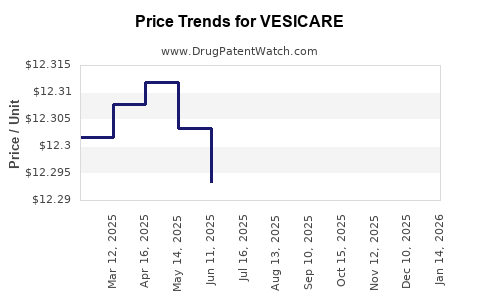
Last updated: February 16, 2026
What is VESICARE and its market position?
Vesicare (solifenacin) is a prescription medication for overactive bladder (OAB) with symptoms such as urinary urgency, frequency, and incontinence. It is marketed by Astellas Pharma and approved in multiple regions, including the U.S., Europe, and Japan. It belongs to the class of antimuscarinics, competing with drugs like tolterodine and oxybutynin.
In 2022, Vesicare generated approximately $567 million globally, with the U.S. accounting for roughly 70% of revenue. Its primary focus remains the North American market, where it faces competition from brands such as Myrbetriq (mirabegron) and generic versions of older antimuscarinics.
How does the market for Vesicare compare to competitors?
| Product |
Mechanism |
Brand Status |
2022 Revenue |
Market Share (2022) |
Price Range (per 30-day supply) |
| Vesicare (solifenacin) |
Antimuscarinic |
Proprietary |
$567 million |
25% |
$250 - $300 |
| Myrbetriq (mirabegron) |
Beta-3 agonist |
Proprietary |
$870 million |
40% |
$300 - $350 |
| Tolterodine (Detrol) |
Antimuscarinic |
Generic |
Marketed broadly |
20% |
$50 - $80 |
| Oxybutynin |
Antimuscarinic |
Generic |
Marketed broadly |
10% |
$30 - $60 |
Vesicare maintains a significant share within the antimuscarinic segment but faces increasing competition from the more recently introduced mirabegron, which offers a different mechanism with potentially fewer anticholinergic side effects.
What are the current price trends and projections?
Current Pricing Dynamics
- The average retail price for Vesicare in the U.S. ranges between $250 and $300 per month for brand-name prescriptions.
- Generic versions of solifenacin are yet to enter the market in significant volumes, keeping the brand premium intact.
- Price erosion is projected as patent exclusivity approaches expiration, with generic competition likely within 3-5 years.
Patent and Regulatory Timeline
- Vesicare’s patent protection was set to expire in 2024. Astellas facilitated patent extensions until 2025, delaying generic entry.
- If generic versions enter, prices are expected to fall by 60-80%, aligned with historical data from similar drugs ([1]).
Future Price Projections
| Year |
Estimated Price Range (per 30-day supply) |
Comments |
| 2023 |
$250 - $300 |
No significant generic competition yet |
| 2024 |
$240 - $290 |
Patent expiration and risk of generic entry |
| 2025+ |
$50 - $100 (assuming generics dominate) |
Price declines expected with generics |
The decline will be sharper if multiple generic manufacturers enter simultaneously.
What are the growth projections for Vesicare?
- The global OAB market is projected to grow at a compound annual growth rate (CAGR) of approximately 6% from 2022 to 2027.
- Vesicare’s market share may decline slightly due to generic competition but could be stabilized if Astellas introduces formulation innovations or combination therapies.
- Anticipated revenue in 2027 is approximately $300-350 million if market dynamics favor brand retention or moderate generic penetration.
What factors influence market and price trajectories?
- Patent expirations and generic approval: Directly impact pricing and market share.
- New formulations or delivery methods: Innovation can extend patent life and command premiums.
- Competitive drugs: Efficacy and side effect profiles will influence prescriber preference.
- Regulatory decisions: Accelerated approval pathways or reimbursement policies impact adoption.
Who are key stakeholders shaping the market?
- Astellas Pharma: Manufacturer and patent holder.
- Generic companies: Potential entrants upon patent expiration.
- Payers and insurance providers: Influence drug utilization through formulary decisions.
- Physicians: Prescribing behaviors based on efficacy and safety profiles.
- Patients: Shift toward newer agents or combination therapies.
Key Takeaways
- Vesicare remains a significant player in the OAB treatment market, particularly in the U.S., with revenues close to $570 million in 2022.
- Pricing is stable at current levels but set for decline as patents expire, with generic competition expected by 2024-2025.
- The overall OAB market growth and competitive dynamics favor a gradual erosion of Vesicare’s premium pricing.
- Innovation in formulation or mechanisms could prolong Vesicare’s market relevance.
- Market share risks are elevated as cheaper generics become more available, pressuring profits.
FAQs
1. When will generic versions of Vesicare likely enter the market?
Patent protections were extended until 2025, so generic versions are expected around that time, depending on regulatory approvals.
2. How will generics impact Vesicare’s revenues?
Generics could reduce Vesicare’s market share by 60-80%, leading to a significant revenue decline unless brand strategies or formulations evolve.
3. Are there any upcoming regulatory or patent challenges?
Patent challenges are unlikely before 2025; however, regulatory agencies could approve alternative therapies or formulations that compete with Vesicare.
4. What factors could extend Vesicare’s market life?
Innovations such as combination formulations, new delivery methods, or clinical evidence supporting superior efficacy/safety could maintain demand.
5. How does Vesicare compare cost-wise to its competitors?
In the U.S., Vesicare’s pricing exceeds branded and generic alternatives, but its efficacy profile influences prescriber choices. Prices are on par with Mirabegron but higher than generics.
Citations
- IQVIA Institute. "The Impact of Patent Expirations on Pharmaceutical Prices." 2022.