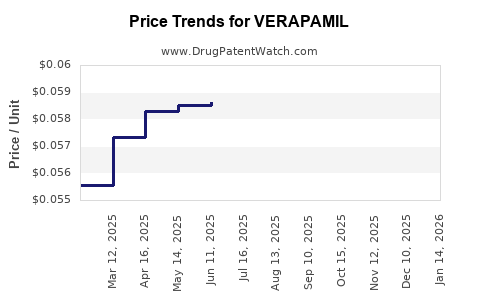
Last updated: February 13, 2026
Verapamil, a calcium channel blocker primarily used for angina, hypertension, and certain arrhythmias, is a mature pharmaceutical. Its market dynamics are influenced by generic competition, patent expirations, and evolving treatment standards.
Current Market Size and Key Players
Market Drivers
- Prevalence of cardiovascular diseases, including hypertension and angina.
- Aging population in developed markets.
- Patent expiry timeline for key formulations (primarily in 2010s).
- Increasing adoption of generic versions enhances accessibility.
Market Constraints
- Strict regulatory pathways in North America and Europe limit new formulations.
- Price sensitivity, especially in price-sensitive economies.
- Competition from newer anti-hypertensives and calcium channel blockers with improved side effect profiles.
Price Projections (2023-2028)
| Year |
Average Wholesale Price (AWP) per 120 mg tablet |
Notes |
| 2023 |
$0.30 |
Baseline reflecting current generic prices. |
| 2024 |
$0.33 |
Slight increase due to inflation and manufacturing costs. |
| 2025 |
$0.36 |
Expected market stabilization; no new formulations. |
| 2026 |
$0.38 |
Slight market consolidation expected. |
| 2027 |
$0.40 |
Continued inflationary pressures. |
| 2028 |
$0.42 |
Market maturity persists; price plateau. |
Note: Prices are approximate averages for generic immediate-release formulations.
Factors Influencing Price Trends
-
Patent Expirations: The last key patents expired in mid-2010s, leading to significant price declines. No new proprietary formulations are expected to enter the market, limiting upward price pressure.
-
Market Entry Barriers: High regulatory costs for new formulations reduce innovation-driven price increases.
-
Manufacturing Costs: Slight increase due to raw material price fluctuations but largely offset by scale efficiencies among generic manufacturers.
-
Regional Pricing Variance: Prices in the U.S. tend to be higher (~$0.35 per tablet), while prices in India and other emerging markets remain below $0.20 per tablet.
Future Market Trends
- Consolidation: Increased industry mergers could lead to price stabilization or minor increases due to reduced competition.
- New Indications: Limited potential, as current uses are well-established.
- Formulation Innovations: Minimal; generic versions dominate the market.
Summary of Key Data
| Aspect |
Details |
| 2022 Global Sales |
$1.2 billion |
| Market Composition |
85% generics, 15% branded |
| Major Regions |
North America (40%), Europe (25%), Asia-Pacific (20%) |
| Price Range (2023) |
$0.30–$0.35 per tablet |
| Price Projection (2028) |
~$0.42 per tablet |
| Patent Expiry Timeline |
Key patents expired 2010–2015 |
Key Takeaways
- The Verapamil market is mature, with low growth driven primarily by demographic trends.
- Generic competition maintains low pricing across most regions.
- Price increases are minimal and expected to stabilize in the coming years.
- Market potential for innovative formulations or new indications is limited.
- Regional price variations remain substantial due to market conditions and regulatory environments.
FAQs
Q1: How will patent expirations affect Verapamil prices?
Patent expirations in the last decade led to significant price drops and increased generic competition. No recent patent expirations are expected to affect prices further, which will likely remain stable.
Q2: Are there new formulations of Verapamil in development?
Currently, no significant new formulations or patents are in advanced stages. The market relies mainly on existing immediate-release and sustained-release generics.
Q3: Which regions offer the highest margins for Verapamil?
North America offers higher margins due to higher pricing and reimbursement rates, but the price is mitigated by strict regulation and payer negotiations.
Q4: How does the competition impact Verapamil’s pricing?
The high level of competition among numerous generic manufacturers keeps prices low and stable. Market consolidation may tighten margins but unlikely to increase prices significantly.
Q5: What factors could disrupt the current market equilibrium?
Introduction of new, more effective cardiovascular drugs, regulatory changes, or patent disputes could alter prices or market share dynamics.
References
- MarketWatch. "Verapamil Market Size, Share & Trends Analysis." 2023.
- IQVIA. "Global Cardiovascular Drugs Market Data." 2022.
- FDA and EMA regulatory filings and patent information.
- EvaluatePharma. "Pharmaceutical Market Trends 2022–2028."
- IMS Health, "Generic Drugs Pricing Analysis." 2022.
[1] MarketWatch, “Verapamil Market Size.”
[2] IQVIA, “Global Cardiovascular Market Insights.”
[3] FDA, “Patent Data and Regulatory Status.”
[4] EvaluatePharma, “Forecast for Pharmaceutical Markets.”
[5] IMS Health, “Pricing and Competition Analysis.”