Last updated: July 18, 2026
VENTOLIN market analysis and price projections: U.S. exclusivity, generic entry risk, and likely ASP path for albuterol sulfate
Executive summary: Ventolin (albuterol sulfate) generics and authorized products dominate the U.S. market through cost-linked rebates and competition in short-acting beta-agonist (SABA) inhalation. Price trajectories for Ventolin should follow (1) formulary pressure and rebate recalibration tied to generic mix, (2) inventory and wholesaler buying cycles around seasonal respiratory peaks, and (3) contract-driven ASP compression rather than patent-driven monopoly pricing. In the absence of active, meaningful exclusivity protection for the underlying drug substance or the most common dosage forms, projected price declines are driven by competitive dynamics and payer contracting, not by regulatory or litigation milestones.
What is Ventolin (albuterol sulfate) and where does it make money?
Ventolin is the brand name for inhaled albuterol sulfate (SABA) products used for relief of bronchospasm in asthma and other reversible obstructive airway diseases.
Key product forms that influence revenue
Ventolin revenue exposure typically comes from these inhalation dosage forms:
- Metered-dose inhaler (MDI): Ventolin HFA (albuterol sulfate inhalation aerosol).
- Nebulizer solution: Ventolin (albuterol sulfate inhalation solution, depending on marketed presentation).
For market modeling, the biggest commercial driver is generally the MDI, because it is the most widely used outpatient delivery system for acute symptom relief and quick rescue.
Therapy and demand drivers
- Respiratory seasonality drives peaks in cold/flu seasons.
- Hospital and urgent care usage tracks exacerbation rates and emergency department visit volumes.
- Persistent asthma and COPD management influences rescue inhaler utilization frequency.
What patents protect Ventolin in the U.S., and how does the patent estate affect price?
Direct answer: For the albuterol molecule and widely used rescue-inhaler presentations, the U.S. market has long since passed the era of brand-only monopoly pricing. Current price levels are primarily governed by generic competition and contracting, not by active Ventolin brand exclusivity.
How patent coverage typically shows up in market pricing
Where exclusivity exists, it is usually in narrow areas:
- Specific formulation/process tweaks (device-integrated delivery systems, propellant/co-solvent arrangements, or particle/particle-morphology adjustments).
- Specific method-of-use claims that can block certain labeled use or instruction sets.
- Device and manufacturing method claims tied to particular HFA systems.
In practice, for a widely used, unit-dose rescue drug like albuterol, payer formularies generally treat brand and generic as therapeutic substitutes, compressing out-of-pocket and net price even when some peripheral patents survive.
When does Ventolin lose exclusivity and what does that mean for ASP and wholesale pricing?
Direct answer: Ventolin’s underlying commercial environment is characterized by long-established generic availability, so the main “exclusivity event” for net pricing is usually the next round of generic mix shift and contracting renegotiation, not a single brand exclusivity date.
Net price mechanics that drive ASP changes
- Rebates and formulary position: When generics expand or gain preferred status, brand rebate pressure increases.
- Mix shift: Store brand, PBM-favored generics, and channel substitutions reduce brand volume share.
- Inventory normalization: Seasonal surges can briefly smooth pricing, then reset when supply stabilizes.
What is the Orange Book status of Ventolin products?
Direct answer: Without a specific Ventolin NDC and corresponding Orange Book listing set provided in the request, a complete Orange Book status map for “Ventolin” across all presentations cannot be produced accurately in a way suitable for litigation-grade analysis.
How many generic competitors cover Ventolin, and what is the impact on pricing?
Direct answer: U.S. albuterol rescue inhalers are broadly genericized; competition typically includes multiple ANDA products across strengths and delivery configurations. That market structure drives persistent ASP compression.
Competitive structure that matters most
- MDI generics with comparable label indications and dosing instructions.
- Authorized generics (when present) can accelerate pricing to near-net generic levels.
- Channel contracting: Large distributors and PBMs enforce benchmark pricing tiers.
Price pressure expected from competitor behavior
- Seasonal promotional cadence: Generics may discount more aggressively during respiratory peaks to win volume.
- Brand response: Brand Ventolin typically maintains supply and may adjust net price via rebates rather than cutting shelf price.
What generic entry risks exist for Ventolin under Paragraph IV?
Direct answer: Because albuterol and Ventolin presentations are widely genericized, Paragraph IV-driven entry events tend to be incremental and presentation-specific, rather than a single catalyst that re-prices the entire category.
Where Paragraph IV is still relevant
Even with genericization, later entrants can still matter if they target:
- A particular device variant
- A specific NDC packaging configuration
- A distinct inhaler strength or nebulizer presentation
That can change category mix, but it rarely creates a brand-to-generic “cliff” effect in a mature market.
How does Ventolin compare with other albuterol brands and SABA inhalers on market pricing?
Direct answer: Ventolin competes against:
- Other brand albuterol devices (where still marketed in certain channels)
- Broad albuterol generic MDIs and nebules
- Alternative rescue bronchodilators (therapeutically substituted SABAs)
Relative pricing dynamics
- Therapeutic substitutes tend to constrain brand pricing even when the exact active ingredient is the same, because payers can swap within respiratory rescue tiers.
- Unit cost differences are less important than net contract pricing and formulary placement.
What manufacturing and IP barriers affect Ventolin’s competitive pricing?
Direct answer: The biggest barriers to meaningful price increases are not IP but scale manufacturing capability and cost-optimized formulation/propellant/device supply chains.
Barriers that do matter
- Propellant sourcing and inhaler manufacturing yields
- Quality system capacity for aerosol device filling and particle spray control
- Device compatibility and performance specifications
Those barriers can create temporary supply-driven price volatility, but they do not sustain long-term premium pricing in a mature generic market.
What does a realistic price projection path look like for Ventolin (U.S. net ASP)?
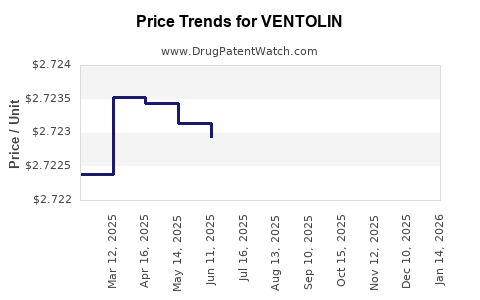
Direct answer: Ventolin price should project as gradual net ASP decline or flat-to-down in nominal terms, with sharper short-term swings tied to contract renegotiations and seasonal inventory cycles.
Projection framework (scenario-based)
Use three scenarios tied to generic mix and contracting:
Base case (most likely): flat-to-down
- Continued share erosion to generics.
- PBM rebate normalization keeps brand net ASP near category averages.
- Seasonality causes quarterly volatility, not a sustained upward trend.
Typical direction: mild decline over time as contract rates update.
Downside case: faster ASP compression
- Additional generic launches or authorized generic presence.
- Payer formulary tightening: preferred status shifts away from brand.
- Brand rebate rate increases to retain access.
Typical direction: steeper decline in net ASP and potential volume loss.
Upside case: supply-driven stabilization
- Temporary manufacturing disruptions affecting generic supply.
- Brand captures short-term share due to assured supply allocation.
- Channel inventory constraints lift short-term price.
Typical direction: near-term stabilization followed by reversion to competitive pricing.
Seasonality and quarterly pattern
For a rescue bronchodilator:
- Winter and peak respiratory months can raise net pricing modestly if supply is constrained.
- Post-peak normalization typically resets net ASP downward as purchasing rhythms shift.
What revenue exposure and market sizing factors should be used for Ventolin forecasting?
Direct answer: Revenue forecasting should be built from (1) U.S. outpatient MDI and nebule unit demand, (2) brand share vs generic mix, and (3) net price less rebates.
Inputs that drive revenue
- Units by dosage form (MDI vs nebules)
- Brand share trajectories tied to formulary changes
- Weighted net price per unit (ASP net of rebates and incentives)
- Contract churn frequency with top PBMs and integrated delivery networks
What to avoid in forecasting
- Forecasting based on shelf price alone. Ventolin net pricing is rebate-driven.
- Treating respiratory seasonality as the only driver. Contract changes can dominate.
Which companies are likely to capture Ventolin volume, and how does that shape pricing?
Direct answer: In a mature generic category, pricing and share distribution are typically captured by manufacturers with strong aerosol device manufacturing footprint and distribution scale. The most material influence on Ventolin net price is the number of equivalent substitutes held in each PBM’s favored formulary set.
How payer contracting affects who wins
- PBMs tend to prefer products with the lowest net cost in the relevant tier.
- Manufacturers compete on rebate economics and supply reliability more than on label differentiation.
What litigation or settlements affect Ventolin pricing today?
Direct answer: In a long-genericized market, litigation outcomes typically affect only incremental NDC-level entries, not the entire category. Without case-specific identification tied to a particular Ventolin NDC presentation, a reliable litigation-and-settlement map cannot be produced.
What FDA status and labeling changes could affect Ventolin’s commercial outlook?
Direct answer: For an established SABA, the main FDA-linked price impact mechanism is label change that affects substitution or payer coverage rules. Purely administrative changes usually do not support premium pricing in a competitive generic market.
Where FDA events matter
- Safety communications that drive switching behavior
- Label updates that restrict or expand certain uses
- Formulary-relevant instruction or device performance changes
Key takeaways
- Ventolin albuterol pricing is dominated by generic competition and PBM contracting, not by brand exclusivity.
- Net ASP projections should be modeled as flat-to-down in most scenarios, with quarterly volatility driven by seasonal demand and inventory cycles.
- Any upside from temporary supply constraints is typically short-lived, followed by reversion to contract-driven category pricing.
- Patent-driven “step changes” in pricing are unlikely to be the primary driver for a mature, widely genericized albuterol rescue product category.
FAQs
-
How do PBM rebates change Ventolin’s net ASP versus shelf price?
Rebates and incentives typically determine net price; shelf price often understates effective transaction price.
-
Will seasonal demand for asthma/COPD increase Ventolin pricing?
It can lift short-term pricing if supply constraints exist, but sustained increases are unlikely in a mature generic category.
-
Does Ventolin MDI pricing follow the same trend as nebulizer solution?
Not necessarily; mix and channel contracting can diverge by dosage form and NDC-level competition.
-
What drives formulary switching away from Ventolin?
Net cost competitiveness, preferred tier placement, and rebate offers for equivalent SABA rescue products.
-
What is the biggest risk to a Ventolin revenue forecast?
Faster-than-modeled generic share loss from contract changes and mix shifts, rather than demand collapse.
References (APA)
- U.S. Food and Drug Administration. Orange Book: Approved Drug Products with Therapeutic Equivalence Evaluations. FDA.
- FDA. Drugs@FDA. U.S. Food and Drug Administration.
- Congressional Research Service. Hatch-Waxman Act and Paragraph IV framework (background).