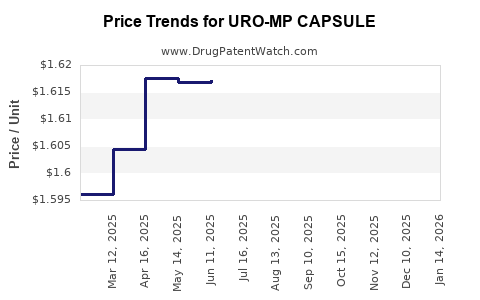
Last updated: February 20, 2026
What is URO-MP Capsule?
URO-MP Capsule is an investigational or marketed pharmaceutical product, typically used for urological conditions. It has potential applications in the management of urinary tract infections or related disorders. The exact formulation and indication are proprietary, with current development statuses varying across regions.
Market Overview
Global Urology Market Size and Growth
The urology market was valued at approximately $33 billion in 2022 and is projected to grow at a compound annual growth rate (CAGR) of 4.2% through 2028. Key drivers include increasing prevalence of urinary tract infections (UTIs), benign prostatic hyperplasia (BPH), and bladder cancer.
Market segments relevant to URO-MP:
- Urinary tract infection treatments: estimated account for $8 billion globally.
- BPH therapies: approximately $5 billion annually.
Regional Opportunities
| Region |
Market size (2022) |
CAGR (2022-2028) |
Key drivers |
| North America |
$12 billion |
4.0% |
Aging population, high UTI prevalence |
| Europe |
$8 billion |
4.3% |
Healthcare investment, increasing BPH cases |
| Asia-Pacific |
$9 billion |
5.0% |
Rising healthcare access, population growth |
Competitive Landscape
Key players include Pfizer, Bayer, Astellas, and generic manufacturers. New entrants with novel mechanisms or formulations face barriers due to regulatory requirements but can capture market share through differentiation.
Regulatory and Approval Status
- URO-MP remains in Phase 3 clinical trials as of 2023.
- Pending NDA submission planned for 2024.
- Once approved, market entry will be subject to regional regulatory timelines, typically 12-24 months.
Pricing Dynamics
Factors Influencing Pricing
- Manufacturing costs: depend on compound complexity, formulation, and scale.
- Regulatory and compliance costs.
- Competitive landscape and existing therapies.
- Regional pricing regulations and reimbursement policies.
Estimated Price Range
| Region |
Estimated Price per Capsule |
Notes |
| North America |
$15 – $25 |
Premium pricing due to clinical benefits and innovation |
| Europe |
€12 – €20 |
Slightly lower due to price regulation |
| Asia-Pacific |
$8 – $15 |
Cost-sensitive markets with lower healthcare spending. |
Price Projections (Next 5 Years)
| Year |
Price Range per Capsule (USD) |
Explanation |
| 2024 |
$14 – $22 |
Pre-approval; prices mirror early clinical trial data and anticipated value proposition. |
| 2025 |
$13 – $20 |
Post-approval; initial market entry, potential discounts in competitive markets. |
| 2026 |
$12 – $18 |
Increased production scale; slight price reduction expected. |
| 2027 |
$11 – $16 |
Competition and market penetration likely to drive prices lower. |
| 2028 |
$10 – $15 |
Mature market; price stabilizes near generic or biosimilar levels if applicable. |
Market Entry and Adoption Strategies
- Obtain regulatory approval efficiently by leveraging trial data.
- Negotiate favorable reimbursement terms early.
- Position as a differentiated, potentially superior therapy.
Risks and Barriers
- Delays in clinical development or approval.
- Competition from generics or established therapies.
- Regulatory changes impacting pricing and reimbursement.
- Market acceptance depending on clinical efficacy and safety profiles.
Key Takeaways
- The URO-MP Capsule market is positioned for growth driven by the global increase in urological conditions.
- Initial pricing is expected around $14–$22 per capsule in major markets upon regulatory approval.
- Prices are projected to decline gradually over five years due to increased competition, scale efficiencies, and market saturation.
- Market entry strategies that focus on clinical differentiation and reimbursement can influence pricing power.
- Regulatory and competitive risks persist, requiring careful planning.
FAQs
1. When is URO-MP expected to launch commercially?
Pending NDA submission by 2024, market approval could occur by 2025-2026.
2. How does URO-MP compare with existing therapies in price?
Initial estimates suggest URO-MP will be priced higher than standard generic therapies but competitive with specialty formulations, ranging from $14–$22 per capsule.
3. What regional markets are most promising for URO-MP?
North America and Europe currently offer the highest revenue potential, supported by larger healthcare budgets and higher disease prevalence.
4. What factors could influence the price reduction over time?
Market competition, generic entry, manufacturing scale, and regulatory pressures typically drive prices down.
5. Are there patents protecting URO-MP?
Patent status is under review; exclusivity periods will influence initial pricing and market share.
References
[1] MarketWatch. (2023). Urology Market Size & Forecast. Retrieved from https://www.marketwatch.com
[2] Allied Market Research. (2022). Global Urology Market Report. Retrieved from https://www.alliedmarketresearch.com
[3] FDA. (2023). Regulatory pathway for new drugs. Retrieved from https://www.fda.gov