Share This Page
Drug Price Trends for URINARY PAIN RELIEF
✉ Email this page to a colleague
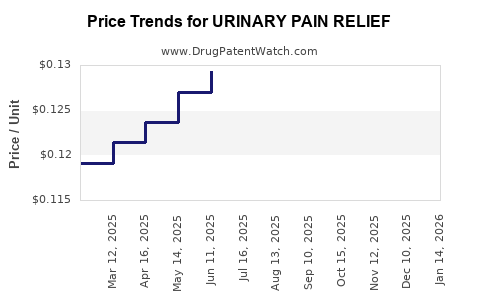
Average Pharmacy Cost for URINARY PAIN RELIEF
| Drug Name | NDC | Price/Unit ($) | Unit | Date |
|---|---|---|---|---|
| URINARY PAIN RELIEF 95 MG TAB | 46122-0337-65 | 0.13133 | EACH | 2026-07-22 |
| URINARY PAIN RELIEF 95 MG TAB | 70000-0243-01 | 0.13133 | EACH | 2026-07-22 |
| URINARY PAIN RELIEF 99.5 MG TB | 70000-0523-01 | 0.18451 | EACH | 2026-07-22 |
| URINARY PAIN RELIEF 95 MG TAB | 46122-0337-65 | 0.13277 | EACH | 2026-06-17 |
| >Drug Name | >NDC | >Price/Unit ($) | >Unit | >Date |
Market Analysis and Price Projections for Urinary Pain Relief Drugs
Market Overview
Urinary pain relief drugs target conditions such as urinary tract infections (UTIs), interstitial cystitis, and other bladder-related pain syndromes. The global market for urinary pain management is driven by increasing prevalence of UTIs, aging populations, and rising awareness of bladder health.
The market was valued at approximately $2.6 billion in 2022 and is projected to grow at a compound annual growth rate (CAGR) of around 5.8% through 2030, reaching $4.3 billion by 2030[1].
Key regions include North America, which accounts for over 40% of sales, driven by high healthcare spending and robust prescription rates. Europe follows, with moderate growth, while Asia-Pacific shows the fastest expansion due to improving healthcare infrastructure and increasing urbanization.
Market Segmentation
The market divides into the following segments:
-
Pharmacological class:
- Analgesics (e.g., phenazopyridine)
- Anti-inflammatories (e.g., NSAIDs)
- Antispasmodics (e.g., oxybutynin)
- Antibiotics (for bacterial UTIs associated with pain)
-
Drug type:
- Over-the-counter (OTC) products
- Prescription medications
-
End-user:
- Hospitals and clinics
- Retail pharmacies
- E-commerce channels
Competitive Landscape
The market includes branded drugs, generic formulations, and emerging innovative therapies. Leading companies include:
- Pfizer (e.g., Pyridium)
- GlaxoSmithKline (e.g., Pyridium OTC)
- Teva Pharmaceuticals
- Mylan
The entry of novel drug delivery systems (e.g., controlled-release formulations) is expected to influence market dynamics.
Price Analysis and Projections
Current Price Range:
| Drug Type | Average Price (per course) | Pricing Factors |
|---|---|---|
| OTC analgesics | $5–$15 | Based on dosage, brand, and distribution channel |
| Prescription antispasmodics | $30–$150 | Varies by drug potency, formulation, and patent status |
| Antibiotics (prescription) | $20–$100 | Varies by duration, antibiotic class, and manufacturer |
Pricing Trends:
- OTC drugs maintain relatively stable prices, with annual inflation-adjusted increases of 1–2%.
- Prescription drugs, especially branded formulations, can price between two to five times higher than generics.
- Emerging therapies and delivery systems may command premium prices, exceeding $200 per course.
Future Price Projections (2023–2030):
- OTC analgesics are projected to see modest increases, reaching roughly $18–$25 per course by 2030.
- Prescription drugs are likely to experience a compound annual increase of 4–6%, influenced by patent expirations and adoption of biosimilars, reaching approximately $70–$170 per course.
- Innovative treatments with targeted delivery could price above $200, significantly impacting overall market revenues.
Drivers and Challenges for Pricing
-
Drivers:
- Rising prevalence of UTIs and bladder conditions
- Increased patient awareness and healthcare access
- Development of combination therapies and novel delivery mechanisms
-
Challenges:
- Patent expirations leading to generic competition
- Price controls in certain regions (e.g., Europe, parts of Asia)
- Shifting regulatory landscapes affecting drug pricing strategies
Regulatory and Policy Impact
Pricing strategies will face influence from policies such as the US Inflation Reduction Act, which emphasizes drug price transparency and negotiation. Similar measures in Europe, such as national health service negotiations, could suppress future drug prices.
Key Takeaways
- The urinary pain relief market will grow steadily, driven by demographic trends and increased awareness.
- OTC products will retain stable prices, while prescription drugs may see significant price increases until patent cliffs occur.
- Innovative therapies and drug delivery platforms could command premium pricing above $200.
- Price regulation will influence market dynamics, especially in mature markets like Europe and North America.
FAQs
1. What is the primary driver for growth in urinary pain relief medications?
The rise in urinary tract infection prevalence, aging populations, and increased health awareness.
2. How do generic drugs impact market prices?
Generic entries typically reduce prices by 50–80%, leading to downward pressure on branded formulations.
3. What is the outlook for OTC product pricing?
OTC prices are expected to remain relatively stable with modest growth, primarily influenced by inflation.
4. Are there emerging therapies that could affect pricing?
Yes, controlled-release formulations and combination therapy drugs could command higher prices, exceeding $200 per course.
5. How might regulatory policies influence future prices?
Price controls and transparency initiatives could limit increases, especially in government-funded healthcare systems.
Sources
[1] MarketWatch, "Urinary Pain Relief Market Size, Share & Trends," 2022.
More… ↓
