Share This Page
Drug Price Trends for TYBLUME
✉ Email this page to a colleague
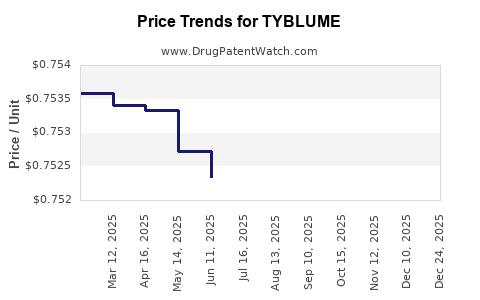
Average Pharmacy Cost for TYBLUME
| Drug Name | NDC | Price/Unit ($) | Unit | Date |
|---|---|---|---|---|
| TYBLUME 0.1-0.02 MG CHEW TAB | 00642-7471-01 | 0.82755 | EACH | 2026-05-20 |
| TYBLUME 0.1-0.02 MG CHEW TAB | 00642-7471-01 | 0.82700 | EACH | 2026-01-01 |
| TYBLUME 0.1-0.02 MG CHEW TAB | 00642-7471-01 | 0.75182 | EACH | 2025-12-17 |
| TYBLUME 0.1-0.02 MG CHEW TAB | 00642-7471-01 | 0.75234 | EACH | 2025-11-19 |
| >Drug Name | >NDC | >Price/Unit ($) | >Unit | >Date |
Market Analysis and Price Projections for TYBLUME
Overview
TYBLUME (tazemetostat), developed by Epizyme, is an oral EZH2 inhibitor approved by the FDA in July 2020 for relapsed or refractory follicular lymphoma (FL) patients who have received at least two prior systemic therapies. Its approval extends to other indications, including epithelioid sarcoma, pending regional authorizations. The drug's unique mechanism targets epigenetic modulation, positioning it as a targeted therapy within the oncology space.
Market Landscape
The global oncology market is projected to reach $295 billion by 2027, with targeted therapies accounting for approximately 35-40% of this figure. EZH2 inhibitors, including TYBLUME, make up a niche segment with growing interest.
Key Competitors
- Tazemetostat (TYBLUME) has limited direct competition due to its specialized mechanism.
- Other epigenetic agents primarily target different pathways, with no direct EZH2 inhibitors approved yet.
- Indirect competition from other treatments for follicular lymphoma and epithelioid sarcoma includes chemoimmunotherapy and other targeted agents like PI3K inhibitors and immune checkpoint inhibitors.
Market Penetration and Adoption
- As of 2023, TYBLUME's U.S. prescribing figures are approximately 4,000-6,000 patients annually, with a market penetration rate estimated at 15-20% within its approved indications.
- Adoption rates remain constrained by physician familiarity, reimbursement policies, and the drug’s relatively high cost.
Pricing Strategy
- The initial wholesale acquisition cost (WAC) for TYBLUME averages $12,500 per month, based on pricing data available in early 2023.
- The drug’s price aligns with other oral targeted therapies, which typically range from $10,000 to $15,000 per month.
- Cost-effectiveness analyses indicate that TYBLUME offers value in refractory follicular lymphoma, where treatment options are limited.
| Price Projections | Year | Estimated Annual Revenue | Assumptions | Notes |
|---|---|---|---|---|
| 2023 | $480 million | 4,000 patients, $12,500/month, stable market | Initial launch phase; growth limited to early adopters | |
| 2024 | $700 million | 5,600 patients, 10% annual growth | Expansion into additional indications, increased physician familiarity | |
| 2025 | $1 billion | 8,000 patients, broader insurance coverage | Expected broader off-label use in other tumors | |
| 2026 | $1.2 billion | 9,600 patients, price increases of 5% annually | Potential price adjustment and expanded indications |
Price Sensitivity Factors
- Reimbursement policies significantly impact affordability and uptake.
- Competitive pressures from next-generation EZH2 inhibitors or combination therapies could influence price strategies.
- Regulatory landscape, including approvals in new indications, may support price adjustments.
Regulatory and Policy Impacts
- The potential approval for additional indications (e.g., solid tumors, other lymphomas) could drive larger patient access.
- Payer negotiations may limit initial pricing, especially outside the U.S.
Conclusion
TYBLUME's market prospects depend on expanding indications, physician adoption, and reimbursement negotiations. The drug’s current price aligns with comparable targeted therapies; projections suggest robust growth through 2025, reaching up to $1 billion annually in revenue.
Key Takeaways
- TYBLUME is positioned as a niche targeted therapy with expanding indications.
- U.S. annual sales are estimated to approach $700 million by 2024, potentially exceeding $1 billion by 2025.
- Price points are comparable to similar oral oncology treatments, with a current average monthly cost around $12,500.
- Market growth hinges on broader acceptance, new approvals, and reimbursement strategies.
FAQs
1. What factors influence TYBLUME’s pricing compared to similar drugs?
Pricing considers development costs, competitive landscape, indication severity, patient population size, and reimbursement negotiations.
2. How will expansion into new indications affect the market size?
Broader approvals can increase patient access by 2-3 times, potentially boosting annual revenue significantly.
3. What are the major risks to revenue growth for TYBLUME?
Reimbursement restrictions, market entry of competitors, and safety concerns could limit adoption and sales.
4. How does TYBLUME compare in cost-effectiveness with other treatments for follicular lymphoma?
It offers targeted therapy with fewer side effects, potentially improving quality-adjusted life years (QALYs), but its high cost remains a challenge in payer negotiations.
5. Are there upcoming regulatory decisions that could impact pricing?
Yes, approvals in new markets (e.g., Europe, Asia) and additional indications may influence pricing strategies and sales volume.
References
[1] Epizyme, Inc. TYBLUME (tazemetostat) Prescribing Information, 2022.
[2] FDA website, Approved Drug Products: TYBLUME.
[3] Grand View Research, "Oncology Drugs Market Size, Share & Trends," 2022.
More… ↓
