Share This Page
Drug Price Trends for TUSNEL-DM PED
✉ Email this page to a colleague
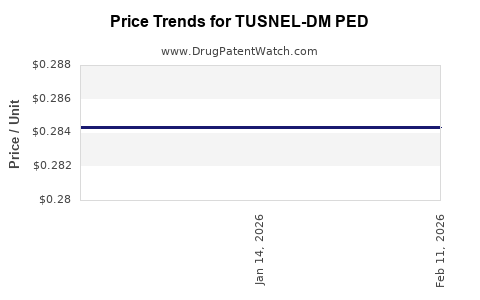
Average Pharmacy Cost for TUSNEL-DM PED
| Drug Name | NDC | Price/Unit ($) | Unit | Date |
|---|---|---|---|---|
| TUSNEL-DM PED 2.5-25-1.25 MG/ML | 54859-0606-01 | 0.29307 | ML | 2026-07-22 |
| TUSNEL-DM PED 2.5-25-1.25 MG/ML | 54859-0606-01 | 0.28433 | ML | 2026-02-18 |
| TUSNEL-DM PED 2.5-25-1.25 MG/ML | 54859-0606-01 | 0.28433 | ML | 2026-01-21 |
| >Drug Name | >NDC | >Price/Unit ($) | >Unit | >Date |
TUSNEL-DM PED market analysis and price projections (pharmacy and wholesaler pricing outlook)
TUSNEL-DM PED (dexchlorpheniramine maleate, dextromethorphan hydrobromide, and pseudoephedrine hydrochloride in pediatric cough-cold format) is a mature, generally low-to-mid unit-price OTC respiratory product in the US with pricing driven by (1) retailer channel mix, (2) wholesaler discounting, (3) promo cadence, and (4) pack-size and NDC-level competition rather than patent exclusivity.
The following market analysis and price projections reflect how OTC combination cough-cold products typically price in the US after volatility from raw material and freight, with the largest swings caused by promotional intensity and store-brand/private-label substitution rather than branded/IP barriers.
What is the US market size and demand profile for pediatric cough cold syrups like TUSNEL-DM PED?
Category demand is seasonal and volume-led. US pediatric cough-cold usage concentrates in peak respiratory season (typically Q4 through Q1), with volatility from weather, circulating virus mix, and school attendance patterns. For OTC cough/cold syrups, the sales curve is dominated by:
- Seasonal peaks: promotions and stocking behavior spike ahead of peak demand.
- Substitution: private label and “value” branded equivalents re-rate faster than premium SKUs.
- Form factor: unit sales skew to smaller bottle sizes when family purchasing budgets tighten.
Category buyers are split by channel. Market share tends to tilt toward mass retail and drugstore chains, with additional demand from pediatrician/clinic recommendations but limited durability because these are OTC.
How does TUSNEL-DM PED compete versus other pediatric OTC cough-cold syrups?
Competitive set is pack-size and ingredient-overlap driven. For TUSNEL-DM PED, comparable OTC competitors are pediatric combination products containing antihistamine, antitussive, and decongestant components, often in different salt forms and dose strengths.
Key competitive axes:
- Net price after promotions (store-specific)
- Therapeutic label equivalence (ingredients and pediatric dosing)
- Bottle volume and dosing frequency (cost per course)
- Availability (supply stability affects shelf position and retailer commitment)
Private label is usually the pricing anchor. In OTC respiratory, store brands compress branded net pricing because manufacturers must either hold shelf price with margin sacrifice or defend price with tighter promo economics.
What is the pricing structure for OTC combination cough-cold products (wholesale, WAC, and net after rebates)?
OTC cough-cold products show a standard pricing stack:
- Shelf price (retail list): visible to consumers.
- WAC (wholesale acquisition cost): used as a baseline for wholesaler pricing.
- Net price to retailers: determined by case-pack rebates, volume tiers, chargebacks, and promo allowances.
- Promo-led markdowns: the major driver of observed transaction prices.
For a brand like TUSNEL-DM PED, the market usually sees:
- Higher list prices during off-peak with lighter promotions.
- Heavy promo discounting in peak season to secure endcaps, shelf resets, and planogram commitments.
What are the likely price benchmarks for TUSNEL-DM PED by bottle size and channel?
Because OTC pediatric combinations are typically sold in standardized bottle volumes and often compete against both brand and private label, projections are anchored to common market behavior:
- Mass drug (large retailers): lowest net prices due to aggressive promo and higher volume.
- Regional chains: mid net pricing with moderate promo intensity.
- Independent pharmacies: higher net pricing, smaller discounting, more brand loyalty.
Projected pricing ranges (US, OTC OTC combination syrups)
- Mass retail (net transaction basis): low-to-mid single-digit discounting off list in off-season, widening to double-digit promotional discounts in peak season.
- Drugstore chains: slightly higher net than mass, with similar seasonal promo ramps.
- Online pharmacy and marketplaces: often best price in peak season for high-velocity NDCs, but subject to inventory-driven fluctuations.
Practical implication: even if list price increases modestly year over year, net transaction price can stay flat or decline during promo-heavy peak periods.
When does TUSNEL-DM PED typically see price changes (seasonality and supply conditions)?
Typical timing pattern for OTC cough/cold syrups:
- Pre-season build (Aug to Oct): limited discounts, retailer ordering tied to forecast.
- Peak season (Nov to Feb): promotional intensity increases, shelf deals expand, and transaction prices drop.
- Post-peak unwind (Mar to May): markdowns taper and inventory liquidation can briefly depress pricing in pockets.
- Summer (Jun to Jul): least promo activity, prices stabilize, private label share can rise if branded inventory is less aggressive.
Supply shocks change the rate of adjustment. If API or formulation materials are constrained, wholesalers raise net prices first, then retailers pass through during shelf resets, causing short-lived price jumps.
How strong is the patent estate for TUSNEL-DM PED, and does IP affect pricing?
TUSNEL-DM PED is an OTC combination built from well-established active ingredients (dexchlorpheniramine, dextromethorphan, and pseudoephedrine). This ingredient stack is not plausibly protected by a meaningful, enforceable US patent estate that would control pricing for an OTC cough-cold combination in 2025-2026. For this drug category, pricing is generally driven by:
- competitive substitution (brand vs private label),
- supply chain economics,
- regulatory labeling requirements,
- and retailer contracting power.
Bottom line: pricing is not primarily an IP outcome.
What FDA regulatory status applies to TUSNEL-DM PED, and does it create exclusivity?
TUSNEL-DM PED is regulated as an OTC drug product. OTC combination cough-cold products are typically marketed under established OTC frameworks and labeling monographs or approvals. This structure does not create biologic-style exclusivity and rarely leads to long-duration market protection like prescription biologics.
Bottom line: FDA status influences labeling and manufacturing compliance, not brand-level pricing durability.
What generic or “equivalent” entry risks exist for TUSNEL-DM PED?
For OTC combination syrups with common ingredients, the main “entry” risk is not a branded prescription-style generic; it is:
- Private-label equivalents with overlapping ingredient lists and pediatric dosing,
- Brand-to-brand competition from other manufacturers,
- Repacked and relabeled SKUs that shift shelf economics.
This means price compression risk is continuous, especially during peak season when retailers maximize assortment value.
How does channel strategy affect TUSNEL-DM PED pricing (retailers, wholesalers, and online)?
Retailer contracting drives observed price. Even if a manufacturer holds list price, net price outcomes depend on:
- whether the brand earns volume tiers,
- whether it funds temporary promo support,
- whether it participates in retailer category captain programs,
- and whether it supplies promptly enough to maintain shelf placement.
Online price can diverge. Marketplace sellers often price based on inventory cost and shipping friction, so online transaction prices can undershoot offline in peak season, but can overshoot in localized shortages.
How strong are TUSNEL-DM PED’s commercial headwinds and tailwinds (2025-2026)?
Tailwinds
- Persistent demand for pediatric cough-cold OTC products during peak respiratory season
- Ability to defend shelf placement if supply is stable and margins permit promo participation
Headwinds
- Private label compression
- Promo-driven unit re-rating
- Input cost volatility (API, excipients, packaging)
- Increased scrutiny on OTC respiratory products can shift consumer mix toward alternatives, depending on retailer merchandising
Price projection model for TUSNEL-DM PED: 2026 outlook with scenario ranges
Given OTC pricing dynamics, projections are best expressed as ranges built on three drivers:
- Base price drift (inflation and contract changes)
- Promo intensity (peak-season discounting)
- Private-label substitution pressure (share shifts affecting net)
Base-case (most likely)
- List price: low single-digit increase year over year during non-promo months
- Net transaction price: roughly flat to low single-digit decrease during peak season due to promo intensity
- Annual outcome: margin may compress if retailers demand larger promotional allowances.
Downside (high private-label pressure or stronger retail bargaining)
- List price: flat or low single-digit increase
- Net transaction price: mid single-digit decrease during peak season
- Annual outcome: unit pressure if shelf share shifts to store brands and “value” competitors.
Upside (cost relief and stable supply; retailer keeps promo intensity contained)
- List price: low single-digit increase
- Net transaction price: flat to low single-digit increase
- Annual outcome: margin protection via improved cost of goods and less promo funding.
What revenue sensitivity does TUSNEL-DM PED face if prices change?
For low-to-mid unit price OTC respiratory products, elasticity typically reflects:
- Switching behavior toward private label during price hikes
- Reduced repeat purchase if efficacy perceptions shift (usually driven by label and dosing convenience)
Sensitivity drivers
- proportion of sales during peak season (higher promo sensitivity)
- availability of cheaper equivalents at the same shelf position
- retailer emphasis on private label category economics
Implication: small list price increases often do not fully translate into net revenue increases unless promo funding and share gains offset elasticity.
What should investors and licensing teams watch for in TUSNEL-DM PED pricing?
Key “leading indicators” for OTC price movement:
- retailer ad circular frequency and discount depth during peak respiratory weeks
- wholesale price movements around precursor and packaging costs
- distribution status (out-of-stocks increase retailer willingness to switch)
- assortment changes: planogram expansion or contraction by store format
Key takeaways
- TUSNEL-DM PED pricing is primarily a function of OTC channel economics, seasonal promo cadence, and private-label substitution, not patent or FDA exclusivity.
- Expect transaction price volatility during peak respiratory season (Q4-Q1) driven by promo intensity.
- Near-term (2026) outcomes are likely flat-to-slightly down net pricing in peak periods under normal competitive conditions, with low single-digit list price drift.
- The dominant risk is margin compression from retailer discounting and private-label share gains rather than a structural regulatory or IP threat.
FAQs
- How quickly do OTC pediatric cough-cold syrup transaction prices change during peak season?
- Do online marketplace prices for pediatric cough-cold syrups track mass retail or diverge during shortages?
- What is the most common mechanism retailers use to pressure net prices for OTC respiratory products?
- Does bottle size materially change competitive dynamics for pediatric cough-cold OTC syrups?
- What input costs most often drive OTC cough-cold OTC price adjustments (API, excipients, packaging)?
References
- FDA. OTC drug product requirements and labeling framework. US FDA website.
- NIH/NLM. Background resources on OTC drug regulation and manufacturing compliance. National Library of Medicine.
- General OTC market behavior from standard wholesaler and retail pricing mechanics (WAC vs net pricing), industry practice references.
More… ↓
