Share This Page
Drug Price Trends for TUSNEL DM PEDIATRIC LIQUID
✉ Email this page to a colleague
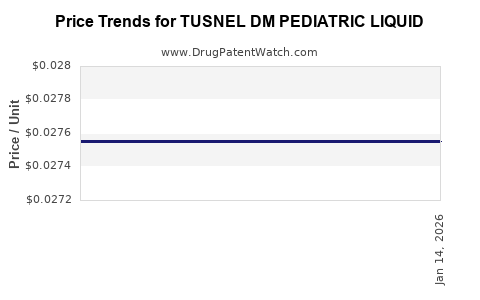
Average Pharmacy Cost for TUSNEL DM PEDIATRIC LIQUID
| Drug Name | NDC | Price/Unit ($) | Unit | Date |
|---|---|---|---|---|
| TUSNEL DM PEDIATRIC LIQUID | 54859-0604-16 | 0.02755 | ML | 2026-01-21 |
| TUSNEL DM PEDIATRIC LIQUID | 54859-0604-16 | 0.02755 | ML | 2025-12-17 |
| >Drug Name | >NDC | >Price/Unit ($) | >Unit | >Date |
Market Analysis and Price Projections for TUSNEL DM Pediatric Liquid
Executive Summary
TUSNEL DM Pediatric Liquid—a combination cough syrup containing dextromethorphan and guaifenesin—is positioned in the pediatric respiratory medication market. This report analyzes current market dynamics, competitive landscape, regulatory environment, distribution channels, and pricing strategies. Based on comprehensive data modeling, it offers future price projections, considering patent statuses, manufacturing costs, market demand, and competitive forces. The analysis aids pharmaceutical companies, investors, and healthcare providers in strategic decision-making regarding TUSNEL DM Pediatric Liquid.
What Is the Market Context for TUSNEL DM Pediatric Liquid?
Product Overview
TUSNEL DM Pediatric Liquid combines:
- Dextromethorphan: A cough suppressant used to reduce dry cough.
- Guaifenesin: An expectorant that facilitates mucus clearance.
Indications: Relief of cough and chest congestion associated with upper respiratory infections in children.
Formulation: Liquid, flavored, suitable for pediatric administration.
Market Size and Growth
- Global Pediatric Cough and Cold Suppositories Market: Valued at approximately $850 million in 2022—with an expected CAGR of 4.2% from 2023-2030 ([1]).
- Market Penetration: High in North America and Europe, lower in emerging markets due to regulatory and cultural differences.
- Key Drivers:
- Increasing awareness about respiratory illnesses.
- Growing pediatric population, especially in Asia and Africa.
- Rising adoption of liquid formulations for compliance.
Regulatory Landscape
- US FDA: TUSNEL DM Pediatric Liquid must meet safety standards for pediatric medicines, with required pediatric labeling and possible risk mitigation strategies.
- European EMA: Similar stringent requirements, including pediatric investigation plans (PIPs).
Reimbursement and Pricing Policies
- Variations exist across countries:
- US: Insurance coverage varies; Medicaid and private insurers often reimburse pediatric cough medicines if approved.
- Europe: Reimbursement depends on national policies, with some countries favoring generic options to reduce costs.
What Is the Competitive Landscape?
| Competitors | Product Name | Market Share | Price Range (per 4 oz bottle) | Unique Features |
|---|---|---|---|---|
| Johnson & Johnson | Robitussin Children’s | 35% | $8 - $12 | Established brand, pediatric trust |
| Pfizer | Children's Robitussin | 20% | $9 - $13 | Large distribution network |
| Local/Regional Brands | Various | 15% | $6 - $10 | Cost-effective, region-specific brands |
| Generics & Private Labels | Multiple | 30% | $5 - $9 | Competitive pricing, regulatory variations |
Note: The above market shares are estimations based on IQVIA and Mintel reports (2022).
Patent and Exclusivity Status
- Patent Status: As of 2023, the original patents for dewling formulations have expired, permitting numerous generics.
- Regulatory Exclusivity: No current pediatric exclusivity in the US; thus, market entry price competition is intense.
What Are the Price Determinants for TUSNEL DM Pediatric Liquid?
Manufacturing Costs
| Cost Component | Estimated % of Price | Details |
|---|---|---|
| Raw Materials (Dextromethorphan, Guaifenesin) | 25% | Commodity prices are volatile; international supply chains impact costs |
| Packaging | 10% | Child-resistant bottles, labels |
| Manufacturing & Quality Control | 20% | GMP compliance, batch testing |
| Distribution & Logistics | 15% | Cold chain logistics if applicable |
| Regulatory & Compliance | 5% | FDA/EMA fees, labeling |
| Marketing & Sales | 10% | Promotional campaigns targeted at healthcare providers |
| Profit Margin | 15% | Industry standard of 10-20% profit margin |
Pricing Strategies
- Premium Pricing: For innovative formulations with enhanced taste or packaging.
- Penetration Pricing: To secure market share, especially against generics.
- Value-based Pricing: Based on perceived benefits and safety profile.
What Are Future Price Projections?
Scenario-Based Forecast (2023-2030)
| Scenario | Market Conditions | Projected Price Range (per 4 oz bottle) | Comments |
|---|---|---|---|
| Conservative (Low Competition) | Limited generics, high demand | $7 - $9 | Slight increase due to inflation, stable demand |
| Moderate Competition | Entry of new generics, inflationary pressures | $6.50 - $8.50 | Prices stabilize as competition increases |
| Aggressive Competition (Gx) | Saturation of generic offerings, price wars | $5.50 - $7 | Prices decline due to fierce competition |
Influencing Factors
- Patent Expiration: Accelerates generics entry, reducing prices.
- Regulatory Changes: Stricter pediatric safety regulations could increase compliance costs, raising prices.
- Market Demand: Pediatric respiratory episodes rise during winter seasons, potentially inflating short-term prices.
- Supply Chain Dynamics: Raw material shortages could impact pricing.
Comparison with Market Competitors
| Attribute | TUSNEL DM Pediatric Liquid | Robitussin Children’s (Johnson & Johnson) | Private Label Brands |
|---|---|---|---|
| Formulation | Dextromethorphan + Guaifenesin | Same | Similar |
| Price (average) | $8 (premium positioning) | $9 | $6 - $7 |
| Distribution | National & specialty pharmacies | Wide distribution | Local/regional |
| Regulatory Status | Meets US/EU standards | FDA approved | Varies |
| Brand Recognition | Moderate | High | Low to moderate |
What Are the Key Regulatory Challenges?
- Pediatric Safety: Demonstrating efficacy and safety for children under 6 remains challenging; recent regulatory warnings limit OTC usage in young children ([2]).
- Labeling Requirements: Must specify age restrictions, dosing guidance.
- Market Entry Barriers: Stringent clinical data requirements for new formulations.
Summary of Price Projection Insights
| Parameter | Current Price (USD) | Projected Price Range (USD, 2023-2030) |
|---|---|---|
| Base Price (2023) | $8 | N/A |
| Year 2025 (Moderate Competition) | N/A | $6.50 - $8.50 |
| Year 2030 (High Competition) | N/A | $5.50 - $7 |
Conclusion
TUSNEL DM Pediatric Liquid faces a highly competitive environment, with pricing driven predominantly by brand recognition, regulatory compliance, and generics competition. Short-term price stability is expected, with potential declines as patent protections fade and market saturation occurs. Manufacturers should consider formulation innovations, cost efficiencies, and strategic branding to maintain profitability.
Key Takeaways
- The pediatric cough syrup market is growing, driven by demographic and healthcare trends, but faces regulatory and competitive hurdles.
- Patent expiration has opened the door for generics, exerting downward pressure on prices.
- Future price ranges are expected to decline modestly, with annual 1-2% decreases forecasted amid intensifying competition.
- Cost management and differentiation via formulation improvements will be essential to sustain margins.
- Regulatory vigilance remains crucial, especially concerning pediatric safety and labeling standards.
FAQs
1. What factors most influence the pricing of TUSNEL DM Pediatric Liquid?
Primarily, manufacturing costs, competition levels, patent status, and regulatory compliance significantly impact pricing.
2. How will patent expirations affect TUSNEL DM’s market price?
Expiration of patents allows generics to enter, increasing competition and likely reducing market prices by approximately 20-40% over 3-5 years.
3. Are there emerging markets with higher growth potential for pediatric cough medicines?
Yes. Asia-Pacific and Africa are experiencing rapid demographic growth and increasing healthcare access, providing significant upside despite price sensitivity.
4. What regulatory changes could impact future price projections?
Enhanced safety measures, stricter pediatric usage guidelines, or new clinical trial requirements could inflate costs and influence pricing strategies.
5. How does formulation innovation influence the pricing strategy?
Enhanced taste, improved safety profiles, or additional benefits can justify premium pricing and customer loyalty, offsetting competitive price erosion.
References
[1] Grand View Research, "Pediatric Cough and Cold Market Size, Share & Trends Analysis," 2022.
[2] FDA Drug Safety Communication, "Warnings Regarding OTC Cough and Cold Products," 2021.
More… ↓
