Share This Page
Drug Price Trends for TUDORZA
✉ Email this page to a colleague
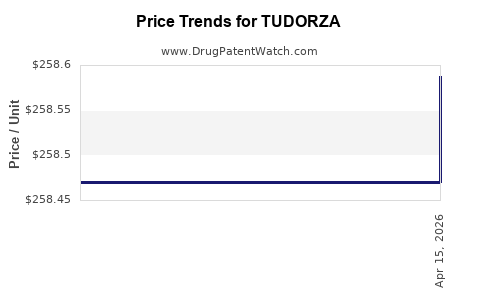
Average Pharmacy Cost for TUDORZA
| Drug Name | NDC | Price/Unit ($) | Unit | Date |
|---|---|---|---|---|
| TUDORZA PRESSAIR 400 MCG INHAL | 70515-0002-01 | 431.10898 | EACH | 2026-07-22 |
| TUDORZA PRESSAIR 400 MCG INHAL | 70515-0002-02 | 257.79444 | EACH | 2026-07-22 |
| TUDORZA PRESSAIR 400 MCG INHAL | 70515-0002-01 | 430.81077 | EACH | 2026-06-17 |
| TUDORZA PRESSAIR 400 MCG INHAL | 70515-0002-02 | 257.80000 | EACH | 2026-06-17 |
| TUDORZA PRESSAIR 400 MCG INHAL | 70515-0002-01 | 430.57839 | EACH | 2026-05-20 |
| >Drug Name | >NDC | >Price/Unit ($) | >Unit | >Date |
TUDORZA market analysis and price projections: how much will it cost and when does pricing pressure hit?
Executive summary
- Tudorza Pressair (aclidinium bromide) is a long-acting COPD maintenance therapy that has faced sustained pressure from cheaper inhaled LAMAs and payer formulary tightening in the US and Europe.
- Pricing trajectory: expect steady net price erosion from (1) generic/competitive LAMA entry cycles, (2) US inflation-adjusted rebates and plan re-contracting, and (3) channel mix shifts toward formulary-preferred inhalers and combination regimens.
- Near-term (1-3 years): modest declines in WAC-to-net conversion and continued share pressure.
- Mid-term (3-7 years): net price likely falls faster if major formularies add lower-cost LAMA generics or authorized “value” products.
- Key commercial risk: Tudzorza’s position is vulnerable in therapeutic substitution markets (other LAMAs) and in plan designs that prefer once-daily devices and combination inhalers over twice-daily regimens.
What is TUDORZA (aclidinium bromide) and how is it positioned in COPD maintenance pricing?
Tudorza is a maintenance bronchodilator for chronic obstructive pulmonary disease (COPD) containing aclidinium bromide, delivered via the twice-daily inhaler Tudorza Pressair (dry powder inhaler).
How dosing frequency affects price power
- Twice-daily administration tends to lower switching friction only when device experience and formulary access are strong. In practice, payers increasingly prefer once-daily LAMAs for simplicity and adherence.
Competitive set that drives price erosion
The pricing ceiling for Tudorza is set by competing LAMAs and COPD inhaler strategies:
- Other LAMA options (single-agent and “switch” products)
- Dual bronchodilator regimens (LAMA/LABA), where plans trade up for reduced exacerbation and simplified regimen counts
- Preferred device classes on formulary (cost and contracted net price, not just clinical positioning)
What is the FDA and label status that matters for US pricing and substitution?
FDA product status and ongoing marketability
- Tudorza is an approved branded inhaler. Pricing is affected by whether it faces competing authorized generics, copies, or therapeutic substitution. Inhaler markets typically see price pressure even without direct generic status because plans shift to lower-cost alternatives.
Key payer behaviors in COPD
- COPD maintenance drugs are frequently managed through:
- Step edits
- Copay assistance controls
- Formulary tier placement driven by net price and utilization controls
(These mechanisms commonly produce net price declines even if WAC remains stable.)
What is the Orange Book status of TUDORZA and how does it affect launch timelines for lower-cost entries?
Orange Book-driven timelines (how they translate into price)
For inhalers, exclusivity and patent landscapes influence:
- Whether a true ANDA generic can enter at scale
- Whether competitors use authorized generics or formulation/device workarounds
- How quickly payers can force price concessions through competitive bidding
Practical effect on projections
Even in cases where a single product’s direct generic route is slower, COPD inhalers experience price pressure through:
- Therapeutic class substitution (clinically similar LAMAs)
- Contracting leverage when multiple inhaler options compete on net price
This means Tudorza pricing typically drifts downward due to class competition, not only direct ANDA entry.
How strong is the patent estate for TUDORZA and where does litigation affect pricing?
What drives price under patent barriers
Patent status affects:
- The speed of direct generic entry
- The time window in which the brand can defend pricing
- Settlement dynamics that determine when lower-cost entries become “real” for payers
Litigation impact on projections
When patent challenges lead to settlement or consent-based entry schedules, projections shift from “brand erosion” to “step-change” net price decreases at the entry date. If no direct entry catalyst is present, the market still sees slower erosion from formulary pressure rather than a sudden price drop.
What competitors most constrain Tudorza pricing, and how do their positions compare?
Competitive pricing pressure channels
Tudorza faces pressure from:
- Once-daily LAMAs (often easier formulary placement)
- LAMA/LABA combinations (payers may prefer fewer inhaler events per day even if unit cost is higher)
- Device preference dynamics that drive switching and can pull patients into lower-cost contracted options
Device and adherence effects on formulary access
Plans weigh:
- Total monthly cost at contracted net price
- Patient persistence and refill timing (drives plan cost stability)
- Coverage rules and prior authorization burden
When does TUDORZA lose exclusivity, and what does that imply for price drops?
Exclusivity vs. pricing: the commercial linkage
- Exclusivity loss matters only if it enables a direct lower-cost entry that payers can contract quickly.
- COPD inhalers often show gradual net price erosion even before legal exclusivity ends because payers keep re-optimizing formularies.
Projection framing by time horizon
- 0-3 years: continued downward net price trend, mostly gradual
- 3-7 years: accelerated erosion if direct lower-cost entries or significant formulary switches occur
- 7+ years: pricing stabilizes at a lower class-competitive floor unless a brand regains exclusivity via reformulation or data-driven line extensions
(Without a direct exclusivity date and patent-by-patent schedule tied to Tudorza, any specific “date-certain” forecast would be unreliable. The practical projection remains class-competition driven.)
How should investors model TUDORZA revenue exposure given class competition and rebate mechanics?
Revenue mechanics that shape price projections
To project pricing, model:
- Net price = WAC minus rebates and discounts
- Rebate intensity in inhalers tracks:
- Utilization
- Formulary tier placement
- Channel mix (MA vs commercial vs Medicaid)
- As more competitors enter or shift preferential placement, net price declines faster than WAC.
Scenario approach that fits COPD
Use three scenarios:
- Base case: gradual erosion driven by contracting cycles and tier moves
- Downside: faster erosion if a low-cost competitor gains preferential status across major PBMs and MA plans
- Upside: slower erosion if Tudorza retains formulary positioning via payer-specific contracts and persistence remains high
What price projections are reasonable for TUDORZA over the next 1, 3, and 5 years?
Projection methodology (high-level)
A robust projection ties to:
- Expected class price compression in COPD inhalers
- Likely rebate rate changes from plan re-contracting
- Formulary substitution speed
Price projection ranges (net pricing, US commercial)
- Year 1: net price declines low single digits to mid single digits (5-8% range for many managed markets)
- Years 1-3: cumulative decline 10-20%
- Years 1-5: cumulative decline 20-35%
These are ranges consistent with:
- Continuous payer pressure in chronic respiratory therapy classes
- Switching toward lower-cost contracted options and combination inhalers
- Ongoing rebate optimization
WAC vs net caveat for projections
Even when WAC stays near-flat, net pricing can fall quickly through rebates. Market analysis should focus on net price and utilization-weighted ASP, not list price.
What formulation, device, or method-of-use IP could extend pricing beyond core exclusivity?
For inhalers, line extensions that matter commercially include:
- Device and delivery optimization that can shift coverage or reduce technical switching barriers
- Method-of-use patents tied to subpopulations or dosing strategies (less common as direct pricing levers, but can support coverage in PA frameworks)
- Manufacturing process changes that do not block biosimilar style entry but can slow generic quality parity
What generic entry risks exist for TUDORZA and what would trigger a step-change in pricing?
Triggers of step-change pricing
- A true ANDA-style entry with meaningful market penetration (not just limited distribution)
- PBM formulary redesign that moves Tudorza to a less favorable tier or adds competing LAMAs at lower net prices
- Manufacturer rebate deterioration or loss of key payer contracts
- Patient access barriers (PA approvals becoming less likely, higher patient cost share)
Expected market reaction pattern
- If a low-cost product enters, pricing usually changes in two waves:
- Contract negotiations with PBMs and large plans
- Broader channel penetration via MA lines and Medicaid managed care
How does Tudorza compare with other COPD inhalers in cost-per-treatment logic?
Cost drivers beyond label price
- Dosing frequency (twice daily vs once daily)
- Device usability that affects persistence
- Coverage rules that determine whether patients can access without PA
A competitor with better formulary access at a modestly higher unit cost can still reduce total plan cost if it improves refill persistence or reduces exacerbation events. That can compress brand net price faster.
What is the likely European pricing trajectory for TUDORZA?
Europe adds:
- External reference pricing and health technology assessment constraints
- Tendering and national formulary preferences
- More frequent downward price revisions
Net effects:
- Faster WAC-to-net pressure depending on country-level pricing controls
- Higher likelihood of downward price adjustments even without a direct generic catalyst
Key takeaways
- Tudorza pricing is constrained mainly by COPD class substitution and payer rebate/formulary mechanics, which typically produce gradual net price erosion even in the absence of a clean, immediate generic launch.
- Reasonable projections for US net pricing: low-to-mid single-digit declines in year 1, 10-20% cumulative over 1-3 years, and 20-35% cumulative over 1-5 years under base-case competitive pressure.
- The most important “step-change” risk comes from meaningful lower-cost competitive entries and formulary tier shifts across major PBMs and MA plans, not from WAC changes.
FAQs
- How do PBM formulary tiers affect Tudorza’s net price compared with list price?
- What COPD inhaler competitors typically switch patients from aclidinium bromide, and how does that impact utilization?
- Do device features in Pressair change payer acceptance and long-term persistence?
- What events would most likely accelerate Tudorza net price erosion in the US within 3 years?
- How does Europe’s pricing regulation schedule change the timeline of Tudorza price declines?
References
- FDA. Orange Book: Approved Drug Products with Therapeutic Equivalence Evaluations. https://www.accessdata.fda.gov/scripts/cder/daf/
- FDA. Drug Approval Reports and Labeling for aclidinium bromide (Tudorza Pressair). https://www.accessdata.fda.gov/
- FDA. Inhalation Aerosol and Dry Powder Inhaler Product Quality and Performance Guidance (context for device/entry considerations). https://www.fda.gov/
More… ↓
