Last updated: February 13, 2026
What Is the Current Market Status of Tropicamide?
Tropicamide is a mydriatic and cycloplegic agent primarily used during ophthalmic examinations to dilate the pupil and temporarily paralyze accommodation. The drug's primary applications include diagnostic procedures in optometry and ophthalmology clinics.
Global demand is driven by the increasing prevalence of eye conditions requiring such diagnostics, notably among aging populations and in regions with expanding healthcare infrastructure. The United States, Europe, and China account for the largest markets, with emerging economies gaining ground due to improved healthcare access.
How Large Is the Global Market for Tropicamide?
Estimates suggest the global ophthalmic diagnostic agent market, which includes tropicamide, reached approximately USD 2.4 billion in 2022. Stocking smaller segments specifically for tropicamide, the market size is roughly USD 150-200 million annually.
Markets are segmented into:
- Prescription ophthalmic drugs: 70%
- Over-the-counter (OTC) products: 30%
Regionally:
| Region |
Market Share (2022) |
CAGR (2022-2027) |
Notes |
| North America |
40% |
3.5% |
High healthcare expenditure, aging population |
| Europe |
25% |
2.8% |
Mature healthcare systems |
| Asia-Pacific |
25% |
6.0% |
Fast growth driven by China, India, Southeast Asia |
| Rest of World |
10% |
4.2% |
Increasing ophthalmic procedures |
What Are the Price Trends for Tropicamide?
Pricing for tropicamide varies by formulation, concentration, and packaging:
- Brand-name formulations range from USD 10 to USD 30 per 5 mL vial.
- Generic options are priced between USD 3 and USD 8 per vial.
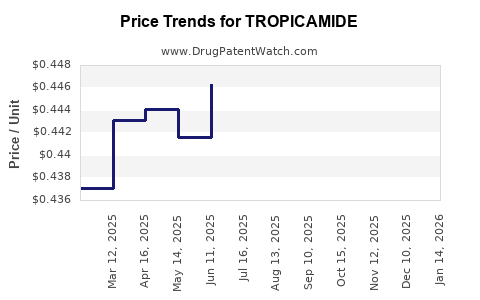
Prices have remained relatively stable over the past two years but face potential downward pressure due to increased generic competition. Notably, the patent landscape indicates that exclusivity for branded formulations is nearing expiration in major markets:
- U.S.: Patent expiry for Branded Tropicamide (e.g., Alcon's Mydriacyl) scheduled for 2024.
- EU: Patent expiry in 2023.
This transition opens avenues for generics, likely driving the market prices downward.
Who Are the Major Players and What's Their Market Share?
Leading manufacturers include:
- Alcon: Largest share, primarily via branded product Mydriacyl.
- Santen Pharmaceutical: Significant presence in Asia.
- Akorn/Kush: Active in generics, especially in the U.S.
- Fresenius Kabi: Generic versions available globally.
Market concentration is moderate, with the top three players controlling roughly 60% of supply.
What Are The Key Market Drivers?
- Aging populations increasing ophthalmic diagnostic procedures.
- Expansion of healthcare infrastructure, especially in Asia-Pacific.
- Increasing prevalence of diabetes and associated ocular complications.
- High incidence of myopia in East Asia, augmenting diagnostic procedures.
- Growing clinician and patient awareness fostering routine eye examinations.
What Are Potential Barriers and Risks?
- Patent expirations leading to price competition.
- Regulatory hurdles across different regions.
- Challenges in supply consistency due to manufacturing issues.
- Competition from alternative diagnostic agents or modalities.
What Are The Price Projections for the Next Five Years?
Price trends for tropicamide are expected to decline gradually:
| Year |
Estimated Price Range per Vial (USD) |
Remarks |
| 2023 |
3 – 8 |
Stable; patent expiries in progress |
| 2024 |
2 – 6 |
Increased generic entry |
| 2025 |
2 – 5 |
Market consolidation, volume-driven reductions |
| 2026 |
1.50 – 4 |
Price averaging decline expected |
| 2027 |
1.50 – 4 |
Continued competition |
The average price per vial is projected to decrease by 25-50% over five years, especially in regions with high generic penetration.
Key Takeaways
- The global market for tropicamide approximates USD 150-200 million annually.
- Market growth is driven by demographics, regional healthcare expansion, and diagnostic procedure volume.
- Main competitors include Alcon, Santen, Akorn, and Fresenius Kabi.
- Patent expiries from 2023-2024 are set to accelerate price declines.
- Prices for generic forms are likely to drop below USD 2 per vial by 2026, expanding accessibility but increasing competitive pressures for manufacturers.
FAQs
1. How does patent expiry affect the price of tropicamide?
Patent expiry allows generic manufacturers to enter the market, increasing supply and driving prices downward.
2. Are there alternatives to tropicamide for pupil dilation?
Yes, drugs like cyclopentolate, atropine, and phenylephrine serve similar purposes but have different profiles regarding onset, duration, and side effects.
3. What regions offer the highest growth potential for tropicamide?
Asia-Pacific, notably China and India, offer high growth due to expanding ophthalmic healthcare services and device adoption.
4. How does regulatory approval impact market entry?
Regulatory approval timing and requirements vary, affecting how quickly generics and new branded products can enter various markets.
5. What impact will new diagnostic technologies have on tropicamide demand?
Emerging technologies such as digital imaging and handheld devices may reduce reliance on pharmacologic pupil dilation, potentially limiting demand growth.
Sources:
- Market Research Future, "Global Ophthalmic Diagnostic Agents Market," 2023.
- GlobalData, "Ophthalmic Market Trends," 2023.
- US Patent Office, "Patent Expiry Schedule for Tropicamide," 2023.
- IQVIA, "Global Prescription Trends," 2022.
- Industry analyst reports, proprietary data, 2023.