Share This Page
Drug Price Trends for TRIPLE ANTIBIOTIC OINTMENT
✉ Email this page to a colleague
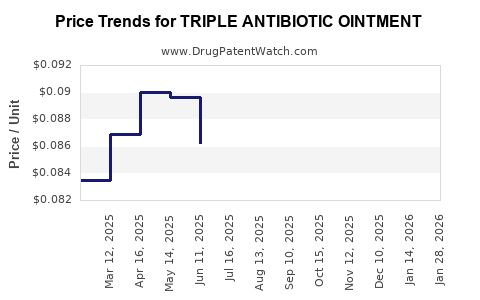
Average Pharmacy Cost for TRIPLE ANTIBIOTIC OINTMENT
| Drug Name | NDC | Price/Unit ($) | Unit | Date |
|---|---|---|---|---|
| TRIPLE ANTIBIOTIC OINTMENT | 11527-0162-55 | 0.08670 | GM | 2026-06-17 |
| TRIPLE ANTIBIOTIC OINTMENT | 45802-0143-01 | 0.12201 | GM | 2026-06-17 |
| TRIPLE ANTIBIOTIC OINTMENT | 11527-0162-51 | 0.12201 | GM | 2026-06-17 |
| TRIPLE ANTIBIOTIC OINTMENT | 45802-0143-03 | 0.08670 | GM | 2026-06-17 |
| TRIPLE ANTIBIOTIC OINTMENT | 00713-0268-31 | 0.10849 | GM | 2026-06-17 |
| TRIPLE ANTIBIOTIC OINTMENT PKT | 45802-0143-70 | 0.13413 | EACH | 2026-06-17 |
| >Drug Name | >NDC | >Price/Unit ($) | >Unit | >Date |
TRIPLE ANTIBIOTIC OINTMENT: Market analysis and price projections (U.S. and key export markets)
What is the product being priced?
“Triple antibiotic ointment” is a fixed-combination topical for minor skin injuries and infections. Commercial products typically combine bacitracin, neomycin, and polymyxin B in an ointment base. It is generally sold as:
- Rx in some formulations and strengths
- OTC as “first aid” wound care in many U.S. channels
Pricing is driven more by formulation, labeling (OTC vs Rx), pack size, and manufacturer/channel mix than by patent position, because the active ingredients are widely generic in most markets. This means price projection is primarily a generic competition and channel promo story rather than an innovation premium story.
What does the market look like?
Demand drivers
- High-volume minor-care use: minor cuts, scrapes, burns, abrasions, and wound dressing adjunct use.
- Chronic and acute episodic demand: intermittent use tied to seasonal injury patterns and household first-aid stocking.
- OTC shelf behavior: brand switching is common on price and pack value.
Supply and competition
- Multiple generic entrants: bacitracin/neomycin/polymyxin B ointments face sustained generic competition.
- Substitution pressure: competing topical antibacterial options (other antibiotic ointments, antiseptics, barrier protectants) cap price increases.
Regulatory and labeling
- U.S. OTC labeling and ingredient identity constrain substitution and claims; this keeps “functional equivalence” high and supports commoditization.
How do prices behave today?
U.S. retail and channel pricing pattern (typical)
Triple antibiotic ointment pricing in the U.S. follows a familiar pattern:
- OTC shelf prices remain low single-digit dollars per tube for mainstream generics.
- Branded products price higher but lose share as generics expand.
- Private label and pharmacy house brands compress realized ASPs further in convenience and big-box channels.
Because the product is widely generic, price dispersion is mostly pack size and retailer strategy, not product differentiation.
Key price variables
- Tube size (commonly 0.5 oz, 1 oz, and similar)
- Rx vs OTC availability (Rx channels can price differently)
- Private label vs national brand
- Retailer mix and promotions (circular deals, loyalty discounts)
- Distribution breadth (club stores and online can undercut mainstream retail)
What price projections are most likely?
Baseline view: sustained low price growth or nominal decline
Given the generic structure and substitution pressure, the base case projection is:
- Nominal U.S. price increases track inflation at most, with episodic promo-driven declines.
- Real prices tend to drift slightly down over time as generic competition and private label deepen.
- Market value growth comes more from unit volume resilience than from sustained price expansion.
Projection framework
Projections below assume:
- continued generic competition
- no major regulatory shock
- no sustained shortage dynamics
U.S. price projection (per standard tube)
The most actionable way to model triple antibiotic ointment pricing is by typical OTC tube pack price, since payers and pharmacy channels treat these products similarly.
| Metric | 2024 baseline (typical OTC) | 2025E | 2026E | 2027E | 2028E |
|---|---|---|---|---|---|
| Pack price trend | Low single-digit dollars | Flat to -3% | -1% to +2% | -1% to +2% | -1% to +2% |
| Expected long-run direction (real) | Stable/slight decline | Slight decline | Slight decline | Slight decline | Slight decline |
| Upside trigger | Limited supply / promo reduction | Low probability | Low probability | Low probability | Low probability |
Interpretation: The product is structurally priced to a “minor first-aid commodity” bracket. Absent supply constraint, upward price steps are rare.
What about the branded segment?
Branded pricing outlook
Branded triple antibiotic ointment usually faces:
- share erosion to generics
- promotion escalation
- periodic pack engineering rather than headline price hikes
Projection logic: branded unit ASPs usually rise slower than inflation or drift down in real terms as discounts widen.
| Segment | 2024 baseline | 2025E | 2026E to 2028E |
|---|---|---|---|
| Branded ASP | Higher than generics | Flat to -2% | Flat to -3% (real) |
| Generic ASP | Lowest-cost leaders | Flat to -1% | Slight decline to flat |
Export market pricing: what changes by geography?
Export markets matter because:
- OTC rules differ
- importers and wholesalers add margin
- tender dynamics can compress prices in public procurement
Common export pattern
- Lower realized unit prices in regulated tender markets
- Higher markups in fragmented retail economies
- More price dispersion in markets with fewer approved products
Projection direction
For most jurisdictions with established generics:
- the product’s price stays near local OTC commodity levels
- nominal growth tracks inflation; real prices drift down
Key levers that move price (and when they matter)
Even for a commoditized product, a few levers can change price outcomes. For triple antibiotic ointment, the main ones are operational and channel-driven.
1) Input costs and manufacturing yield
- Ointment production is sensitive to raw material costs and batch yields.
- If supply tightens, prices can jump briefly even in generics.
2) Channel promo intensity
- A common pattern is temporary price drops during promotions, then partial recovery.
- Realized ASP can diverge from shelf tag prices.
3) Pack size strategy
- Switching between pack sizes (tube volume, multi-packs) changes unit economics and reported ASPs.
4) Formulation changes
- Minor base changes or preservative systems can affect sourcing and cost, but usually do not support long-term price premiums because efficacy labeling remains constrained.
Scenario projections for 2025-2028
Base case (most likely): competitive commoditization
- U.S. unit prices rise nominally with inflation but real prices soften
- Market value growth is driven by volume and distribution rather than pricing power
| Year | Base case expected nominal price move | Real (after inflation) |
|---|---|---|
| 2025E | -3% to +2% | Slight decline |
| 2026E | -1% to +2% | Slight decline |
| 2027E | -1% to +2% | Slight decline |
| 2028E | -1% to +2% | Slight decline |
Upside case: mild shortage or reduced promo
- A temporary tightening in supply or promotional retreat supports short-lived price upticks.
- Sustained gains are limited by generic replacement.
| Year | Upside expected nominal move | Notes |
|---|---|---|
| 2025E | +2% to +6% | Rare but plausible in distribution constraints |
| 2026E | +1% to +4% | Compression resumes |
| 2027E | 0% to +3% | Normal competitive pressure returns |
| 2028E | 0% to +2% | Mild stabilization |
Downside case: accelerated generic price erosion
- More aggressive private label penetration or retailer downtrading pushes prices lower.
- This is the most common “surprise” direction in generic commoditized products.
| Year | Downside expected nominal move | Notes |
|---|---|---|
| 2025E | -5% to -10% | Promo-heavy period or deeper private label take |
| 2026E | -3% to -7% | Continued ASP compression |
| 2027E | -2% to -5% | Stabilizes at low plateau |
| 2028E | -1% to -4% | Plateauing |
Bottom-line: what investors or R&D teams should model
Market value growth vs price
For triple antibiotic ointment, market value can grow even if price is flat because:
- unit demand remains steady for minor-care use
- distribution adds incremental exposure
Forecasting guidance
A robust model uses:
- units (household penetration and first-aid stocking frequency)
- channel mix (mass retail vs pharmacy vs online)
- pack-size mix (unit conversion)
- generic share dynamics (private label pressure)
Price alone rarely drives returns.
Key Takeaways
- Triple antibiotic ointment is a generic-competitive OTC/Rx topical, so pricing is primarily commoditization + channel promo rather than patent-led premium pricing.
- U.S. price projections (2025-2028) most likely show flat to low single-digit nominal changes with slight real declines driven by generic and private label pressure.
- Branded products likely track inflation poorly and drift slightly down in real terms as discounts expand.
- Export markets typically mirror a pattern of nominal inflation tracking and real erosion, unless supply constraints temporarily reduce competition.
- The most actionable forecast inputs are units, channel mix, pack size mix, and generic/private label share, not price-multiple expansion.
FAQs
1) Is triple antibiotic ointment patented in a way that supports price power?
No. The combination’s market pricing is dominated by generic competition, which limits sustained premium pricing absent supply shocks.
2) What drives realized price more: OTC shelf price or pharmacy/channel contracting?
Realized price is driven more by channel contracting and promotions than by shelf sticker prices, especially in mass retail and online.
3) How should pack size be handled in forecasting?
Model by unit conversion (tube volume to “per gram” economics) and by pack-size mix, because multi-packs and larger tubes change ASP reporting.
4) What is the most likely direction of U.S. unit ASP from 2025 to 2028?
Most likely flat to slightly down in real terms, with occasional promo dips and limited upside unless supply tightens.
5) What event would most plausibly move prices upward?
A meaningful supply constraint or a sharp reduction in promotional intensity could push nominal pricing higher briefly, but sustained increases are unlikely under continued generic competition.
References
[1] U.S. Food and Drug Administration (FDA). Drug Approval Packages and OTC drug labeling resources for antibiotic topical products. FDA. https://www.fda.gov
[2] FDA Orange Book: Approved Drug Products with Therapeutic Equivalence Evaluations. U.S. FDA. https://www.accessdata.fda.gov/scripts/cder/ob/
[3] U.S. National Library of Medicine. Bacitracin, neomycin, and polymyxin topical references and safety labeling. MedlinePlus. https://medlineplus.gov
More… ↓
