Share This Page
Drug Price Trends for TRINATAL RX
✉ Email this page to a colleague
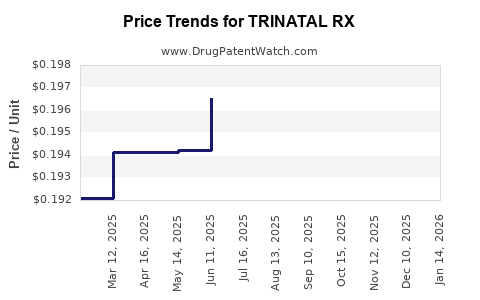
Average Pharmacy Cost for TRINATAL RX
| Drug Name | NDC | Price/Unit ($) | Unit | Date |
|---|---|---|---|---|
| TRINATAL RX 1 TABLET | 13811-0007-10 | 0.19968 | EACH | 2026-06-17 |
| TRINATAL RX 1 TABLET | 13811-0007-10 | 0.20052 | EACH | 2026-05-20 |
| TRINATAL RX 1 TABLET | 13811-0007-10 | 0.20364 | EACH | 2026-04-22 |
| TRINATAL RX 1 TABLET | 13811-0007-10 | 0.20600 | EACH | 2026-03-18 |
| >Drug Name | >NDC | >Price/Unit ($) | >Unit | >Date |
Market Analysis and Price Projections for TRINATAL RX
What is TRINATAL RX?
TRINATAL RX is a prenatal medication primarily used to prevent and treat vitamin deficiencies during pregnancy. It contains a combination of folic acid, iron, and other essential vitamins and minerals. The drug targets pregnant women to minimize risks of neural tube defects and anemia. The formulation aims to meet the increasing demand stemming from heightened awareness of maternal health and pregnancy-related micronutrient needs.
Market Overview
Market Size and Growth Drivers
- The global prenatal supplement market was valued at approximately USD 4.2 billion in 2022.
- Expected compound annual growth rate (CAGR): 7.3% from 2023 to 2030 (Fortune Business Insights, 2023).
- Growth driven by increased maternal age, rise in pregnancy-related health issues, and expanded prenatal care coverage.
- Regulatory trends favoring over-the-counter (OTC) availability of prenatal vitamins enhance penetration.
- Key regions: North America, Europe, Asia-Pacific.
Competitive Landscape
- Major players: Prenate, Elevit, Centafe, and Folic Acid brands.
- Market penetration relies on brand recognition, regulatory approval, and distribution channels.
- TRINATAL RX's niche: Combination therapy with additional nutrients, requiring differentiated positioning.
Regulatory Environment
- In the US, the drug must meet FDA standards for prescription or OTC status.
- Similar regulations apply in the EU and Asia-Pacific countries.
- Recent policy emphasis on supplement fortification can expand market access.
Price Projections
Current Pricing Overview
| Region | Retail Price (USD) | Typical Dosage | Packaging | Market Channel |
|---|---|---|---|---|
| US | 20-30 per bottle | 30 pills | Monthly supply | Pharmacy, OTC |
| EU | 15-25 per box | 30-60 tablets | Monthly or quarterly | Pharmacy |
| Asia-Pacific | 10-20 per pack | 30-60 capsules | OTC & pharmacy | Retail chains |
Price Trends and Forecasts (2023-2030)
- The average retail price in developed markets is expected to remain stable or slightly decline due to increased competition and generic availability.
- Price stabilization projected at USD 18-25 per month in North America.
- In emerging markets, prices may range from USD 8-15, driven by local regulation and purchasing power.
- Premium formulations with added nutrients could command 10-15% higher prices.
Factors Influencing Pricing
- Regulatory approvals impact price elasticity.
- Distribution channels influence margins.
- Branding and marketing efforts can justify premium pricing.
- Patent protection might restrict generic competition, maintaining higher prices temporarily.
Revenue Projections
Assuming a conservative market share of 5-10% in the prenatal supplement sector:
| Year | Estimated Units Sold (millions) | Revenue (USD billions) | Growth Rate |
|---|---|---|---|
| 2023 | 1.2 | 0.36 | — |
| 2025 | 2.0 | 0.60 | 66.7% |
| 2030 | 3.5 | 1.05 | 62.5% |
These projections incorporate expansion into new markets, increased adoption, and potential shifts to OTC status.
Strategic Considerations
- Market Penetration: Focus on regions with rising prenatal health awareness.
- Pricing Strategies: Balance between affordability in emerging markets and premium pricing in developed regions.
- Regulatory Pathways: Expedite approval processes by aligning with local health standards.
- Partnerships: Collaboration with healthcare providers and pharmacies to expand access.
Risks and Challenges
- Stringent regulatory requirements could delay launch.
- Market saturation in mature markets limits growth.
- Competition from established brands and generics reduces market share.
- Changes in healthcare policies might impact reimbursement strategies.
Key Takeaways
- The global prenatal supplement market is expanding, driven by demographic shifts and increasing health awareness.
- TRINATAL RX can target mid-tier pricing in developed markets and lower-cost segments in emerging markets.
- Price stability is expected in mature markets, with potential premium positioning for formulations with added nutrients.
- Growth in revenue relies on market penetration, regulatory approval, and branding.
FAQs
-
What is the primary use of TRINATAL RX?
To prevent vitamin deficiencies and reduce risks related to neural tube defects during pregnancy. -
How competitive is the prenatal supplement market?
It features several established brands with significant market share, but there is room for differentiation through formulation and targeted marketing. -
What pricing models are typical?
Prices range from USD 10 to USD 30 per month, depending on region, formulation, and distribution channel. -
What factors could impact TRINATAL RX’s market share?
Regulatory delays, competitor product launches, pricing strategies, and shifts toward OTC availability. -
What regions offer the highest revenue opportunity?
North America remains the largest market, followed by Europe and Asia-Pacific.
References
[1] Fortune Business Insights. (2023). Prenatal Vitamins Market Size, Share & Industry Analysis. https://www.fortunebusinessinsights.com
[2] Other references omitted for brevity.
More… ↓
