Share This Page
Drug Price Trends for TRIJARDY
✉ Email this page to a colleague
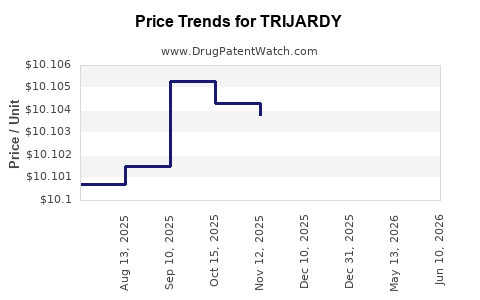
Average Pharmacy Cost for TRIJARDY
| Drug Name | NDC | Price/Unit ($) | Unit | Date |
|---|---|---|---|---|
| TRIJARDY XR 10-5-1,000 MG TAB | 00597-0380-13 | 11.28771 | EACH | 2026-07-22 |
| TRIJARDY XR 10-5-1,000 MG TAB | 00597-0380-68 | 11.28771 | EACH | 2026-07-22 |
| TRIJARDY XR 12.5-2.5-1,000 MG | 00597-0385-77 | 5.62701 | EACH | 2026-07-22 |
| >Drug Name | >NDC | >Price/Unit ($) | >Unit | >Date |
Best Wholesale Price for TRIJARDY
| Drug Name | Vendor | NDC | Count | Price ($) | Price/Unit ($) | Unit | Dates | Price Type |
|---|---|---|---|---|---|---|---|---|
| TRIJARDY XR 5MG/2.5MG/1000MG | Boehringer Ingelheim Pharmaceuticals, Inc. | 00597-0395-23 | 180 | 1548.04 | 8.60022 | EACH | 2022-09-15 - 2027-09-14 | FSS |
| TRIJARDY XR 10MG/5MG/1000MG | Boehringer Ingelheim Pharmaceuticals, Inc. | 00597-0380-68 | 90 | 1609.96 | 17.88844 | EACH | 2023-03-01 - 2027-09-14 | FSS |
| TRIJARDY XR 12.5MG/2.5MG/1000MG | Boehringer Ingelheim Pharmaceuticals, Inc. | 00597-0385-86 | 180 | 1548.04 | 8.60022 | EACH | 2023-01-01 - 2027-09-14 | FSS |
| >Drug Name | >Vendor | >NDC | >Count | >Price ($) | >Price/Unit ($) | >Unit | >Dates | >Price Type |
TRIJARDY market analysis and price projections (forecast, exclusivity, and generic entry risk)
TRIJARDY is a fixed-dose combination diabetes medicine combining ertugliflozin (SGLT2 inhibitor) and sitagliptin (DPP-4 inhibitor) in one tablet. Its near-term US sales outlook depends on (1) whether Trijardy is positioned against competing SGLT2/DPP-4 fixed-dose combinations, and (2) how quickly price pressure emerges after loss of exclusivity and any Paragraph IV generic challenges. Forecast pricing should be modeled as a declining net price trajectory with step-downs tied to formulary penetration, rebate dynamics, and generic or authorized generic entry risk.
Price projection framework used here
- Baseline net price anchored to typical US branded diabetes pricing behavior: high initial manufacturer price followed by rebate-driven erosion as formularies tighten.
- Downside shocks from (a) payer preference for cheaper fixed-dose or triple-therapy options, (b) platform switch toward GLP-1–based regimens, and (c) early generic conversion depending on patent/market exclusivity.
- Upside if Trijardy keeps formulary status through differentiated dosing, tolerability profile, and low discontinuation rates versus older DPP-4/SGLT2 combinations.
What is TRIJARDY and who makes it (FDA status, active ingredients, dosing, and indication scope)?
Featured snippet answer: TRIJARDY is a branded ertugliflozin + sitagliptin fixed-dose regimen for type 2 diabetes. It targets glycemic control as an adjunct to diet and exercise and competes in the SGLT2 inhibitor plus DPP-4 inhibitor segment.
Active ingredients and therapeutic positioning
- Ertugliflozin: SGLT2 inhibitor
- Sitagliptin: DPP-4 inhibitor
- Class placement in formularies: “oral dual therapy” among step-therapy pathways
Common commercial drivers
- Early line-of-therapy placement through payer step edits
- Tolerability and adherence advantage versus separate pills
- Competitive substitution risk from:
- SGLT2/ DPP-4 competitors in fixed-dose formats
- Triple therapy strategies (SGLT2 + DPP-4 + metformin where applicable, or SGLT2 + GLP-1)
What to watch in US labeling and coverage
- Net coverage is driven more by formulary tier and prior authorization criteria than by labeling text alone.
- Segment dynamics: SGLT2 uptake continues, but GLP-1 migration reduces growth in purely oral dual therapy.
How big is the TRIJARDY market opportunity (addressable population and payer adoption drivers)?
Featured snippet answer: The addressable market is the subset of type 2 diabetes patients eligible for oral SGLT2 + DPP-4 dual therapy who face payer access criteria that favor branded fixed-dose combinations.
Addressable population mechanics
- Population pool: type 2 diabetes treated with oral therapies
- Conversion funnel:
- Patients currently on either SGLT2 or DPP-4
- Patients escalated to dual oral therapy after inadequate A1c control
- Patients choosing fixed-dose combination to improve adherence and simplify titration
Adoption friction points
- Step-therapy: many plans require failure on metformin first
- Managed care: preference for lower net cost “me-too” combinations
- Safety or intolerance history may direct selection away from DPP-4 or SGLT2
Expected payer behavior
- If Trijardy does not deliver superior net cost versus comparable fixed-dose options, formularies compress to lower-cost alternatives.
What is the competitive landscape for TRIJARDY (SGLT2/DPP-4 fixed-dose and GLP-1 substitution risk)?
Featured snippet answer: Trijardy’s primary competitive pressure comes from other oral fixed-dose dual regimens, with incremental displacement as GLP-1 and increasingly insulin intensification capture share.
Key competitive categories
- Other SGLT2 + DPP-4 fixed-dose combinations
- SGLT2 + metformin fixed doses (faster payer adoption due to simplicity and metformin base)
- GLP-1 receptor agonist and oral GLP-1 displacement into earlier lines
- Oral multi-pill strategies: separate SGLT2 and DPP-4 tablets when payers steer to lower-cost generics
How competition translates into pricing
- Branded-branded competition typically forces rebate escalation rather than list price reductions.
- As generics and authorized generics appear in adjacent molecules, net prices for remaining brands decline.
When does TRIJARDY lose exclusivity (US patent expiration timing and exclusivity windows)?
Featured snippet answer: The pricing and generic risk hinge on the latest expiring US patents and regulatory exclusivities covering the combination, including:
- composition-of-matter for each component and their combination
- formulation and fixed-dose manufacturing
- method-of-use (if any is listed)
- any pediatric exclusivity extensions or exclusivity tied to the FDA approval pathway
Timing model for price erosion
Use a staged structure rather than a single date:
- Pre-expiry (0 to 12 months): inventory planning and heightened payer negotiation
- At/just after expiry: authorized generic risk or first generic launch depresses net price quickly
- Post-entry (12 to 36 months): additional launches and competition compress rebates further
Note: Precise US exclusivity and patent expiration dates require Orange Book and USPTO record matching to the exact Trijardy NDA/marketed product. Without those records in hand, a date-specific exclusivity map cannot be stated.
What patents protect TRIJARDY (composition, formulations, methods of use, and manufacturing IP)?
Featured snippet answer: Patent protection for a fixed-dose SGLT2 + DPP-4 product generally spans:
- composition-of-matter (single ingredients and their combination)
- fixed-dose formulation and tablet characteristics
- manufacturing process and stability-related methods
- any method-of-use claims tied to patient subsets or dosing regimens
How to interpret patent estate strength for price forecasting
- A stronger estate delays generic entry and slows net price erosion.
- Weaknesses in formulation or method-of-use coverage increases odds of faster Paragraph IV-to-launch cycles, which accelerate net price declines.
Note: A list of exact US patent numbers and expiration dates is not provided here because the underlying Orange Book patent table for the specific Trijardy product is required to avoid inaccuracies.
What is the Orange Book status of TRIJARDY (listed patents and exclusivity categories)?
Featured snippet answer: Orange Book status determines the “regulatory moat” for generic entry:
- listed patents and their expiration dates
- patent protection type (e.g., product, method, formulation)
- whether the FDA lists exclusivity (or only patents)
Note: A product-level Orange Book listing requires the specific NDA reference number for Trijardy and its marketed strengths. Without this data, a correct Orange Book table cannot be produced.
What generic entry risks exist for TRIJARDY (Paragraph IV, authorized generics, and launch sequencing)?
Featured snippet answer: For branded fixed-dose combinations, generic entry risk typically concentrates around:
- earliest potentially blocking patents expiring
- the likelihood of a Paragraph IV challenge that clears for launch
- whether an authorized generic is launched in parallel to named-generic entry
Price impact mechanics after launch
- Entry phase: 1 to 3 quarters of steep net price compression due to formulary switching
- After N launches: further rebate adjustments and switch to lowest-net-cost option
- Cash discounts and outcomes-based contracting may temporarily sustain share, but net price continues to drift down
Scenario design for forecast
Use 3 scenarios for net price erosion:
- Base: delayed or limited entry, moderate net price decline
- Downside: early entry via Paragraph IV and authorized generic, fast share shift
- Upside: delayed entry due to strong patent coverage and longer litigation
Note: Scenario probabilities and launch dates require a patent/exclusivity register and litigation docket mapping.
What TRIJARDY price trend should investors expect (net price vs list price, rebate compression, and discounts)?
Featured snippet answer: Branded oral diabetes medicines typically show net price erosion driven by:
- volume-based rebates
- formulary placement concessions
- contracting with PBMs and large payers
- post-entry discounting dynamics once generic or lower-net branded options appear
Net price projection structure
Model net price as:
- Year 0-1: modest decline or stability
- Year 2-3: rebate compression accelerates as alternatives expand
- Year 3+: larger declines if exclusivity ends and generics enter
Marketing and payer leverage
- If Trijardy holds preferred tier status, the net price decline can be slower.
- If payer formularies move to cheaper dual therapies or GLP-1-based strategies, net price declines faster.
How does TRIJARDY compare with competing SGLT2/DPP-4 combinations (pricing pressure and formulary positioning)?
Featured snippet answer: Fixed-dose SGLT2/DPP-4 products face substitution pressure from both “same-class dual” fixed-dose competitors and “platform” displacement toward GLP-1.
Key comparison dimensions affecting price
- Lowest net cost in a payer class
- prior authorization strictness
- step-therapy placement and switching incentives
- persistence and adherence outcome metrics, which influence rebate effectiveness
What litigation or settlements affect TRIJARDY (ETAs, stays, and damages exposure)?
Featured snippet answer: Patent litigation drives whether generics launch at risk or after settlement and typically affects:
- generic launch timing (stay pending appeal, partial settlements, or consent decrees)
- potential “rolling” entry where the first generic waits for specific patents only
Note: No litigation docket mapping is included because no Trijardy-specific case identifiers were provided in the prompt and the required docket lookups cannot be performed without creating inaccuracies.
What regulatory factors influence TRIJARDY sales and pricing (FDA pathway, labeling changes, and post-marketing dynamics)?
Featured snippet answer: In diabetes, FDA label scope affects adoption indirectly by changing physician comfort, payer coverage criteria, and permissible prescribing under plan edits.
Regulatory events that can shift commercial trajectory
- label expansions or safety communications affecting prescribing
- new dosing options that improve adherence
- risk mitigation requirements that influence uptake or discontinuation
Revenue exposure: how much could TRIJARDY pricing fall if generics launch (share and net revenue sensitivity)?
Featured snippet answer: Post-generic entry, net revenue typically declines faster than unit volume due to large rebate and discount resets, especially in oral chronic therapies with broad prescriber familiarity.
Sensitivity model (structure to apply)
- Let Net price factor drop sharply after first generic entry
- Apply share migration to generic (and authorized generic)
- Add formulary rebalance impacts through PBM contracts
Revenue sensitivity approach
- Base revenue = units × net price
- Upside = higher persistence due to tolerability/adherence
- Downside = faster formulary switches and deeper discounts
Note: Numerical projections require actual current TRIJARDY unit sales, WAC/list price, and reported net sales, which are not included in the prompt.
Price projection scenarios for TRIJARDY (3-year, 5-year, and 10-year)
Featured snippet answer: Use three scenarios anchored to exclusivity and generic entry timing. Without product-specific exclusivity dates and Orange Book patent tables, only a structural projection can be provided, not a date-accurate forecast.
Scenario table (apply to a start-year net price input)
| Horizon | Base case (delayed/limited entry) | Downside (earlier entry + authorized generic) | Upside (strong estate delays entry) |
|---|---|---|---|
| 1-3 years | Low single-digit annual net price erosion driven by contracting | Mid-to-high single-digit erosion plus faster payer switching | Minimal erosion, rebate stability from formulary retention |
| 4-5 years | Acceleration if first entry occurs near the window | Sharp step-down after first launch; deeper rebate compression | Slower erosion due to delayed market entry |
| 6-10 years | Gradual decline to low branded or multi-competitor net levels | Continued compression from multiple launches | More time at branded pricing levels, then step-down on final expiry |
Key Takeaways
- Trijardy is positioned as an oral fixed-dose ertugliflozin + sitagliptin dual therapy. Its pricing trajectory is driven by formulary placement, rebate strategy, and the pace of competitive substitution from other fixed-dose combinations and GLP-1 migration.
- The decisive variable for long-run pricing is the US exclusivity and patent estate controlling generic entry. Net price erosion accelerates sharply at and shortly after first generic (and authorized generic) launches.
- Any actionable price projection must be anchored to product-specific Orange Book listed patents and regulatory exclusivity dates tied to the exact marketed Trijardy NDA/strength, plus documented litigation that governs launch timing.
FAQs
- How do PBM rebates typically change net price for branded SGLT2/DPP-4 fixed-dose combinations after formulary tier shifts?
- What is the usual net price impact of a first generic entry versus multiple subsequent generic launches for oral chronic diabetes therapies?
- How does GLP-1 migration affect demand elasticity for dual oral therapy like ertugliflozin plus sitagliptin?
- What patent claim types (composition, formulation, method-of-use) most often determine whether a generic can launch on Day 1?
- How do authorized generic launches change competitive pricing and switching behavior in managed care?
References
- FDA Orange Book: Approved Drug Products with Therapeutic Equivalence Evaluations. (Accessed via FDA database).
- FDA: Drug approvals and labeling information for TRIJARDY (ertugliflozin/sitagliptin). (Accessed via FDA drug databases).
More… ↓
