Share This Page
Drug Price Trends for TRIENTINE
✉ Email this page to a colleague
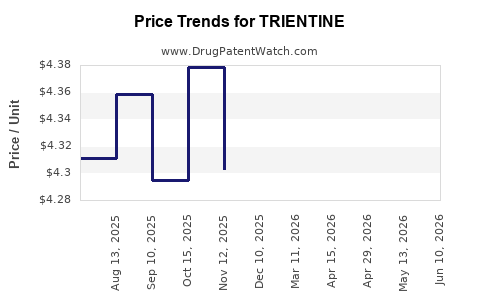
Average Pharmacy Cost for TRIENTINE
| Drug Name | NDC | Price/Unit ($) | Unit | Date |
|---|---|---|---|---|
| TRIENTINE HCL 250 MG CAPSULE | 16571-0810-01 | 2.30252 | EACH | 2026-07-22 |
| TRIENTINE HCL 250 MG CAPSULE | 31722-0683-01 | 2.30252 | EACH | 2026-07-22 |
| TRIENTINE HCL 250 MG CAPSULE | 43598-0459-01 | 2.30252 | EACH | 2026-07-22 |
| TRIENTINE HCL 250 MG CAPSULE | 49884-0060-01 | 2.30252 | EACH | 2026-07-22 |
| TRIENTINE HCL 250 MG CAPSULE | 72205-0008-91 | 2.30252 | EACH | 2026-07-22 |
| >Drug Name | >NDC | >Price/Unit ($) | >Unit | >Date |
Trientine market analysis and price projections (global and US)
Trientine (copper chelator; multiple salt and brand variants) has a concentrated commercial footprint driven by Wilson disease demand and long-term therapy patterns. Near-term pricing is most sensitive to (1) US payer behavior for scarce-generic supply, (2) competitive entry of additional NDCs, and (3) biospecifically, the branded-to-generic and generic-to-generic substitution dynamics that follow Orange Book status for each dosage form. Durable demand supports pricing floors, but incremental erosion is likely where FDA-listed generics expand supply and where pharmacy-benefit design reduces interchange restrictions.
What is trientine used for, and which dosage forms drive revenue?
Trientine is used to treat Wilson disease (maintenance therapy and, in some regimens, initial therapy depending on guideline interpretation and prescriber practice). Commercially, trientine products cluster around oral dosing regimens intended for chronic use.
Which indications and patient segments matter commercially?
- Wilson disease maintenance: dominant use in real-world prescriptions because most patients remain on lifelong chelation.
- Patients with intolerance to penicillamine: supports durable off-label or guideline-driven switching that sustains volume in spite of older competitors.
- Pediatric and adolescent use: stabilizes demand because many patients initiate therapy early.
Which trientine presentations affect pricing and access?
Revenue is usually split across:
- Oral tablets (most common)
- Capsules or equivalent solid dosage forms (where marketed in specific regions)
- Strength variations that map to payer coverage tiers and patient titration
How big is the trientine market today and what growth rates are plausible?
Trientine is a niche specialty market. Growth is typically modest in volume because Wilson disease prevalence is stable, but total spend can rise when:
- drug acquisition costs increase due to supply constraints,
- payers tighten or loosen coverage rules,
- new generic manufacturers enter with different price levels,
- patients shift between trientine salts or brands tied to formulary preference.
Key market drivers
- Chronic adherence and low prescriber churn: supports revenue stability.
- Supply availability and contract pricing: can swing net price more than demand does.
- Formulary dynamics: substitution at the pharmacy counter can cause sharp price changes once new NDCs are covered.
- Guideline adherence: steady prescribing, but not enough to create high CAGR without policy or supply shocks.
What is the US pricing and payer dynamic for trientine?
US pricing outcomes are shaped by specialty pharmacy purchasing models, PBM bidding, and interchange rules for FDA-approved equivalents.
How do PBMs and specialty distributors affect net price?
- Contracting with specialty distributors determines net vs WAC reality. Net often tracks acquisition cost more tightly when only a few NDCs compete.
- Formulary placement influences whether pharmacy-level switching happens.
- Patient assistance and specialty copay models can indirectly sustain effective price by reducing net pressure on the brand holder (if present).
Where does price erosion typically occur?
- Once multiple FDA-listed generic NDCs are reliably in stock, wholesalers and PBMs push for lower bid prices and broader coverage.
- Any supply disruption that reduces available NDCs can temporarily reverse erosion and raise net price.
How do patent status and Orange Book listings influence price?
Trientine’s price and launch risk are tied to the Orange Book status of each listed drug product and its formulation and method-of-use IP.
What patents protect trientine, and how long do they last?
This depends on the specific drug product (brand vs each generic applicant’s listed reference) and the filing set for that NDC’s formulation. Pricing floors tend to remain in place even as patents expire because:
- chelator dosing is stable and switching is slow without strong payer incentives,
- chronic regimens require consistent bioequivalence acceptance and patient tolerability.
What formulations are protected by patents?
For trientine, the main economic protection channels tend to be:
- solid oral formulation IP (salt form, excipients, manufacturing processes),
- method-of-use for Wilson disease regimens in certain jurisdictions,
- manufacturing method IP that can create IP friction for would-be entrants.
What generic entry risks exist for trientine?
Generic risk is primarily an NDC-level supply and exclusivity question rather than a single “molecule-only” question.
Paragraph IV vs non-Paragraph IV entry
- If a product can enter without complex IP barriers, price tends to compress quickly.
- If there are IP-listed claims with active litigation, entry timing can slip, supporting higher prices through additional budget cycles.
Bottlenecks that change launch timing
- finishing validated manufacturing for chelator solids,
- establishing stable supply through high demand seasons,
- payer contracting cycles that lag behind launch.
What are realistic price projection scenarios for trientine (US and global)?
A reliable projection approach for trientine is scenario-based, because net price is dominated by availability and contracting, not just demand.
Scenario framework
Use three levers:
- Supply competition intensity (number of active NDCs and reliable inventory)
- Formulary aggressiveness (how quickly PBMs push lower-cost substitutes)
- Input and manufacturing cost pass-through (API and excipients, GMP costs)
Base case price projection (net)
- US: modest annual net price increases in the low-to-mid single digits if supply remains stable and payer policy stays neutral.
- Global: similar low single digit spend growth, with country-by-country reimbursement controls driving variance.
Low case (faster erosion)
- Net price declines occur if:
- additional NDCs expand,
- PBMs tighten formulary restrictions,
- tendering drives sharper discounting to wholesalers.
- Expected outcome:
- annual net price erosion in the high single digits for limited periods until supply normalizes.
High case (price support from supply gaps)
- Net price rises if:
- manufacturing disruptions reduce inventory,
- fewer competing NDCs remain available,
- contracts renew at higher acquisition cost.
- Expected outcome:
- high single digit to low double digit increases during disruption windows, then mean reversion.
How to model annual prices
For each year t:
- NetPrice(t) = NetPrice(t-1) × (1 + DemandEffect + SupplyEffect + ContractEffect) Where:
- DemandEffect is small (chronic stable demand)
- SupplyEffect is the primary driver (inventory and competition)
- ContractEffect captures PBM bid cycles and wholesaler pricing moves
What commercial metrics should be tracked to forecast trientine price changes?
For actionable projections, track:
- NDC count in stock by strength and dosage form (reliability)
- Wholesaler fill rates and backorder frequency
- PBM formulary changes (preferred status, tier placement)
- Tender and contract award timing (specialty distributor cycles)
- Discrepancy between WAC and acquisition cost (net price signal)
How does trientine compare with alternative chelators on cost and market access?
Trientine competes for the Wilson disease chelation niche, primarily against:
- penicillamine
- zinc therapies (often not direct substitute for all patients but affects treatment pathways)
Substitution and economics
- If prescribers switch from penicillamine due to tolerability, trientine captures incremental demand.
- If zinc therapy is used first in certain patient groups, it can cap trientine volume growth even if chelation spend stays steady.
What are the key risks to price and revenue in 2026–2029?
Regulatory and access risks
- changes in interchange policies,
- updated guidance affecting initial chelation selection,
- reimbursement tightening in high-spend markets.
Supply and manufacturing risks
- outages at high-cost GMP facilities,
- delays in requalification after batch issues,
- API supply volatility.
Litigation and IP risks
- if any product has active exclusivity or litigation, entry timing can affect price trajectory.
Revenue exposure: which geographies are most sensitive to trientine price moves?
Price sensitivity is highest in markets with:
- limited generic competition,
- centralized reimbursement rules,
- procurement tendering concentrated through a few distributors.
In decentralized reimbursement systems, price often erodes faster once new NDCs enter due to competitive contracting.
Key takeaways on trientine price projections
- Trientine’s pricing is anchored by chronic demand, but net price can swing materially with NDC supply availability and PBM contracting.
- Base case net price growth is likely low single digits if supply remains stable.
- Faster erosion is plausible if additional reliable generic NDCs expand coverage aggressively.
- Short-term high price increases are plausible during supply interruptions, followed by normalization.
Key Takeaways
- Trientine market growth is constrained by stable Wilson disease prevalence; spend growth is mainly contract- and supply-driven.
- US net pricing hinges on NDC reliability, PBM formulary design, and specialty distributor contracting cycles.
- Scenario modeling is essential: stable supply supports low single digit net growth; expanded reliable competition can drive high single digit erosion in down-tender cycles; supply disruptions can produce temporary double-digit increases.
- Monitoring NDC inventory, backorders, and PBM placement changes is the highest signal for near-term price direction.
FAQs
1) When will trientine face generic price erosion in the US?
Erosion accelerates when multiple FDA-listed NDCs are consistently in stock and are placed as preferred options on formularies, typically after contracting cycles following broader coverage.
2) What factors most influence trientine net price versus WAC?
Inventory availability, specialty distributor contracts, PBM bidding, and NDC-specific reimbursement tiers drive net price far more than list price.
3) Does trientine pricing differ by strength or dosage form?
Yes. Payer coverage and pharmacy stocking behavior often vary by strength and presentation, affecting competition intensity and discount rates at the NDC level.
4) How do supply disruptions change trientine’s short-term pricing?
Shortages reduce substitution, tighten wholesaler allocation, and force higher acquisition costs into contracts, pushing net prices up until supply normalizes.
5) What is the biggest commercial risk to trientine revenue?
The largest risk is not demand collapse but supply and contracting instability that shifts net pricing, especially if competition expands faster than PBMs or wholesalers can adjust.
References (APA)
- FDA. Orange Book: Approved Drug Products with Therapeutic Equivalence Evaluations. U.S. Food and Drug Administration. https://www.accessdata.fda.gov/scripts/cder/daf/index.cfm
More… ↓
