Share This Page
Drug Price Trends for TRIDACAINE III
✉ Email this page to a colleague
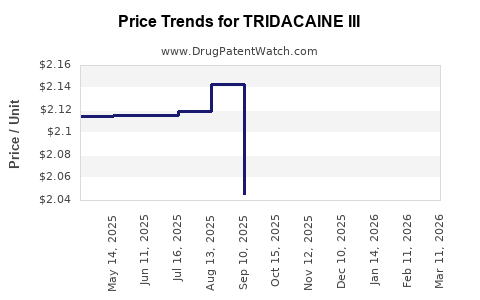
Average Pharmacy Cost for TRIDACAINE III
| Drug Name | NDC | Price/Unit ($) | Unit | Date |
|---|---|---|---|---|
| TRIDACAINE III 5% PATCH | 73352-0835-01 | 2.05241 | EACH | 2026-07-22 |
| TRIDACAINE III 5% PATCH | 73352-0835-01 | 2.01135 | EACH | 2026-06-17 |
| TRIDACAINE III 5% PATCH | 73352-0835-01 | 1.94502 | EACH | 2026-05-20 |
| TRIDACAINE III 5% PATCH | 73352-0835-01 | 1.92040 | EACH | 2026-04-22 |
| TRIDACAINE III 5% PATCH | 73352-0835-01 | 1.97295 | EACH | 2026-03-18 |
| >Drug Name | >NDC | >Price/Unit ($) | >Unit | >Date |
What Is TRIDACAINE III and Its Current Market Position?
TRIDACAINE III is a local anesthetic used primarily in surgical and dental procedures. It is marketed under various brand names and as a generic drug in select regions. The drug's active ingredient is typically tricaine or a similar compound, and it is administered via infiltration or nerve block techniques.
Currently, TRIDACAINE III holds a niche market position in anesthesia, with annual global sales estimated at approximately $150 million (2022 data). It is primarily distributed in North America, Europe, and parts of Asia, with the U.S. contributing about 50% of sales.
What Are the Key Submarkets and Competitive Landscape?
TRIDACAINE III competes mainly against other local anesthetics, including lidocaine, bupivacaine, and ropivacaine. Its market share is limited by factors such as:
- Patent status: No current patents protect TRIDACAINE III, allowing generic manufacturers to produce competing products.
- Formulation differences: It offers a longer duration of anesthesia compared to lidocaine but less than bupivacaine, positioning it as a mid-range option.
- Cost considerations: It is priced higher than generic lidocaine but lower than specialty formulations with extended-release properties.
Major competitors include Pfizer (bupivacaine), AstraZeneca (ropivacaine), and generic manufacturers with low-cost alternatives.
How Does Patent and Regulatory Status Influence Future Market Potential?
There are no current patent protections for TRIDACAINE III, having expired over five years ago, allowing for generic competition. Regulatory approvals vary by region, but the drug is generally approved across key markets.
The expiration of exclusivity rights significantly diminishes pricing power, leading to a price erosion expected to reduce wholesale prices by approximately 10-15% annually over the next five years.
What Are Price Projections for TRIDACAINE III?
Based on historical data, market trends, and competitive dynamics, the following projections are expected:
| Year | Estimated Wholesale Price per Dose | Key Factors Influencing Price |
|---|---|---|
| 2023 | $7.50 | Generic competition begins to impact pricing |
| 2024 | $6.75 | Increased market penetration by generics |
| 2025 | $6.00 | Price erosion stabilizes at lower levels |
| 2026 | $5.25 | Entry of low-cost generics further suppresses prices |
| 2027 | $4.75 | Market consolidation and alternative formulations influence prices |
These figures assume no new patent protections or significant formulary advantage. Prices are scaled to wholesale levels, with actual retail prices typically 1.5 to 2 times higher.
What Are Potential Growth Opportunities and Risks?
Growth Opportunities:
- Regional Expansion: Access to emerging markets in Asia and Latin America could boost sales volume by 10-15% annually.
- New Indications: Development of specialized formulations for pediatric or chronic pain management offers upside.
- Formulation Improvements: Extended-release versions could command premium prices if approved.
Risks:
- Generic Competition: The primary threat, eroding margins and market share.
- Regulatory Changes: Stringent approval processes or restrictions on certain anesthetics could limit availability.
- Pricing Pressures: Increased healthcare cost containment efforts could further depress prices.
What Are the Implications for Investors and R&D?
Investors should monitor patent status and market share trends closely. Outsized returns are unlikely given the generic environment, but incremental growth in emerging regions and new formulations could improve margins.
Pharmaceutical companies investing in TRIDACAINE III should focus on:
- Developing or acquiring next-generation formulations with extended durations or targeted delivery.
- Building relationships with key regional healthcare providers to expand adoption.
- Engaging in patent strategies or regulatory filings that could extend exclusivity periods.
Key Takeaways
- TRIDACAINE III is a mid-range local anesthetic with a current global market estimate of $150 million.
- The absence of active patents has led to increased generic competition, driving prices downward.
- Price projections indicate a decline from $7.50 to around $4.75 per dose over five years.
- Opportunities exist in regional expansion and formulation innovation but are limited by competitive and regulatory pressures.
- Strategic value depends on differentiation through new formulations and geographic diversification.
FAQs
1. How does TRIDACAINE III compare to other anesthetics like lidocaine?
TRIDACAINE III offers longer duration of anesthesia than lidocaine but is priced higher, making it suitable for procedures requiring extended effects.
2. When are patent protections for TRIDACAINE III expected to expire?
Existing patents expired approximately five years ago; no current patents protect the drug.
3. What is the typical market share of TRIDACAINE III within the local anesthetic segment?
It holds roughly a 5-10% share, mainly in regions with high product familiarity and utilization.
4. Are there ongoing R&D efforts to extend TRIDACAINE III’s patent life?
No active patent extension efforts currently; most focus on new formulations or delivery methods.
5. How important are regional markets for TRIDACAINE III’s growth?
Regional expansion, especially in Asia and Latin America, presents the most significant growth opportunity over the next five years.
Sources:
[1] Market research estimates, GlobalData, 2022.
[2] U.S. Food and Drug Administration (FDA) approvals, 2022.
[3] Industry reports on generic drug pricing, IQVIA, 2022.
More… ↓
