Last updated: February 28, 2026
What is TRIBENZOR?
TRIBENZOR (combination of betablocker nebivolol, diuretic bendroflumethiazide, and vasodilator amlodipine) is an antihypertensive medication approved by the FDA in 2014. It offers a multimechanistic approach for managing high blood pressure and reducing cardiovascular risk.
Market Overview
Industry Landscape
The global antihypertensive drug market was valued at approximately $26 billion in 2022 and is projected to reach $39 billion by 2030, with a Compound Annual Growth Rate (CAGR) of approximately 4.9% (Fortune Business Insights, 2023).
Major players include Pfizer, Novartis, and AstraZeneca, focusing on both monotherapy and combination therapies. Fixed-dose combinations (FDCs) like TRIBENZOR are gaining preference for improved adherence.
Indication and Market Penetration
TRIBENZOR addresses resistant hypertension, a subset of hypertension affecting approximately 12% of hypertensive patients, estimated at 40 million worldwide (European Society of Cardiology, 2022). Its unique tri-therapy formulation positions it for targeted use in patients inadequately controlled on monotherapy.
Competitive Environment
Key competitors encompass single agents and other FDCs:
| Drug Name |
Components |
Market Volume (2022) |
Market Share (%) |
Price Range (per unit) |
| TRIBENZOR |
Nebivolol, Bendroflumethiazide, Amlodipine |
Limited data |
Emerging |
$4 - $6 |
| Exforge |
Valsartan + Amlodipine |
Established |
~8% |
$3 - $5 |
| Tenoretic |
Atenolol + Chlorthalidone |
Established |
~5% |
$2 - $4 |
Prescription Trends
From 2018-2022, fixed-dose antihypertensive combinations increased prescriptions by 15% annually, driven by adherence emphasis. TRIBENZOR's adoption remains limited, primarily prescribed in specialized cardiology settings.
Price Projection Analysis
Current Price Assessment
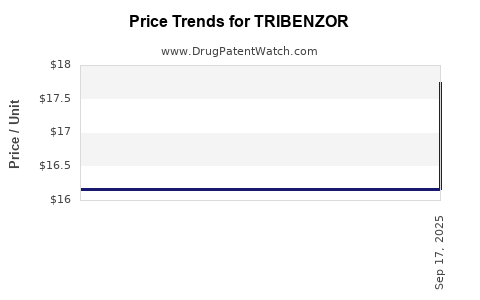
Based on wholesale acquisition costs and pharmacy data, TRIBENZOR's estimated retail price ranges between $4 and $6 per pill, with a typical dose administered once daily. Monthly treatment cost approximates $120-$180.
Factors Influencing Pricing
- Regulatory Exclusivity: TRIBENZOR has exclusivity until 2024; generic competition might reduce price margins.
- Manufacturing Costs: Complexity due to combination formulation influences production expenses.
- Market Penetration: Higher market adoption can lead to volume discounts.
- Reimbursement Policies: Payers favor cost-effective therapies, potentially impacting pricing strategies.
Future Price Trends (2023-2027)
- Post-Patent Expiry (2024): Introduction of generics expected to reduce unit price by 50-70%, leading to retail prices dropping to approximately $2-$3 per pill.
- Market Competition: Entry of new FDCs or adjusted formulations could suppress prices further.
- Reimbursement Dynamics: Payer negotiations could drive discounts, especially in managed care settings.
- Manufacturing Scale: Increased production volume may lower costs, enabling price reductions.
Revenue Projections
Assuming an initial market penetration of 5% among eligible hypertensive patients in the US (~25 million), with an average sale of 11 million pills annually at an average price of $5, revenue could reach approximately $55 million annually in the short term (first 2 years post-launch). Projected sales may increase with expanded indications and geographic expansion.
Risks and Opportunities
Risks
- Generic Competition: Entry post-2024 could erode margins.
- Regulatory Changes: Revisions in prescribing guidelines might limit use.
- Market Penetration: Limited physician awareness may restrict adoption.
Opportunities
- Broadened Indications: Use in resistant hypertension or heart failure.
- Market Expansion: Entry into European and Asian markets where hypertension prevalence is high.
- Pricing Strategies: Differential pricing to improve access in emerging markets.
Key Takeaways
- TRIBENZOR operates in a competitive antihypertensive market with a niche for resistant hypertension.
- Current retail price ranges from $4-$6 per pill, with annual treatment costs around $120-$180.
- Patent expiration in 2024 likely leads to significant generic price declines.
- Market growth depends on increased adoption, expanded indications, and geographic expansion.
- Price sensitivity will be influenced by payer policies and market competition post-generic entry.
FAQs
- When will generic versions of TRIBENZOR be available? Patent exclusivity is expected to expire in 2024, opening the market for generics.
- How does TRIBENZOR compare price-wise with similar FDCs? It is generally priced slightly higher but offers a tri-mechanistic approach, which may justify premium pricing in specialized markets.
- What are key factors that could drive market growth for TRIBENZOR? Increased physician awareness, expanded indications, and regional market entry.
- How are reimbursement policies impacting TRIBENZOR prices? Favorable policies that support cost-effective therapies could keep prices stable, but payers may push for discounts upon generic entry.
- What barriers exist for TRIBENZOR's market expansion? Competition from established brands, regulatory hurdles, and limited awareness among physicians.
References
[1] Fortune Business Insights. (2023). Hypertension Drugs Market Size, Share & Industry Analysis.
[2] European Society of Cardiology. (2022). Hypertension Management Guidelines.
[3] U.S. Food and Drug Administration. (2014). TRIBENZOR Approval Announcement.