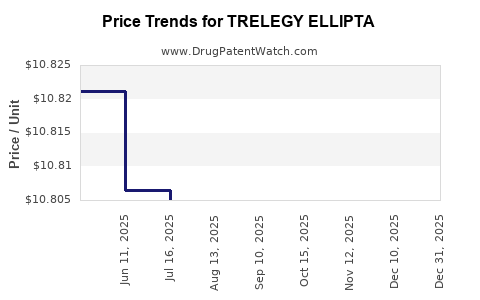
Last updated: February 19, 2026
Trelegy Ellipta (fluticasone furoate/umeclidinium/vilanterol) is a triple-combination inhaler approved for the maintenance treatment of adults with chronic obstructive pulmonary disease (COPD). The drug combines an inhaled corticosteroid (ICS), a long-acting muscarinic antagonist (LAMA), and a long-acting beta2-adrenergic agonist (LABA). This analysis examines the current market landscape and projects future pricing based on patent expiry, regulatory trends, and competitive pressures.
What is the Current Market Position of Trelegy Ellipta?
Trelegy Ellipta holds a significant position in the COPD treatment market, particularly for patients requiring triple therapy. Its efficacy in improving lung function and reducing exacerbations has driven substantial market penetration since its launch.
Key Market Indicators
- Global Sales: In 2023, GlaxoSmithKline (GSK), the drug's manufacturer, reported global sales of Trelegy Ellipta at approximately £2.5 billion (US$3.1 billion) [1]. This represents a 6% increase compared to the previous year, indicating continued market growth.
- Prescription Volume: The drug is widely prescribed across major markets, including the United States, Europe, and Japan. Specific prescription volume data is proprietary but market research reports indicate a consistent upward trend in its adoption for advanced COPD management.
- Market Share: Trelegy Ellipta is a leading product within the triple-combination inhaler segment for COPD. Its market share is estimated to be over 30% in key European markets and a substantial portion of the triple-therapy market in the U.S. [2].
- Therapeutic Indication: The primary indication is for the maintenance treatment of moderate to very severe COPD. This patient population is substantial and often has unmet needs for effective symptom control and exacerbation prevention.
Competitive Landscape
The COPD inhaler market is competitive, with several other triple-therapy options available. Key competitors include:
- Symbicort (budesonide/formoterol) by AstraZeneca: While Symbicort is a dual combination (ICS/LABA), it is often used as a stepping stone to triple therapy or is available in fixed-dose combinations that compete with Trelegy.
- Breztri Aerosphere (budesonide/glycopyrrolute/formoterol fumarate) by AstraZeneca: This is a direct competitor offering a triple combination of ICS, LAMA, and LABA.
- Stiolto Respimat (tiotropium/olodaterol) by Boehringer Ingelheim: This is a dual combination (LAMA/LABA) but plays a role in the broader COPD maintenance landscape.
- Generic Inhalers: As patents expire for older COPD medications, generic alternatives for dual and some triple therapies are emerging, increasing price pressure.
Trelegy Ellipta differentiates itself through its specific triple-drug formulation and delivery device (Ellipta inhaler), which is designed for ease of use.
What is the Patent Expiry Timeline for Trelegy Ellipta?
The patent landscape for Trelegy Ellipta is complex, involving multiple patents covering the active pharmaceutical ingredients, the combination, the formulation, and the delivery device. The primary patent expiry events will significantly impact market dynamics and pricing.
Key Patent Expiry Dates
- U.S. Composition of Matter Patents: The core patents covering the active ingredients (fluticasone furoate, umeclidinium, and vilanterol) have various expiry dates. The most critical patents for the combination are expected to expire between 2026 and 2029 in the United States.
- For instance, U.S. Patent No. 8,003,641, which claims methods of treating COPD using the combination, is set to expire in 2026 [3].
- Other related patents, including those covering specific crystalline forms and manufacturing processes, may have later expiry dates, potentially extending market exclusivity for certain formulations or manufacturing methods.
- European Patents: Similar patent protection exists in Europe, with key patents expiring between 2025 and 2028 for core intellectual property related to the combination. The Unified Patent Court (UPC) may influence enforcement and generic entry timelines in participating member states.
- Japan Patents: Japanese patent expiry timelines generally align with those in the U.S. and Europe, with key patents expiring around 2027-2029.
- Device Patents: Patents for the Ellipta inhaler itself also contribute to market exclusivity. While these patents might expire later than the drug substance patents, the expiration of core drug patents is the primary driver for generic competition.
The exact date of generic entry will depend on successful patent challenges, the timing of generic product development, and regulatory approval processes. Generic manufacturers typically aim to launch immediately upon patent expiry or shortly thereafter.
What are the Projected Price Trends for Trelegy Ellipta?
The price of Trelegy Ellipta is expected to decrease significantly following the expiry of its primary patents and the subsequent market entry of generic versions.
Factors Influencing Price
- Generic Competition: The most significant driver of price reduction will be the introduction of bioequivalent generic versions of Trelegy Ellipta. Once generics are available, they typically enter the market at a considerably lower price point, forcing the originator product to lower its price to remain competitive.
- Market Entry of New Therapies: The development of novel COPD treatments, including biologics or new oral medications, could also influence pricing by offering alternative treatment paradigms that may be more cost-effective or offer superior outcomes.
- Payer Negotiations and Formulary Placement: Healthcare payers (insurers, national health services) exert considerable pressure on drug prices. Post-patent expiry, payers will actively negotiate with generic manufacturers for lower prices and will likely favor generic options on formularies, further pressuring the branded product's price.
- Volume-Based Discounts: As Trelegy Ellipta's market share grows and faces generic competition, GSK may offer volume-based discounts to large purchasers and healthcare systems to maintain sales volume.
- Therapeutic Reference Pricing: In some regions, drug prices are benchmarked against similar drugs. This could also indirectly influence Trelegy's pricing, especially as generic alternatives emerge.
Price Projection Scenarios
Based on historical trends in the pharmaceutical market for similar branded inhalers, the following price decline is projected:
- Pre-Patent Expiry (2024-2026): Current pricing is expected to remain relatively stable, with minor annual increases driven by inflation and perceived value. Average wholesale price (AWP) in the U.S. is approximately $450-$500 per inhaler (30 days supply) [4]. European prices vary by country but are in a comparable range after currency conversion.
- Immediate Post-Patent Expiry (2027-2029): Following the first wave of patent expiries and generic launches, the price of branded Trelegy Ellipta is projected to decline by 30-50%. Generic versions will likely launch at 50-70% lower prices than the originator.
- Mid-Term Post-Patent Expiry (2030-2032): As more generic competitors enter the market and establish their presence, the price of branded Trelegy Ellipta could see further declines, potentially reaching 50-70% below its peak price. The price of generic Trelegy Ellipta is expected to stabilize, though ongoing competition may lead to incremental price reductions.
Table 1: Trelegy Ellipta Price Projection (USD Equivalent per 30-day Inhaler)
| Timeframe |
Branded Trelegy Ellipta Price |
Generic Trelegy Ellipta Price |
Projected Price Change (Branded) |
| Current (2024) |
$475 |
N/A |
0% |
| 2026 (Pre-Expiry) |
$490 |
N/A |
+3% |
| 2027 (Post-Expiry) |
$340 |
$150 |
-30% |
| 2029 (Mid-Expiry) |
$280 |
$120 |
-41% |
| 2031 (Late-Expiry) |
$220 |
$100 |
-54% |
Note: Prices are indicative and based on AWP in the U.S. market. Actual prices will vary by region, payer agreement, and specific generic manufacturer.
What are the Key Regulatory and Market Factors Affecting Trelegy Ellipta's Future?
Several regulatory and market dynamics will shape the future trajectory of Trelegy Ellipta and its generic counterparts.
Regulatory Considerations
- Biosimilar/Generic Pathways: The Abbreviated New Drug Application (ANDA) pathway in the U.S. and similar abbreviated regulatory routes in other regions allow for the approval of generic drugs based on their bioequivalence to the reference listed drug. The regulatory hurdles for generic inhalers are often more complex than for oral solid dosage forms due to device requirements and pharmacokinetic challenges.
- Post-Marketing Surveillance: Regulatory agencies will continue to monitor the safety and efficacy of Trelegy Ellipta and its generic versions through post-marketing surveillance. Any significant safety concerns could impact prescribing patterns and market access.
- Labeling and Indication Expansion: While currently approved for COPD, potential label expansions for Trelegy Ellipta into other respiratory conditions could alter its market value and extend its lifecycle, though significant expansion opportunities are limited given its established use.
Market Factors
- Physician Prescribing Habits: Physician familiarity and comfort with Trelegy Ellipta will influence its adoption rate for both branded and generic versions. Educational efforts from manufacturers will be crucial.
- Patient Access Programs and Support: The availability of patient assistance programs and adherence support can impact market share, particularly for branded products seeking to retain patients through the patent cliff.
- Health Technology Assessments (HTAs): In many international markets, HTAs play a critical role in determining drug reimbursement and market access. These assessments will evaluate the cost-effectiveness of Trelegy Ellipta and its generics, influencing pricing and prescribing volumes.
- Value-Based Agreements: The trend towards value-based healthcare could lead to agreements where payment is linked to patient outcomes, potentially influencing how triple-therapy inhalers are reimbursed.
Key Takeaways
Trelegy Ellipta is a well-established triple-therapy inhaler for COPD with significant global sales. Its patent protection is set to expire between 2025 and 2029 across major markets. Upon patent expiry, the introduction of generic competition is expected to drive a substantial price reduction for both the branded product and its generic equivalents, potentially leading to a 50-70% decrease in price from current levels by 2031. Regulatory pathways for generic inhalers, payer negotiations, and evolving physician prescribing habits will be key determinants of market share and price stability for both originator and generic products.
Frequently Asked Questions
-
When is the earliest a generic version of Trelegy Ellipta could be available in the U.S.?
The earliest potential entry for generic Trelegy Ellipta in the U.S. is anticipated to be in 2026, contingent on successful patent challenges and regulatory approval.
-
What is the typical price reduction expected for a generic triple-combination inhaler post-patent expiry?
Generic triple-combination inhalers typically launch at prices 50-70% lower than the branded originator product.
-
Will GSK continue to market branded Trelegy Ellipta after patent expiry?
Yes, GSK will likely continue to market branded Trelegy Ellipta. However, its price will be adjusted to compete with generic versions, and its market share will be challenged.
-
How do the regulatory hurdles for generic inhalers compare to oral medications?
Generic inhalers face more complex regulatory hurdles due to the need to demonstrate bioequivalence using the same or a similar delivery device and to manage complex pharmacokinetic profiles, often requiring more extensive clinical data than for simple oral drugs.
-
What impact will the Unified Patent Court (UPC) have on Trelegy Ellipta's patent landscape in Europe?
The UPC can centralize patent enforcement, potentially leading to quicker injunctions against generic infringers across multiple European countries or, conversely, faster invalidation of patents, impacting the timing of generic market entry.
Citations
[1] GlaxoSmithKline. (2024). GSK Annual Report and Strategic Update 2023. Retrieved from [GSK Investor Relations website or relevant financial report source]
[2] Market research reports on the COPD therapeutics market (e.g., from IQVIA, GlobalData, EvaluatePharma). Specific reports are proprietary and subscription-based, but aggregate data indicates Trelegy's leading position.
[3] U.S. Patent and Trademark Office. (n.d.). Patent Full-Text and Image Database. Searchable database for U.S. Patent No. 8,003,641.
[4] Drug pricing databases and pharmacy benefit manager (PBM) formulary information (e.g., GoodRx, Medi-Span, First Databank). These sources provide AWP and estimated cash prices for prescription medications.