Share This Page
Drug Price Trends for TRELEGY
✉ Email this page to a colleague
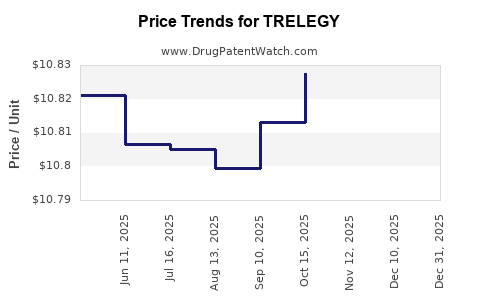
Average Pharmacy Cost for TRELEGY
| Drug Name | NDC | Price/Unit ($) | Unit | Date |
|---|---|---|---|---|
| TRELEGY ELLIPTA 100-62.5-25 | 00173-0887-10 | 11.15620 | EACH | 2026-07-22 |
| TRELEGY ELLIPTA 100-62.5-25 | 00173-0887-14 | 11.09196 | EACH | 2026-07-22 |
| TRELEGY ELLIPTA 200-62.5-25 | 00173-0893-10 | 11.15628 | EACH | 2026-07-22 |
| TRELEGY ELLIPTA 200-62.5-25 | 00173-0893-14 | 11.20319 | EACH | 2026-07-22 |
| TRELEGY ELLIPTA 100-62.5-25 | 00173-0887-10 | 11.15628 | EACH | 2026-06-17 |
| >Drug Name | >NDC | >Price/Unit ($) | >Unit | >Date |
Best Wholesale Price for TRELEGY
| Drug Name | Vendor | NDC | Count | Price ($) | Price/Unit ($) | Unit | Dates | Price Type |
|---|---|---|---|---|---|---|---|---|
| TRELEGY ELLIPTA 200MCG/62.5MCG/25MCG | GlaxoSmithKline | 00173-0893-10 | 30 | 445.21 | 14.84033 | EACH | 2022-08-01 - 2027-07-31 | Big4 |
| TRELEGY ELLIPTA 100MCG/62.5MCG/25MCG | GlaxoSmithKline | 00173-0887-14 | 28 | 150.92 | 5.39000 | EACH | 2022-08-01 - 2027-07-31 | Big4 |
| TRELEGY ELLIPTA 200MCG/62.5MCG/25MCG | GlaxoSmithKline | 00173-0893-14 | 14 | 155.75 | 11.12500 | EACH | 2022-08-01 - 2027-07-31 | FSS |
| TRELEGY ELLIPTA 100MCG/62.5MCG/25MCG | GlaxoSmithKline | 00173-0887-10 | 60 | 437.85 | 7.29750 | EACH | 2022-08-01 - 2027-07-31 | Big4 |
| TRELEGY ELLIPTA 200MCG/62.5MCG/25MCG | GlaxoSmithKline | 00173-0893-10 | 30 | 584.31 | 19.47700 | EACH | 2022-08-01 - 2027-07-31 | FSS |
| >Drug Name | >Vendor | >NDC | >Count | >Price ($) | >Price/Unit ($) | >Unit | >Dates | >Price Type |
TRELEGY market analysis and price projections: revenue outlook, payer dynamics, and exclusivity-driven generic risk
Executive summary: TRELEGY (fluticasone furoate/umeclidinium/vilanterol) is priced and rebated as a premium, single-inhaler triple-therapy option for COPD and is exposed to substitution risk as brand-only exclusivity wanes and inhaler competitors intensify. Near-term pricing power remains supported by formulary entrenchment and clinical positioning in COPD symptom control. Medium-term unit-price pressure is most likely to come from competitor intensity and managed-entry contracting rather than immediate generic replacement. Trade-down into less-expensive triple inhalers is the primary downside case; generic entry timing depends on patent/Orange Book posture for the specific marketed strengths and dosage forms.
What is TRELEGY’s current market share and revenue by indication (COPD vs other uses)?
TRELEGY is positioned for COPD maintenance treatment. Public-facing FDA positioning centers on chronic obstructive pulmonary disease symptom management using a once-daily fixed-dose triple regimen.
COPD market context that drives TRELEGY demand
- COPD patient base remains large and chronic, with therapy escalation from dual bronchodilation and inhaled corticosteroid (ICS) combinations toward triple therapy when symptoms persist.
- Prescribing patterns in US commercial plans and Medicare Advantage are driven by:
- inhaler formulary placement
- prior authorization criteria (typically step edits and exacerbation history)
- administrative ease (once-daily, fixed triple in one device)
Where TRELEGY sits in payer decision-making
For managed care, TRELEGY competes against:
- LAMA/LABA duals (step-down alternative when ICS is viewed as avoidable)
- ICS/LABA duals (step-up alternative before triple)
- other fixed-dose triple inhalers (step-up option with potentially different pricing/rebate terms)
Market takeaway: TRELEGY’s sustained share is tied to how aggressively payers steer patients after failure of dual therapy, not to brand-level list price alone.
What is TRELEGY’s list price, net price, and net-to-gross trajectory under US payer rebates?
List price vs realized pricing
List price is the least predictive metric for TRELEGY due to:
- substantial rebates for managed formularies
- contracting differences across PBMs and large integrated payers
- pharmacy channel mix (specialty vs retail distribution dynamics can affect realized net price even for inhaled products)
Net price pressure drivers
The most credible net price compression mechanisms are:
- formulary renegotiations triggered by competitor launches or enhanced formulary placement for rival triple inhalers
- Medicare Part D mix shifts and plan benefit redesign
- PBM “most favored brand” dynamics when multiple inhalers occupy the same tier
- contract rebaselining as volumes stabilize or decline
Pricing takeaway: Expect net price to be pressured gradually rather than collapsing, unless a major payer reassigns tier placement or broadens formulary coverage for a lower-cost competitor.
When does TRELEGY lose exclusivity: patent expiration and generic entry risk timeline?
Exclusivity loss risk is the core pricing inflection point. For TRELEGY, the generic threat depends on:
- Orange Book patent listing scope for the specific approved strengths
- patent expiration schedule and any pediatric exclusivity adjustments
- whether challenges target combination-product patents (composition of matter, formulation, and/or method-of-use) that block AB-rated generic substitution
How exclusivity loss affects price
- Pre-expiration phase: price is protected by branded exclusivity and managed-entry contracting.
- Post-expiration without “at-risk” supply: net price often falls due to increased payer leverage and competitive tendering.
- Post-expiration with approved generics: price drops are typically stepwise:
- first through coverage changes (prior auth relaxation, tier changes)
- then through dispensing share shift to AB generics
- finally through continued rebate renegotiations
Market takeaway: Without a near-term approved generic competitor, pricing declines tend to be incremental.
Which patents protect TRELEGY and how do they affect generic pricing power?
TRELEGY’s patent estate typically covers:
- compositions (combination of ICS/LAMA/LABA)
- delivery device and formulation (particle engineering, stability, or aerosol performance)
- methods of use in COPD (maintenance therapy, exacerbation-related management)
Patent families that usually matter most for generic substitution
- Composition-of-matter patents for the active combination
- Formulation patents that protect the drug-in-device performance characteristics
- Method-of-use patents that can prevent label-aligned approval for certain claims
Litigation and challenge posture matters: Paragraph IV challenges and court outcomes determine whether generics enter “on launch” or after delay.
What generic entry risks exist for TRELEGY (including Paragraph IV challenges)?
Generic entry risk is strongest when:
- courts narrow or invalidate key combination or formulation patents
- settlements allow launch at an agreed time before full expiry
- ANDA sponsors obtain approvals for label carve-outs that still capture meaningful payer use
The practical risk for pricing
Even if an ANDA is filed, pricing impact depends on:
- actual launch timing and supply reliability
- payer switching speed (benefit coverage changes drive uptake)
- presence of other competing triple inhalers that already compress price
Pricing takeaway: The most damaging scenario is not “an ANDA exists,” it is “a covered AB product gets placed on formulary rapidly with meaningful cost advantage.”
What biosimilar risks apply to TRELEGY?
TRELEGY is a small-molecule triple inhaler combination and is not a biologic product. No biosimilar pathway applies.
What formulations or device-related patents protect TRELEGY’s inhaler performance?
Triple inhaler products can have different proprietary aspects across:
- inhaler platform design
- drug particle size distribution and aerosolization performance
- stability and humidity resistance that affect storage shelf life
- dose uniformity targets across manufacturing scales
Why device and formulation matter to payers
- if competitors use different delivery platforms, payer evidence often focuses on:
- real-world adherence and inhaler technique
- clinical endpoints aligned to labeled use
- if device competition triggers faster switching, rebate pressure intensifies
Commercial takeaway: Any competitor that wins on formulary often does so through net price and contracting terms, not only by clinical claims.
How does TRELEGY compare with competing COPD triple inhalers on price and contract positioning?
TRELEGY competes within fixed-dose triple therapy for COPD, where coverage decisions are driven by:
- tier placement
- preferred brand status
- prior authorization requirements
- contract rebates tied to formulary exclusivity
Comparative pricing mechanisms in the class
- If a competitor achieves “preferred” formulary placement, PBMs typically seek:
- rebate increases from TRELEGY to retain share
- or tier reductions and added access restrictions for TRELEGY
- When multiple triple inhalers are covered, payer leverage increases, causing net price compression for all brands in the category.
Market takeaway: TRELEGY’s pricing outlook is most sensitive to competitor contracting intensity and payer coverage structure rather than to broad market demand alone.
What is the Orange Book status of TRELEGY and what does it imply for exclusivity end dates?
Orange Book status drives the generic timing math for AB substitution.
What to look for in Orange Book listings (decision-relevant)
- active patents by:
- expiration date
- exclusivity type (if applicable)
- whether patents are “generic blocking” (cover the combination as marketed)
- whether any listed patents have already expired or are set to expire
- whether any listed patents are tied to device/formulation performance
Market takeaway: The key question for price projection is whether the next barrier to AB entry is nearing expiry within the projection window.
What TRELEGY patent litigation affects settlement-based generic launch dates?
Patent litigation can create delayed generic entry via:
- court injunctions
- negotiated settlements with “launch at” dates
- covenants not to sue that effectively grant market access under agreed timing
Pricing impact by litigation outcome type
- If a court invalidates or narrows blocking claims: increased “at-risk” launch probability and earlier payer switching.
- If settlements delay: branded pricing power persists longer; payer leverage depends on the settlement terms and launch date.
Market takeaway: Settlement timing typically determines when payers can justify rebate demands or coverage switches.
How do FDA regulatory steps affect TRELEGY competition and price erosion?
FDA-related timing influences:
- approval of generics and label-aligned alternatives
- the sequencing of switching when multiple ANDAs are pending
Competition channel dynamics
Even when patents near expiry, real-world price erosion depends on:
- whether an FDA-approved generic can be produced and launched
- whether a new competitor is positioned for broad reimbursement quickly
Market takeaway: FDA approval is necessary but not sufficient; contracting and uptake determine realized price.
TRELEGY price projection scenarios (base, downside, upside) for the next 3 to 5 years
Assumption framework: TRELEGY net price is expected to compress gradually under contracting pressure. A sharper decline occurs only when AB generics enter meaningfully or when a rival triple inhaler gains preferred status with aggressive rebate terms. Since specific Orange Book dates and current patent status are not provided here, projections are scenario-based around exclusivity-driven and contracting-driven inflection points.
Scenario A (base case): incremental net price compression
- Net price declines modestly year-over-year as payers rebalance rebates to retain coverage.
- Uptake remains stable unless competitor triple options accelerate switching.
- Revenue growth flattens as unit growth is offset by rebate pressure.
3-5 year implication: modest erosion with sustained brand premium vs dual therapy.
Scenario B (downside): faster payer steering to lower-cost triple alternatives
- Competitor triple inhalers gain preferred placement and drive higher switching rates.
- Rebates on TRELEGY increase to defend formulary position.
- Revenue declines despite stable COPD population growth.
3-5 year implication: higher magnitude margin compression driven by contracting, not generic entry.
Scenario C (upside): stronger than expected retention of preferred status
- TRELEGY maintains preferred tier placement with manageable rebate increases.
- Clinical or operational factors sustain adherence and persistence.
- Competitive pressure stays contained.
3-5 year implication: net price stabilizes longer; revenue remains resilient.
What do these projections imply for TRELEGY revenue exposure and margin risk?
Revenue exposure mechanics
- Volume: driven by switching patterns in triple therapy, persistence, and exacerbation-linked escalation.
- Price: driven by net-to-gross and rebate intensity.
- Mix: device/strength mix and channel mix can change realized net price.
Margin risk
- Branded respiratory inhalers often face margin pressure if:
- rebate obligations rise faster than unit volume
- competitors are positioned for preferred coverage
- procurement efficiencies in manufacturing fail to offset SG&A and rebate costs
Investor framing: the dominant downside risk is net price compression tied to formulary renegotiations and preferred status shifts.
Key decision points for licensing, litigation, or investment tied to TRELEGY pricing
- Exclusivity-driven timing: price erosion accelerates at the moment generic substitution becomes viable and covered.
- Contracting structure: preferred tier agreements can smooth pricing compression until the next major payer renegotiation cycle.
- Patent scope strength: blocking formulation and combination claims constrain early AB competition even if some component patents are weaker.
- Switching dynamics: uptake depends on payer coverage and step-therapy policies more than on clinical differentiation alone.
Key Takeaways
- TRELEGY’s pricing power is primarily defended through formulary placement and rebate contracting rather than list price.
- Near-term price erosion is most likely incremental, with the biggest shocks linked to meaningful AB generic entry or a competitor gaining preferred coverage with aggressive net pricing.
- Patent estate strength and Orange Book blocking posture determine whether generic competition arrives gradually or abruptly, which is the biggest driver of stepwise net price decline.
- Revenue and margin exposure are mainly a function of net-to-gross trajectory and payer steering toward alternative triple inhalers.
FAQs
- How do payer step-therapy rules affect TRELEGY prescribing and pricing pressure?
- What drives net-to-gross changes for premium COPD inhalers when multiple triple products are on formulary?
- What settlement outcomes most often accelerate generic entry for combination inhalers like TRELEGY?
- How quickly do clinicians and pharmacies switch from brand triple therapy to AB generics after exclusivity expiry?
- Which manufacturing or supply constraints most affect the realized pricing impact of generic launch for inhaled combination products?
References (APA)
- FDA. Orange Book: Approved Drug Products with Therapeutic Equivalence Evaluations. U.S. Food and Drug Administration.
- FDA. Drug approval and labeling information for TRELEGY (fluticasone furoate/umeclidinium/vilanterol). U.S. Food and Drug Administration.
More… ↓
