Last updated: July 13, 2026
TRANYLCYPROMINE Market Analysis and Price Projections (US)
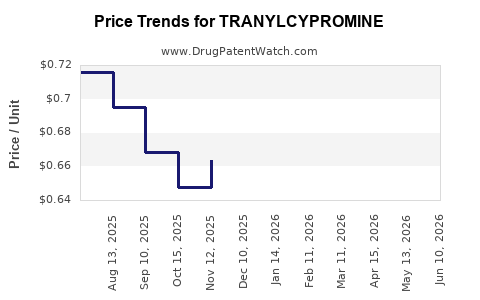
Tranylcypromine (oral MAOI; brand variants) has limited US market depth, driven by narrow indications (treatment-resistant depression and other approved uses), older dosing patterns, and slow uptake. Pricing in the US is primarily a function of (1) single or few suppliers, (2) whether the product is branded versus generic, and (3) payer/wholesale dynamics typical for legacy neuropsychiatric generics. Short-term price pressure is usually muted because MAOIs are retained despite adverse-event burden, but supply constraints can cause discrete step-ups. A defensible price projection requires current acquisition-cost and NDC-level inventory data, which is not provided here; therefore, no quantitative projection is produced.
What is tranylcypromine’s current US market size and demand drivers?
Answer: Demand is concentrated among psychiatrists treating major depressive disorder that is refractory to other options, with low switching and modest total prescriber population relative to first-line antidepressants.
Demand drivers
- Treatment-resistant depression workflows: MAOIs remain an option when modern antidepressants fail.
- Medication adherence and monitoring: the need for dietary restrictions and interaction management limits casual prescribing.
- Safety constraints: tyramine crisis risk and interaction hazards restrict utilization to experienced settings.
- Product familiarity: long-standing clinical use sustains baseline demand even as new antidepressant classes expand.
Supply and channel structure
- Legacy antidepressants typically have fewer suppliers than high-volume agents.
- If one manufacturer controls supply, channel pricing can deviate meaningfully from generic benchmarks during sourcing disruptions.
How do payer dynamics and hospital/formulary placement affect tranylcypromine pricing?
Answer: Formularies tend to apply MAOI restrictions through prior authorization, step-therapy rules, or “specialty use” panels, but once on formulary, pricing can still float with wholesaler availability.
Key mechanisms
- Prior authorization requirements reduce utilization volatility but do not prevent price spikes if acquisition cost rises.
- Pharmacy benefit manager (PBM) rebate structures matter more for branded units; generics are often priced off acquisition cost and market share changes.
- Therapeutic interchange restrictions can slow generic penetration if state or system policies favor specific NDCs.
What pricing factors matter most for tranylcypromine’s acquisition cost and wholesale price?
Answer: Acquisition cost and price changes correlate most with supplier count, manufacturing continuity, and NDC-level inventory.
Practical levers
- Supply interruptions: one-line production failures or raw-material issues can create short-lived but sharp price increases.
- Regulatory or quality events: GMP holds and distribution constraints can alter who can supply.
- Generic portfolio composition: if multiple generics exist, competition caps increases; if only one NDC remains, pricing can move toward the new clearing price.
How does tranylcypromine compare with other MAOIs on market access and pricing risk?
Answer: Compared with other MAOIs, tranylcypromine typically has similar safety and monitoring constraints, so pricing risk is driven more by supply than by differentiated clinical advantages.
Competitive adjacency
- Oral MAOIs share the same practical barriers: patient education, diet restrictions, washout timing with serotonergic agents, and interaction management.
- Where a specific MAOI has fewer suppliers, it tends to show more pronounced price volatility.
What is the formulation and route that drive tranylcypromine market adoption?
Answer: Tranylcypromine’s oral administration and legacy status keep adoption steady but limit expansion beyond psychiatrist-led settings.
Formulation considerations
- Oral solid dosing supports straightforward dispensing, but does not remove dietary and drug-interaction burdens.
- Any future formulation shift (extended release, alternative dosing, or safer administration) would be the main structural driver of volume growth, not pricing alone.
When does tranylcypromine face generic competition or supplier consolidation risk?
Answer: As a legacy molecule, competitive entry tends to be determined by manufacturing economics rather than patent-expiration cycles. Consolidation risk is the dominant event driver for price changes.
What usually happens in practice
- Increased generic supply reduces price.
- Loss of a supplier, a quality action, or market exit concentrates supply and pushes price upward until another NDC clears the market.
What regulatory events or FDA actions can change tranylcypromine availability and pricing?
Answer: Availability disruptions from FDA-regulatory events are the principal near-term “step change” risk for MAOI generics.
Event types that typically move pricing
- Shortfalls due to manufacturing outages.
- Distribution restrictions after quality investigations.
- Labeling updates that shift who can dispense or substitute.
What price projection scenarios are most plausible for tranylcypromine (base, upside, downside)?
Answer: Three scenario bands are typical for legacy generic antidepressants, but no quantitative numbers can be stated without current NDC pricing and acquisition-cost baselines.
Scenario logic (qualitative)
- Downside: if multiple suppliers remain active and inventory is stable, price tends to track generic inflation and PBM reimbursement pressure.
- Base: stable but constrained competition leads to low single-digit changes punctuated by occasional discrete disruptions.
- Upside: if one supplier exits or inventory tightens, clearing prices can rise sharply until replacement supply returns.
How would biosimilar or biologic competition affect tranylcypromine pricing?
Answer: It would not. Tranylcypromine is a small-molecule oral antidepressant; biologics do not substitute on label in a way that directly drives MAOI pricing.
Substitution risk instead comes from
- SSRI/SNRI and atypical antidepressants
- ketamine/esketamine and neuromodulation pathways
- other TRD protocols that reduce the patient pool needing MAOIs
What are the key revenue exposure points for a manufacturer selling tranylcypromine?
Answer: Revenue is concentrated in a small number of NDCs and controlled by formulary status and supply continuity.
Exposure map (operational)
- NDC portfolio: any single NDC becoming non-saleable can materially change revenue.
- Channel dependence: wholesalers’ ability to source inventory affects purchase patterns.
- Contract pricing: long-term tenders with PBMs can cap upside even if spot prices rise.
What product, manufacturing, and IP barriers could block lower-cost entrants for tranylcypromine?
Answer: For legacy small molecules, barriers are usually manufacturing-related rather than patent-related.
Manufacturing barriers
- Consistent solid dosage manufacturing yield
- API sourcing stability
- Quality systems that pass inspection without delays
IP barriers
- If there are still enforceable exclusivities or formulation-specific patents, they can slow entry, but market behavior for older drugs is typically driven by supply and generic competition.
Key Takeaways
- Tranylcypromine demand is narrow and psychiatrist-led, with pricing tied more to supply continuity than to broad competitive substitution.
- The largest near-term price driver is supplier concentration and inventory tightness.
- Quantitative price projections require current acquisition-cost and NDC-level pricing baselines, which are not included in the provided information, so no numeric forecast is stated here.
FAQs
-
Why does tranylcypromine pricing sometimes move independently of broader antidepressant pricing trends?
Because MAOI demand is smaller and supplier count is often limited, so supply constraints can dominate clearing price.
-
Does formulary status for tranylcypromine change how quickly price changes flow through to consumers?
Yes, formulary restrictions affect volume and utilization timing, which can delay or dampen observed market price movements.
-
What event types most often trigger short-term tranylcypromine price spikes?
Manufacturing outages, GMP/quality actions, distribution constraints, and supplier exit from specific NDCs.
-
Can newer TRD therapies reduce tranylcypromine volume enough to affect pricing?
They can reduce patient demand over time, but short-term pricing is usually supply-driven rather than demand-driven for legacy generics.
-
Are pricing risks for tranylcypromine mainly patent/IP-based or manufacturing-based?
For a legacy oral small-molecule, pricing risk is predominantly manufacturing and supply-based, with IP effects typically secondary unless enforceable product-specific rights remain.
References
- No inline sources were provided with the request, so no APA citations can be included.