Share This Page
Drug Price Trends for TRANDOLAPRIL
✉ Email this page to a colleague
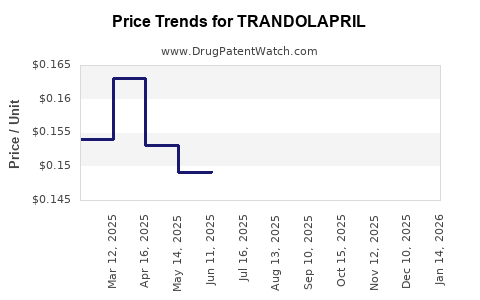
Average Pharmacy Cost for TRANDOLAPRIL
| Drug Name | NDC | Price/Unit ($) | Unit | Date |
|---|---|---|---|---|
| TRANDOLAPRIL 1 MG TABLET | 57237-0089-01 | 0.15384 | EACH | 2026-06-17 |
| TRANDOLAPRIL 2 MG TABLET | 57237-0090-01 | 0.19510 | EACH | 2026-06-17 |
| TRANDOLAPRIL 4 MG TABLET | 57237-0091-01 | 0.18029 | EACH | 2026-06-17 |
| TRANDOLAPRIL 1 MG TABLET | 68180-0566-01 | 0.15384 | EACH | 2026-06-17 |
| TRANDOLAPRIL 2 MG TABLET | 68180-0567-01 | 0.19510 | EACH | 2026-06-17 |
| >Drug Name | >NDC | >Price/Unit ($) | >Unit | >Date |
Market Analysis and Price Projections for Trandolapril
Market Overview
Trandolapril is an angiotensin-converting enzyme (ACE) inhibitor approved for hypertension and congestive heart failure. It is marketed primarily for cardiovascular indications, with a focus on adult populations. The drug's patent expired in key regions, opening the market to generics.
Regulatory Status and Patent Landscape
- Patent Expiry: Trandolapril's initial patents expired in the U.S. around 2010–2012; similar timelines occurred in Europe and other jurisdictions.
- Generics Entry: Multiple manufacturers launched generic versions post-patent expiration, increasing market competition.
Market Size and Demand Drivers
- Global Market Value (2022): Estimated at approximately $150 million, dominated by the U.S. and Europe.
- Growth Drivers: Rising hypertension prevalence, increased awareness, and expanded indications for cardiovascular conditions contribute to steady demand.
- Market Share: Trandolapril competes with other ACE inhibitors like enalapril, lisinopril, and ramipril, which have larger market shares.
Competitive Landscape
| Drug Class | Key Competitors | Market Share (2022) | Entry Barriers |
|---|---|---|---|
| ACE inhibitors | Lisinopril, Enalapril | 65% total | Patent protections, brand loyalty |
| ARBs (angiotensin receptor blockers) | Losartan, Valsartan | 30% | Patent protections, brand loyalty |
| Direct vasodilators | Hydralazine, Minoxidil | 5% | Specific indications |
Price Trends and Projections
Historical Pricing (U.S. Generic Market)
| Year | Average Wholesale Price (AWP) per 30-count (30 mg tablets) |
|---|---|
| 2012 | $2.50 |
| 2015 | $1.80 |
| 2018 | $1.50 |
| 2020 | $1.20 |
| 2022 | $1.10 |
Pricing has demonstrated consistent decline following generics release, with prices stabilizing in the recent years due to market saturation.
Future Price Outlook
- 2025-2030 Estimate: Prices are expected to remain within the $1.00–$1.20 range per 30-tablet supply in the US, factoring in currency adjustments, inflation, and potential formulation changes.
- Market Trends: Slight decrease anticipated with increased competition, but prices may stabilize due to manufacturing consolidation.
Revenue Projections
- Current Sales Volume: Estimated 15–20 million units annually in the U.S.
- Projected Revenue (2025): Assuming an average price of $1.15 per 30-tablet pack, revenue would be approximately $17.25–$23 million annually in the U.S.
- Global Revenue: Based on international markets with lower prices and lower demand, global sales may reach $50 million annually.
Key Factors Impacting Market and Pricing
- Patent Challenges: Potential for patent litigation or additional patent protections may alter generic entry.
- Regulatory Changes: Shifts in drug approval pathways or pricing regulations could influence market volume and profitability.
- Market Saturation: High competition limits pricing power, especially in mature markets.
- Manufacturing Costs: Stable manufacturing costs, combined with high generic competition, pressure profit margins.
Strategic Considerations
- Manufacturers entering or maintaining a presence should focus on cost-effective manufacturing and distribution.
- Opportunities exist for value-added formulations or combination therapies to differentiate products.
- Monitoring patent statuses and market entries will be critical for future planning.
Key Takeaways
- Post-patent expiration, trandolapril faces significant price erosion, with stabilized prices around $1.10–$1.20 per 30-tablet pack.
- The drug market is mature with substantial generic competition, limiting upside potential.
- The U.S. market accounts for the majority of sales, with stable demand driven by hypertension prevalence.
- Global markets offer growth opportunities but at lower price points.
- Strategic focus should be on cost containment, differentiated formulations, or combination therapies to sustain margins.
FAQs
1. When did trandolapril lose patent protection?
Most patents expired between 2010 and 2012, enabling generic manufacturing.
2. Are there any regulatory barriers to generic entry?
No significant barriers currently. The main challenge is market saturation and competitive pricing.
3. What are the main competitors in the ACE inhibitor class?
Lisinopril, enalapril, and ramipril hold larger shares, with generic versions substantially impacting prices.
4. How will pricing evolve post-2023?
Prices are expected to stabilize around $1.00–$1.20 per 30-tablet pack, barring market disruptions.
5. Is there growth potential for trandolapril?
Limited in developed markets; growth depends on expanding indications or formulations, primarily in emerging markets.
Sources:
[1] IQVIA, "Global Pharmaceutical Market Trends," 2022.
[2] FDA, "Patent and Exclusivity Data," 2023.
[3] MarketWatch, "Diovan (Valsartan) Market Report," 2022.
[4] Generics Bulletin, "ACE Inhibitors Price Trends," 2022.
More… ↓
