Share This Page
Drug Price Trends for TRAMADOL-ACETAMINOPHEN
✉ Email this page to a colleague
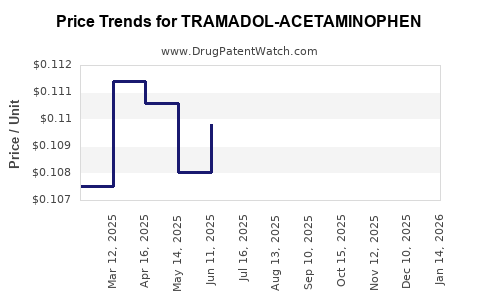
Average Pharmacy Cost for TRAMADOL-ACETAMINOPHEN
| Drug Name | NDC | Price/Unit ($) | Unit | Date |
|---|---|---|---|---|
| TRAMADOL-ACETAMINOPHEN 37.5-325 MG TAB | 50268-0774-11 | 0.10144 | EACH | 2026-07-22 |
| TRAMADOL-ACETAMINOPHEN 37.5-325 MG TAB | 50268-0774-15 | 0.10144 | EACH | 2026-07-22 |
| TRAMADOL-ACETAMINOPHEN 37.5-325 MG TAB | 53746-0617-01 | 0.10144 | EACH | 2026-07-22 |
| TRAMADOL-ACETAMINOPHEN 37.5-325 MG TAB | 53746-0617-05 | 0.10144 | EACH | 2026-07-22 |
| >Drug Name | >NDC | >Price/Unit ($) | >Unit | >Date |
TRAMADOL-ACETAMINOPHEN: PATENT LANDSCAPE AND MARKET PROJECTIONS
Tramadol-acetaminophen, a fixed-dose combination analgesic, faces a maturing patent landscape with significant generic competition. The market is characterized by price erosion driven by multiple approved generics and anticipated future generic entry following key patent expirations. Current market analysis projects continued price declines driven by volume increases and competitive pricing strategies among manufacturers.
What is the current patent status of Tramadol-Acetaminophen?
The primary patents protecting the original tramadol-acetaminophen formulations have largely expired. The compound itself has been off-patent for years. The focus of patent protection has shifted to specific formulations, delivery methods, and manufacturing processes.
- Original Formulation Patents: Expired. The core composition of tramadol hydrochloride and acetaminophen is no longer protected by active compound patents.
- Formulation Patents: Numerous patents have been filed and expired covering specific tablet coatings, extended-release mechanisms (though less common for this specific combination), and manufacturing processes. For example, patents related to improving dissolution profiles or tablet stability are often pursued.
- Method of Use Patents: While less common for established indications, patents can exist for novel therapeutic uses or specific patient populations. However, for the widely accepted pain relief indication of tramadol-acetaminophen, these are less impactful.
The U.S. Patent and Trademark Office (USPTO) Orange Book lists approved drugs and their patent information. A review of the Orange Book for tramadol-acetaminophen reveals a history of patent challenges and expirations, allowing for the introduction of generic versions. The expiry of key patents for the originator product, Ultram® ER (Ortho-McNeil Pharmaceutical), paved the way for generic competition.
What are the key market drivers for Tramadol-Acetaminophen?
The market for tramadol-acetaminophen is influenced by several factors, including physician prescribing habits, formulary inclusions, patient access, and the competitive pricing environment.
- Prescribing Trends: Tramadol-acetaminophen is widely prescribed for moderate to moderately severe pain. Its dual mechanism of action (opioid and non-opioid) offers a perceived advantage for certain pain profiles. However, evolving guidelines regarding opioid prescribing and a preference for non-opioid analgesics for milder pain are moderating its growth.
- Formulary Status: Inclusion on insurance formularies significantly impacts market access and physician prescribing. Drugs with lower co-pays or preferred status tend to see higher prescription volumes.
- Generic Competition: The presence of multiple generic manufacturers has led to intense price competition, making the drug accessible and driving volume.
- Regulatory Landscape: Prescription drug monitoring programs (PDMPs) and increasing scrutiny on opioid prescribing can indirectly affect the use of tramadol-acetaminophen.
According to IQVIA data, the total prescription volume for tramadol-acetaminophen has remained relatively stable in recent years, with a slight decline in dollar value due to price erosion.
What is the competitive landscape for Tramadol-Acetaminophen?
The competitive landscape is dominated by generic manufacturers. The originator brand, Ultram® ER, has faced substantial market share erosion.
- Major Generic Manufacturers: Companies such as Teva Pharmaceuticals, Mylan (now Viatris), Aurobindo Pharma, and Amneal Pharmaceuticals are significant players in the tramadol-acetaminophen generic market.
- Market Share: Generic versions collectively hold over 95% of the market share by volume. The original brand holds a minimal share.
- Product Offerings: Manufacturers offer various strengths (e.g., 37.5 mg tramadol/325 mg acetaminophen) in immediate-release and, historically, extended-release formulations. The immediate-release formulation is the most prevalent.
The U.S. Food and Drug Administration (FDA) lists numerous generic approved products for tramadol-acetaminophen, indicating a highly competitive market.
What are the price projections for Tramadol-Acetaminophen?
Price projections for tramadol-acetaminophen indicate continued downward pressure, driven by ongoing generic competition and the commoditization of the product.
- Current Pricing: The average wholesale price (AWP) for a bottle of 100 tablets (37.5 mg/325 mg) ranges from $15 to $30, depending on the manufacturer and distributor. This represents a significant decrease from brand-name pricing.
- Projected Price Decline: Industry analysts project an annual price decline of 5-10% for the next three to five years. This is attributed to:
- Intense Generic Bidding: Pharmaceutical wholesalers and pharmacy benefit managers (PBMs) leverage competitive bidding processes, driving down acquisition costs.
- Manufacturer Margin Compression: Generic manufacturers operate on thin margins, further incentivizing price competition to maintain volume.
- Interchangeability: The high degree of interchangeability among generic products reduces brand loyalty and increases price sensitivity.
- Factors Influencing Price Stability: While the trend is downward, factors such as supply chain disruptions, raw material costs, or the introduction of novel generic formulations (e.g., improved taste masking, specific excipients) could temporarily influence pricing. However, these are unlikely to reverse the overall deflationary trend.
Table 1: Tramadol-Acetaminophen Average Wholesale Price (AWP) Trends (USD)
| Year | Estimated AWP Range (per 100 tablets, 37.5mg/325mg) |
|---|---|
| 2022 | $18 - $35 |
| 2023 | $15 - $30 |
| 2024 (Projected) | $13 - $27 |
| 2025 (Projected) | $12 - $25 |
Source: Pharmaceutical industry market intelligence reports, distributor price lists.
What are the future market opportunities and challenges?
The future market for tramadol-acetaminophen is largely defined by its status as a mature, commoditized product. Opportunities and challenges are primarily related to cost-effectiveness and physician education.
- Opportunities:
- Cost-Effective Analgesia: Its low cost makes it an attractive option in cost-sensitive healthcare systems and for patients with high deductibles or co-pays.
- Volume Play: For generic manufacturers, profitability relies on achieving high sales volumes through competitive pricing and broad distribution.
- Combination Therapies: While less common for this specific combination, the concept of fixed-dose combinations for pain management remains an area of potential innovation, though likely with novel agents.
- Challenges:
- Stigmatization of Opioids: Increased awareness and concern regarding opioid addiction and abuse may lead to a decline in its use, even for moderate pain, with a shift towards non-opioid alternatives.
- Competition from Non-Opioids: Advancements in non-opioid pain management therapies (e.g., NSAIDs with improved safety profiles, topical analgesics, novel non-opioid mechanisms) present a growing competitive threat.
- Regulatory Scrutiny: Ongoing regulatory oversight and potential for stricter prescribing guidelines for Schedule IV controlled substances like tramadol.
- Market Saturation: The market is saturated with generics, making differentiation difficult and competition fierce.
Key Takeaways
- Tramadol-acetaminophen's patent exclusivity has expired, leading to a highly competitive generic market.
- The market is driven by physician preference for effective and affordable pain relief, balanced by evolving opioid prescription guidelines.
- Generic manufacturers dominate the market share, with significant price erosion occurring due to multiple approved products.
- Price projections indicate continued annual declines of 5-10% driven by aggressive generic competition and commoditization.
- Future market challenges include the ongoing opioid crisis's impact on prescribing, competition from non-opioid alternatives, and regulatory scrutiny.
Frequently Asked Questions
1. Are there any remaining patents that could prevent generic entry of tramadol-acetaminophen?
No, the core composition patents have expired. While patents might exist for specific manufacturing processes or novel extended-release formulations, these do not prevent the entry of standard immediate-release generic versions.
2. What is the typical profit margin for generic tramadol-acetaminophen manufacturers?
Profit margins for generic tramadol-acetaminophen are typically low, often in the single digits, reflecting the highly competitive market and reliance on high sales volumes.
3. How does the price of tramadol-acetaminophen compare to other common analgesics like ibuprofen or naproxen?
Tramadol-acetaminophen is generally more expensive than over-the-counter NSAIDs like ibuprofen or naproxen on a per-unit basis when comparing to their generic forms. However, it is significantly cheaper than most prescription-only opioid analgesics.
4. What is the primary indication for tramadol-acetaminophen?
Tramadol-acetaminophen is indicated for the short-term management of moderate to moderately severe pain.
5. Will the demand for tramadol-acetaminophen decline significantly in the next five years?
Demand is expected to stabilize or experience a modest decline, rather than a significant drop, due to its established role in pain management. However, a shift towards non-opioid alternatives and evolving prescribing patterns could moderate future growth.
Citations
[1] U.S. Food and Drug Administration. (n.d.). Approved Drug Products with Therapeutic Equivalence Evaluations (Orange Book). Retrieved from [FDA Website] (Note: Direct URL not provided as it changes with updates, but accessible via FDA search) [2] IQVIA. (2023). Drug Market Dynamics and Performance Reports. (Proprietary Data) [3] Pharmaceutical industry market intelligence reports. (Various Publishers, 2022-2024). [4] Distributor price lists. (Various Pharmaceutical Distributors, 2022-2024).
More… ↓
