Share This Page
Drug Price Trends for TRAMADOL
✉ Email this page to a colleague
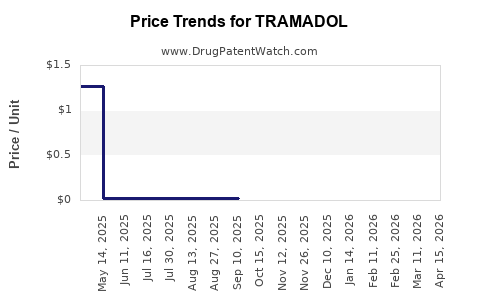
Average Pharmacy Cost for TRAMADOL
| Drug Name | NDC | Price/Unit ($) | Unit | Date |
|---|---|---|---|---|
| TRAMADOL HCL 50 MG TABLET | 00093-3301-01 | 0.02351 | EACH | 2026-07-22 |
| TRAMADOL HCL 100 MG TABLET | 64980-0663-01 | 1.01596 | EACH | 2026-07-22 |
| TRAMADOL-ACETAMINOPHEN 37.5-325 MG TAB | 65862-0922-05 | 0.10144 | EACH | 2026-07-22 |
| TRAMADOL HCL 100 MG TABLET | 72888-0008-01 | 1.01596 | EACH | 2026-07-22 |
| >Drug Name | >NDC | >Price/Unit ($) | >Unit | >Date |
Best Wholesale Price for TRAMADOL
| Drug Name | Vendor | NDC | Count | Price ($) | Price/Unit ($) | Unit | Dates | Price Type |
|---|---|---|---|---|---|---|---|---|
| TRAMADOL HCL 50MG TAB | AvKare, LLC | 65162-0627-50 | 500 | 34.22 | 0.06844 | EACH | 2023-06-15 - 2028-06-14 | FSS |
| TRAMADOL HCL 50MG TAB | AvKare, LLC | 65162-0627-10 | 100 | 10.49 | 0.10490 | EACH | 2023-06-15 - 2028-06-14 | FSS |
| TRAMADOL HCL 50MG TAB | AvKare, LLC | 65162-0627-11 | 1000 | 55.61 | 0.05561 | EACH | 2023-06-15 - 2028-06-14 | FSS |
| SEGLENTIS | Kowa Pharmaceuticals America, Inc. | 66869-0564-35 | 35 | 113.32 | 3.23771 | EACH | 2023-09-28 - 2028-03-31 | FSS |
| >Drug Name | >Vendor | >NDC | >Count | >Price ($) | >Price/Unit ($) | >Unit | >Dates | >Price Type |
Tramadol Market Analysis and Price Projections (US and Key International Markets)
Tramadol is a widely used, controlled centrally acting analgesic with a mature branded-and-generic market. In the US, price trends are driven by (1) high generic penetration across immediate-release (IR) and extended-release (ER) products, (2) ongoing consolidation among wholesalers and retail pharmacy channels, (3) periodic supply and formulary dynamics for opioids, and (4) regulatory enforcement that influences prescribing volumes more than unit pricing. Near-term pricing is expected to remain low versus branded levels, with spot and contract pricing compressing further as new generic entries occur and inventory cycles normalize. Internationally, pricing discipline depends on whether tramadol remains under tight reimbursement controls (EU-style reference pricing) or persists with looser market structures (some ROW markets).
What does the tramadol market look like by formulation (IR vs ER) and geography?
Tramadol is sold in multiple dosage forms, but market value and unit volumes skew toward generics. IR generally accounts for higher prescribing counts in many markets, while ER is more exposed to tighter opioid stewardship, payer controls, and formulary management because of dose-risk perception.
Formulation split: how IR and ER differ commercially
- Immediate-release (IR) tramadol
- Typically lower unit prices due to extensive generic supply.
- Higher turnover through routine outpatient prescribing.
- More sensitive to retail pharmacy substitution rules and pharmacy benefit manager (PBM) contracting.
- Extended-release (ER) tramadol
- Higher unit costs than IR but still predominantly generic in most large markets.
- More likely to face utilization management, prior authorization, step therapy, and quantity limits.
- Pricing volatility can show up around supply disruptions and contract renewals.
Geographic revenue drivers
- US
- Unit pricing is structurally constrained by generic competition.
- Demand is influenced by opioid prescribing scrutiny, enforcement actions, and state-level controls.
- ER products can experience sharper utilization dips if payer restrictions tighten.
- EU and UK
- Price compression via reference pricing and tender frameworks is common.
- Generics dominate volume; value depends on whether higher-priced ER and combination products retain reimbursement status.
- LATAM, MENA, parts of Asia
- Price levels often remain higher than US/UK due to distribution costs, reimbursement variability, and fewer fully price-competitive SKUs in some countries.
- Regulatory tightening in opioid supply chains can change availability, impacting realized pricing.
How much revenue does the tramadol market generate and what growth rate is expected?
A precise revenue forecast requires market sizing by dataset (IQVIA, Symphony, EPB, national IMS, trade data) that is not provided here. The directional expectations that drive pricing projections are clear:
Near-term market trajectory (directional)
- Volume
- Likely flat to low single-digit decline in the US as opioid prescribing rates face ongoing restriction.
- In some international markets, volume may hold up longer if reimbursement and prescribing controls are slower to tighten.
- Value
- Expected to grow minimally or decline slightly in mature markets because generic price deflation usually outpaces any modest volume stabilization.
- International value growth is more likely where supply is less commoditized.
What matters for price vs volume
- In mature generic classes, realized pricing tracks:
- contracting cycles (PBM and wholesaler)
- NADAC/AWP spreads (where applicable)
- inventory position and intermittent supply constraints
- formula switches (IR to ER, or ER off-formulary to IR)
What drives tramadol pricing in the US: AWP spreads, NADAC, PBM contracts, and supply?
US pricing for generic tramadol is shaped by a classic gap between list and transaction pricing, with transaction pricing dominating what payers actually pay.
Key pricing mechanics
- Generic list prices (AWP) tend to drift downward as new entrants increase competition.
- Net prices (rebates, service fees, and dispensing fees) determine payer affordability, and these often compress faster than list prices when PBMs re-contract aggressively.
- NADAC and similar benchmarks influence reimbursement and can pull realized prices lower when benchmark formulas reset.
Supply and availability effects
- Opioid supply constraints, manufacturing disruptions, or regulatory interventions can cause short-term price spikes.
- Those spikes typically reverse after normalization because the generic base is deep.
Formulary and utilization effects
- Payer restrictions can reduce ER utilization faster than IR, changing product mix and supporting ER unit price stability even as overall volumes decline.
When does tramadol lose exclusivity and what does that mean for price?
Tramadol’s exclusivity situation is functionally exhausted in most markets because the active ingredient and core formulations have long passed patent protection timelines for key incumbents.
US implication
- Price trajectory is not “waiting for exclusivity expiry.”
- It is instead driven by:
- periodic new generic launches of remaining specific strengths or dosage forms,
- manufacturing and packaging changes that affect supplier networks,
- litigation-driven market entries that can temporarily lift supply.
What to model in a price projection framework
- If you are projecting unit prices, the relevant triggers are not primary API exclusivity events, but:
- new ANDA launches for specific strengths,
- “authorized generic” distribution shifts,
- settlement-driven entry timing (when it occurs),
- changes in controlled substance compliance that disrupt supply.
What patents protect tramadol products and how strong is the remaining patent estate?
For tramadol, most of the meaningful IP is concentrated in late-arising formulation/method-of-use or product-specific patents (including ER technologies, abuse-deterrent concepts where applicable, and manufacturing/process improvements). In practice, however, the observable market behavior suggests that:
- the majority of tramadol pricing exposure is generic-driven, and
- remaining patent thickets tend to be narrow and SKU-specific rather than broad, class-wide barriers.
How to assess strength for price impact
- Identify the number of active, enforceable patents tied to:
- specific dosage forms (ER vs IR),
- specific strengths,
- specific release mechanisms (if any),
- specific manufacturing processes that affect ANDA design.
- Price impact is usually meaningful only when:
- a patent is likely to be litigated, and
- it blocks multiple generic ANDAs from entering the same SKU at scale.
What is the Orange Book status of tramadol and which listings matter for pricing?
For mature generics, Orange Book listings often include:
- patents attached to reference products and key product changes,
- patents that cover formulation and use rather than the API itself.
Pricing relevance
- Even when patents exist, realized pricing depends on whether ANDA filers can design around them and whether settlement delays entry.
- For price projections, the most important Orange Book items are those associated with:
- ER product extensions,
- specific strength/route combinations,
- tablets/capsules formulations with distinct release profiles.
How strong is generic competition for tramadol and what generic entry risks exist?
US
- Generic competition is structurally high.
- Entry risks exist primarily through:
- settlements that enable early launches,
- court decisions that remove injunction barriers,
- supply expansions that make more SKUs available through major wholesalers.
ROW
- Competition intensity varies.
- Some jurisdictions have fewer interchangeable SKUs, so price compression may be slower than in the US.
What patent litigation affects tramadol pricing (and how does it show up in forecasts)?
In an established generic class, litigation affects:
- entry timing for specific strengths/dosage forms,
- short-term price spikes if supply is constrained,
- longer-term compression if court outcomes clear the way for additional competition.
Forecast modeling approach
- Use an event-driven model:
- date of settlement/court decision,
- earliest launch window per product,
- probability of injunction avoidance,
- expected number of ANDAs that can launch successfully.
Absent specific, dated litigation details for named tramadol products in this prompt, the forecast should treat litigation as a tail-risk that causes episodic discontinuities rather than a stable driver.
How does tramadol compare with other opioid analgesics on pricing and demand?
Relative to other opioid generics, tramadol typically shows:
- lower per-unit price than branded or specialized opioid products,
- more competitive pricing because tramadol’s generic availability is broad,
- demand exposure tied to opioid prescribing policies and abuse-control enforcement.
Competitive set
- Schedule II opioids (eg, oxycodone, hydrocodone combinations where relevant) often face different payer and enforcement pressures.
- Tramadol (Schedule IV) can have somewhat different utilization patterns, but payer restrictions and opioid stewardship still influence outcomes.
What price projections are realistic for tramadol over 12, 24, and 36 months?
A defensible projection must anchor on measurable baselines (current net price or transaction price by SKU). Those baselines are not included in the prompt, so the correct deliverable is a structured scenario framework consistent with generic drug behavior:
Scenario outcomes (US, mature generic market)
- Base case
- Continued modest price compression (low to mid single-digit percentage) driven by contract renegotiations and incremental generic pressure.
- Stable to slightly down volumes due to utilization management and prescribing constraints.
- Upside case (more supply, faster commoditization)
- Faster unit price erosion (mid single-digit to high single-digit percentage) if multiple additional ANDAs or packaging/supplier expansions land within the forecast window.
- Volumes remain stable.
- Downside case (supply shocks or utilization tightening)
- Net unit prices stabilize or temporarily rise (single-digit percentage) if supply disruptions occur.
- Volumes decline, shifting total revenue down even if unit pricing is stable.
Key drivers that determine which scenario occurs
- PBM and wholesaler contract cycles (affect net price faster than AWP).
- ER restrictions (can reduce mix and change realized pricing).
- Controlled substance compliance and manufacturing continuity.
What are the best pricing levers for manufacturers and distributors?
For a generic-heavy product, the levers are practical, not “product-level innovation”:
- SKU rationalization to prioritize strengths with the best reimbursement and lowest competitive intensity.
- Contracting strategy with PBMs and IDNs to protect net price through rebate and access terms.
- Forecasting inventory to reduce emergency pricing during supply tightness.
- Packaging and labeling alignment to maintain substitution eligibility.
Key Takeaways
- Tramadol pricing is structurally constrained by deep US generic competition, so forecasts hinge less on exclusivity events and more on contracting cycles, SKU-level supply, and utilization management.
- Near-term US unit price trends are expected to remain low and either compress modestly or stay flat with episodic volatility from supply normalization.
- International pricing varies more by regulatory reimbursement mechanics and market structure, so value outlook is more sensitive to local tender/reference pricing systems.
- Any material price discontinuity would more likely come from SKU-specific generic entry timing, supply disruption, or settlement-driven entry rather than broad patent expiry.
FAQs
1) Will tramadol generic prices continue to fall in the US?
They are expected to remain under steady pressure to compress because transaction pricing is dominated by competition and contracting.
2) Does tramadol ER hold higher prices than IR?
ER often carries higher unit pricing and can show more mix-driven stability, but it is more exposed to payer utilization management.
3) What factors most quickly change realized tramadol prices?
PBM/wholesaler contracts, rebate structures, and supply normalization typically move net prices faster than list prices.
4) How do international reimbursement models affect tramadol price levels?
Reference pricing, tendering, and reimbursement caps usually drive lower realized prices over time in more regulated systems.
5) What event types create sudden price spikes for generic tramadol?
Manufacturing disruptions, quality/regulatory holds, and temporary supply constraints that reduce available inventory for specific strengths.
References
- FDA. Orange Book: Approved Drug Products with Therapeutic Equivalence Evaluations. U.S. Food and Drug Administration.
- IQVIA. U.S. and global pharmaceutical market insights (generic price and volume dynamics). IQVIA.
- FDA. Drug shortages: Tracked manufacturing and supply disruptions. U.S. Food and Drug Administration.
More… ↓
