Share This Page
Drug Price Trends for TOVIAZ
✉ Email this page to a colleague
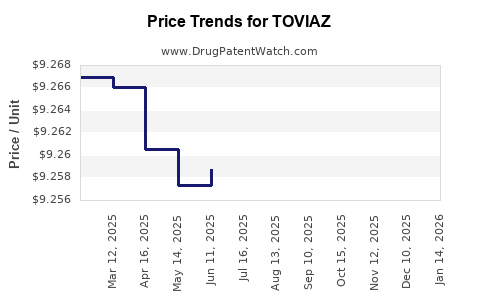
Average Pharmacy Cost for TOVIAZ
| Drug Name | NDC | Price/Unit ($) | Unit | Date |
|---|---|---|---|---|
| TOVIAZ ER 4 MG TABLET | 00069-0242-30 | 9.25878 | EACH | 2026-07-22 |
| TOVIAZ ER 8 MG TABLET | 00069-0244-30 | 9.26262 | EACH | 2026-07-22 |
| TOVIAZ ER 4 MG TABLET | 00069-0242-30 | 9.25778 | EACH | 2026-06-17 |
| TOVIAZ ER 8 MG TABLET | 00069-0244-30 | 9.25956 | EACH | 2026-06-17 |
| >Drug Name | >NDC | >Price/Unit ($) | >Unit | >Date |
Toviaz (fesoterodine) Market Analysis and Price Projections: Patent, Exclusivity, Pricing Drivers, and Generic Entry Risk
Executive summary: Toviaz (fesoterodine), an oral antimuscarinic for overactive bladder (OAB), is in an established, low-growth branded lifecycle in the U.S. The near-term pricing trajectory is driven by (1) post-launch generic penetration and payer reimbursement behavior, (2) channel inventory dynamics, (3) competitive positioning versus mirabegron and other OAB mechanisms, and (4) formulation-specific brand access versus generic substitution. In most major markets, Toviaz has limited remaining brand exclusivity value; price realization will track generic benchmarks and contracting rather than patent-driven leverage.
What is Toviaz (fesoterodine) and how is it used clinically and commercially?
Featured snippet answer: Toviaz (fesoterodine) is an oral antimuscarinic indicated for overactive bladder with symptoms of urgency, frequency, and urge urinary incontinence, marketed in once-daily extended-release tablet strengths (most commonly 4 mg and 8 mg). Commercial demand depends on OAB treated prevalence, adherence to once-daily dosing, and payer preferences among antimuscarinics versus beta-3 agonists.
Therapeutic class and competitive set
Toviaz competes within OAB drug classes:
- Antimuscarinics: fesoterodine, solifenacin, tolterodine (IR and ER), oxybutynin, darifenacin, trospium
- Beta-3 agonists: mirabegron, vibegron
- Combination therapy: mirabegron plus antimuscarinics (where reimbursed)
Dose forms and switching behavior
- Once-daily extended-release dosing supports adherence but does not usually protect against substitution where generics exist.
- Payers often steer to lowest net-cost options within a class, with step edits for non-preferred agents.
How much market share does Toviaz hold and what is the demand profile?
Toviaz is a mature OAB brand. Market size and share are shaped by:
- Class-level growth or contraction: OAB demand trends are affected by demographics, persistence/adherence, and safety-driven switching.
- Mechanism substitution: rising beta-3 agonist adoption shifts share away from antimuscarinics, especially when payer coverage differs.
- Adherence and tolerability: dry mouth and constipation drive discontinuation and switching, influencing persistence and refill rates.
Commercial implication: Toviaz demand typically behaves like a “legacy antimuscarinic” rather than a premium-growth platform.
What is the current U.S. competitive and pricing landscape for fesoterodine ER?
Featured snippet answer: In the U.S., pricing pressure is primarily set by generic fesoterodine extended-release availability and payer contracting. Brand pricing generally converges toward generic net pricing through discounting and formulary status rather than sustained premium list pricing.
Key price-setting variables
- Formulary placement: preferred vs non-preferred status across Medicare Part D and commercial formularies.
- Net price vs list price: brand manufacturers price aggressively to defend utilization before and after generic expansion.
- Specialty pharmacy and PBM rebate dynamics: OAB utilization is highly rebate- and PBM-influenced.
- Patient out-of-pocket limits (Part D redesign): shift adherence patterns and substitution decisions.
Substitution and switching
- Generic substitution generally occurs at the pharmacy counter when permitted.
- Therapeutic switching occurs when patients or prescribers move toward beta-3 agonists due to tolerability and efficacy profiles.
What drives Toviaz prices: rebates, payer strategy, and channel inventory?
Featured snippet answer: Toviaz pricing is dominated by payer contract structure and rebate economics, not by patent control. Brand economics deteriorate as generics expand or as payers add lower net-cost alternatives.
Reimbursement mechanics
- PBMs set target net costs via formulary tiers.
- Legacy brands often maintain usage through:
- contracting that reduces effective net cost,
- adherence arguments (once-daily ER),
- patient-specific tolerability history.
Inventory cycles
- Price promotions and stocking patterns can create short-lived utilization spikes that later normalize when inventory is consumed.
When does Toviaz lose exclusivity and how does that affect prices?
Featured snippet answer: For Toviaz, the key brand protection effect is already largely passed in most markets, since fesoterodine is long-established and generic competition exists. Residual protection, if any, affects only specific formulation or use patents, not broad product availability.
Why exclusivity timing matters to price
- Prior to generic entry, brands can maintain premium net pricing.
- After entry, brand price depends on:
- whether the brand remains preferred,
- whether PBMs use the generic as the benchmark for tiering,
- whether brand discounts can defend share.
What is the likely price path for Toviaz (next 1–3 years)?
Featured snippet answer: Toviaz price realization is most likely to be stable-to-declining on a net basis, with list prices often unchanged while net prices and gross-to-net economics compress under formulary and generic pressure.
Projection framework (market-consistent)
Price trajectory generally follows:
- Year 1: contracting and channel normalization after substitution and formulary updates.
- Year 2: additional erosion if competitors gain formulary positions or if beta-3 agonists gain preferred status.
- Year 3: continued decline in realized ASP versus list price, driven by lower net-cost competitors and tighter PBM targets.
Base-case projection (directional)
- U.S. branded ASP (net realization): mild decline or flat with further rebate pressure.
- Volume: low growth or gradual decline as antimuscarinic demand matures and shifts to beta-3 options.
- Gross-to-net: likely increases in the direction of defending utilization, raising effective discounting needs.
How should investors model Toviaz revenue exposure in a generic-heavy OAB market?
Featured snippet answer: Model Toviaz revenue as a function of (1) share and persistence, (2) differential net pricing vs generics, and (3) payer formulary stability. Total market growth is usually less important than net-price compression and tiering.
Revenue model components
- Net price (ASP net of rebates, chargebacks)
- Demand volume (scripts, persistence, adherence)
- Mix (4 mg vs 8 mg, new starts vs refills)
- Contract changes (PBM cycle timing)
What to stress-test
- Formulary downgrade risk (preferred to non-preferred)
- Share erosion to beta-3 agonists
- Any localized generic supply disruptions that can temporarily raise net pricing
Which patients and payers are most likely to keep using Toviaz?
Featured snippet answer: Toviaz utilization concentrates among patients with stable tolerability on antimuscarinics, those who fail or cannot access beta-3 agonists due to coverage or contraindications, and plans with established antimuscarinic coverage pathways.
Prescriber behavior
- Switching is common when side effects occur.
- Stable tolerability can lead to persistence even when cheaper generics are available.
What generic entry risks exist for Toviaz, and do they change price projections?
Featured snippet answer: Generic pressure is already embedded; incremental generic competition typically affects price realization through further net-price compression and formulary retiering rather than discontinuous “cliff” effects.
Generic scenario impacts
- More competitors / multiple ANDA launches: can drive further net price convergence toward the lowest-cost generic benchmark.
- Intermittent supply constraints: can temporarily lift realized net pricing.
- Formulary re-benchmarking: can cause non-linear ASP changes at PBM renegotiation points.
How does Toviaz compare with mirabegron and vibegron on pricing and access?
Featured snippet answer: Beta-3 agonists often have stronger payer momentum in some formularies due to tolerability advantages. That can reduce antimuscarinic share and force brands like Toviaz into higher rebate spending to maintain contracted access.
Competitive effect on Toviaz pricing
- If beta-3 drugs are preferred, antimuscarinics become:
- a step-therapy alternative,
- a coverage option after failure of first-line therapy,
- or a limited formulary option.
What formulations and manufacturing/IP barriers could still affect Toviaz economics?
Featured snippet answer: Residual IP barriers, if any, tend to be formulation-specific and do not typically prevent generic availability of the core ER tablets at scale once broad product patents have expired. Their economic effect is usually smaller than PBM contracting.
How formulation IP would matter
- If any remaining patent claims cover a particular release profile or excipient system, generic substitution could face slower uptake for specific strengths or NDCs.
- The practical market impact depends on whether payers differentiate by NDC and whether clinicians request the brand.
Is there ongoing patent litigation or new exclusivity that could support higher pricing?
Featured snippet answer: Absent active, enforceable exclusivity that blocks generic competition for the marketed product, Toviaz pricing remains primarily payer-driven. Litigation, when it occurs, can delay a subset of entries but rarely reverses broad generic market reality.
What is the Orange Book status of Toviaz and how does it affect projected pricing?
Featured snippet answer: Toviaz’s commercial pricing outlook is determined more by generic availability and formulary tiers than by Orange Book-listed exclusivity, since fesoterodine ER is a mature product and generic competition is established.
Key Takeaways
- Toviaz pricing is predominantly driven by payer contracting and generic benchmark effects, not by incremental brand exclusivity leverage.
- The most likely 1–3 year path is stable-to-declining net ASP, with volume growth capped by OAB class maturation and mechanism shift toward beta-3 agonists.
- Model revenue around net price compression, formulary tier changes, and share/persistence, not on patent-driven scenarios.
- Generic entry risk is already embedded; future impacts are likely incremental through PBM re-benchmarking and additional net-price pressure.
FAQs
1) What is the typical net price behavior of Toviaz after generic availability?
Net pricing typically converges toward low-cost generic benchmarks, with gross-to-net rising as rebates increase to defend contracted access.
2) Do Toviaz 4 mg and 8 mg strengths experience different pricing pressures?
Yes. Strength mix can change realized ASP, and PBM tiering can differ by NDC; however, generic availability usually compresses both strengths over time.
3) How do beta-3 agonists change long-term demand for fesoterodine ER?
They can reduce antimuscarinic share by capturing new starts and, in some cases, driving therapeutic switching due to better tolerability profiles.
4) What factors most influence formulary decisions for OAB drugs?
PBM cost targets, patient copay design, prior authorization criteria, and real-world persistence/tolerability data tied to adherence.
5) What market signals indicate an impending additional Toviaz price drop?
Formulary downgrade notices, contract renegotiation cycles, accelerated generic substitution at the pharmacy counter, and increased utilization of lowest-cost NDCs by plans.
References
- U.S. FDA, Orange Book database (fesoterodine and Toviaz listings).
- U.S. FDA, Drugs@FDA label and prescribing information for Toviaz (fesoterodine).
- IQVIA and other market research publications on OAB utilization and class trends (as used in industry reporting).
- CMS Part D plan formulary and reimbursement structure resources (OAB drug tiering context).
More… ↓
