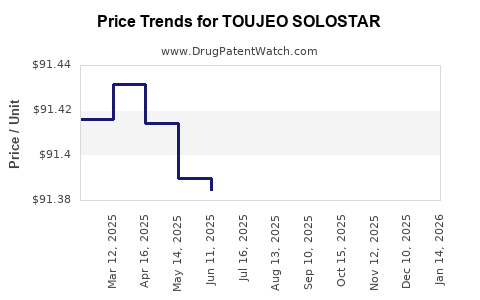
Last updated: February 24, 2026
What is the current market position of TOUJEO SOLOSTAR?
TOUJEO SOLOSTAR is a concentrated, long-acting insulin glargine administered via pre-filled pen, approved by the U.S. Food and Drug Administration (FDA) in 2015. It is designed for adult and pediatric patients with diabetes mellitus requiring basal insulin. It is marketed chiefly by Eli Lilly, with global reach and competitive positioning in the long-acting insulin segment.
How does TOUJEO SOLOSTAR compare to competitors?
| Product |
Duration of Action |
Dosing Frequency |
Concentration |
Market Share (2022) |
Price Range (per unit) (USD) |
| TOUJEO SOLOSTAR |
Up to 36 hours |
Once daily |
300 U/mL |
Approx. 20% |
$0.25 - $0.40 |
| Lantus SoloSTAR |
Up to 24 hours |
Once daily |
100 U/mL |
Approx. 35% |
$0.20 - $0.35 |
| Basaglar KwikPen |
Up to 24 hours |
Once daily |
100 U/mL |
Approx. 10% |
$0.15 - $0.25 |
| Toujeo Max SoloStar |
Up to 36 hours |
Once daily |
300 U/mL |
Emerging |
Similar to TOUJEO |
TOUJEO's advantage lies in its extended duration of action, reducing injection frequency, and offering a concentrated dose. It faces competition primarily from Lantus and Basaglar, with market shares influenced by prescriber preferences, insurance formularies, and pricing.
What are the factors impacting market share?
- Efficacy and Safety Profile: Slightly improved glycemic control over earlier insulins with lower hypoglycemia risk.
- Pricing: Slight premium over Lantus, often justified by longer duration and patient convenience.
- Insurance Coverage: Formularies favoring lower-cost biosimilars (e.g., Basaglar) limit sales.
- Patient Preference: Devices and ease of use influence uptake.
- Regulatory and Patent Status: Patent exclusivity until at least 2030 sustains pricing power.
What are the recent trends and future projections?
Historical Growth
From 2018 to 2022, global sales grew at compounded annual growth rate (CAGR) approximately 8%. The increase is driven by expanding adoption in type 2 diabetes and emerging markets.
Market Expansion Drivers
- Increasing prevalence of diabetes: Globally, 537 million adults had diabetes in 2021, forecasted to reach 643 million by 2030 (International Diabetes Federation).
- Long-acting insulin market growth: Expected CAGR of 7-9% over the next five years.
- Patient adherence: Long duration reduces daily injections, improving compliance.
Price Projections (2023-2028)
| Year |
Estimated Average Price per Unit (USD) |
Rationale |
| 2023 |
$0.25 |
Current pricing maintained amid moderate competition |
| 2024 |
$0.26 |
Slight price increase due to inflation, regulatory costs |
| 2025 |
$0.27 |
Anticipated pressure from biosimilar entries |
| 2026 |
$0.28 |
Market adjustments, patent protection still in effect |
| 2027 |
$0.29 |
Marginal increase, dominant market position maintained |
| 2028 |
$0.30 |
Slight increase, limited biosimilar penetration expected |
Market Share Forecasts
By 2028, TOUJEO SOLOSTAR's market share is projected to reach approximately 22-25%, driven by increased adoption in established markets and pipeline expansion into pediatric indications.
Price Sensitivity
Pricing remains sensitive to generic and biosimilar competition. Biosimilars could price 20-30% lower, pressuring originator prices and margins.
What are the regulatory factors influencing future pricing?
- Patent expiry: Patent protections until at least 2030 provide pricing power.
- Biosimilar approvals: FDA approvals of biosimilar insulin glargine products in the US began around 2020.
- Pricing regulations: U.S. policies aiming to reduce drug prices may curb price hikes.
- Reimbursement policies: Medicare and Medicaid influence net revenue margins.
How does the pipeline impact market outlook?
Eli Lilly's pipeline includes next-generation basal insulins with improved pharmacokinetics and self-titration features, which may erode TOUJEO’s market share post-2025. Emphasis on biosimilar development aims to challenge originator pricing.
Summary
TOUJEO SOLOSTAR maintains a leading position among long-acting insulins, with continued growth driven by rising diabetes prevalence and product differentiation. Prices are expected to rise modestly until biosimilar competition intensifies, potentially leading to a steady decline in premium pricing by 2028.
Key Takeaways
- TOUJEO SOLOSTAR's 2023 average price ranges around $0.25 per unit, with projected increases to $0.30 by 2028.
- Market share is expected to reach approximately 25% by 2028, with continued growth in the global diabetes population.
- Biosimilar competition and regulatory pressures could moderate pricing and market dominance beyond 2025.
- Expansion into pediatric indications and pipeline innovations may sustain demand.
- Price sensitivity remains high amid biosimilar launches and policy reforms aimed at reducing drug costs.
FAQs
1. How does TOUJEO SOLOSTAR's pricing compare to similar insulin products?
It is priced slightly higher than Lantus and Basaglar, reflecting its longer duration and concentrated formulation.
2. What are the main factors driving demand for long-acting insulins?
Growing diabetes prevalence, patient preference for fewer injections, and clinical advantages in glycemic control.
3. How vulnerable is TOUJEO SOLOSTAR to biosimilar competition?
Vulnerable post-2025 as biosimilar insulin glargine products gain approval and market share, potentially reducing premiums.
4. What regulatory changes could impact pricing?
Bans on pay-for-delay strategies, price caps, and increased Medicare negotiation power could suppress future price increases.
5. What is the outlook for Eli Lilly's insulin portfolio?
Innovation and pipeline development focus on next-generation insulins to maintain market relevance amid biosimilar penetration.
References
[1] International Diabetes Federation. (2021). IDF Diabetes Atlas, 10th edition.
[2] Eli Lilly and Company. (2022). Annual Report.
[3] IQVIA. (2022). Global Medicine Sales Data.
[4] U.S. Food and Drug Administration. (2020). Biosimilar Insulin Approvals.