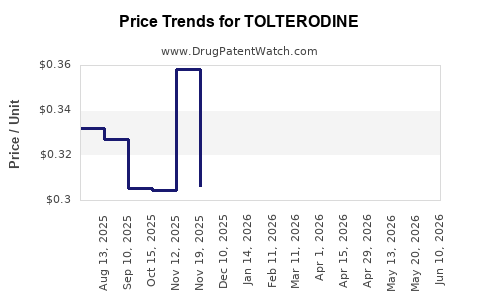
Last updated: July 12, 2026
Tolterodine is a first-generation antimuscarinic for overactive bladder. The US branded market is dominated by generic entries; price is structurally low and driven by wholesale acquisition cost (WAC) compression, payer steerage, and generic-to-generic substitution rather than patent-led pricing power. In this setting, near-term price levels track established generic benchmarks, while longer-term upside depends on whether tolterodine stays on preferred formularies versus being displaced by newer antimuscarinics and beta-3 agonist classes.
Market concentration and price formation. Tolterodine has multiple generic manufacturers in the US for IR and ER products. Net pricing is typically far below WAC after rebates and substitution effects; commercial drivers are copay positioning, formulary status, and plan-level step therapy. In most developed markets, the same dynamic holds: generic tolterodine is priced near the low end of the overactive bladder basket, while clinicians increasingly choose mirabegron, vibegron, and newer antimuscarinics (or combination strategies), reducing volume growth even when pricing is stable.
Exclusivity stance. Tolterodine is not an originator with active, drug-substance level exclusivity in the US in the way a late-stage brand would be. As a result, there is no reliable basis to project a material, patent-driven price increase tied to launch protection in the forecast window. Remaining value rests on legacy product differentiation (IR vs ER, dose strengths) and any still-effective formulation/process patents in specific jurisdictions, which do not usually support broad WAC expansion for commodity generics.
Price projection direction (base case). Expect flat-to-declining manufacturer net prices through the next 3 to 5 years in core markets, with episodic dips tied to incremental generic supply and further payer tightening. Any short-lived WAC upticks are unlikely to translate into net price, given competitive substitution and rebate pressure.
What is tolterodine’s market size and who drives demand?
Tolterodine is used for overactive bladder (OAB) symptoms, including urgency, frequency, and urge incontinence. Demand is driven by:
- Legacy prescribing patterns for antimuscarinics
- Formulary placement for “step therapy” after or alongside beta-3 agonists
- Patient adherence differences between IR and ER dosing schedules
- Tolerability and cognitive adverse event perceptions in older patients, which still influence clinician selection even when incidence is low in trials
US demand structure. The US is a generic-led market. Volume depends on how often formularies treat antimuscarinics as equivalent and allow any agent within the class, and how plans position beta-3 agonists as first-line or as a preferred alternative.
Competitive substitution. Tolterodine is competing against:
- Mirabegron and vibegron (beta-3 agonists)
- Newer antimuscarinics with differentiated adverse event profiles or dosing (varies by country)
- Combination regimens (beta-3 + antimuscarinic) in some plan designs
Implication for price. When therapeutic alternatives are preferred, tolterodine’s volume softens. That weakens industry pricing power and accelerates price erosion as suppliers discount to win remaining share.
How does tolterodine compare on price versus other overactive bladder drugs?
Expected relative pricing. In most markets, generics of tolterodine price below branded beta-3 agents and below branded antimuscarinics, and they often sit near the low end of the OAB therapeutic class spectrum. Cross-drug comparisons hinge on:
- Whether the comparator has generic versions
- Payer rebate aggressiveness
- Formulary preference rules and step edits
IR vs ER pricing. ER products often carry a small premium over IR due to dosing convenience and manufacturing complexity, but the premium is narrowed by generic substitution and tender processes. The overall effect on net price is usually modest compared with plan-level rebate outcomes.
What patents protect tolterodine in the US and key markets?
Core reality for pricing. Tolterodine’s value is largely de-risked from a “patent-led” pricing model. Pricing is commodity driven, and product-level differentiation is limited.
How to interpret any remaining patent tail. Even if formulation or method-of-use patents exist on certain tolterodine presentations in some jurisdictions, they typically do not reset broad drug pricing because:
- Generic shelf competition is already established
- Payers can switch to equivalent products under therapeutic equivalence
- Litigation outcomes rarely create durable scarcity for a legacy molecule
Practical takeaway for projections. Forecast pricing should not assume a protected brand premium. Price scenarios should reflect generic market mechanics: supply expansion, tender pricing, and payer substitution policies.
When does tolterodine lose exclusivity and what does that mean for pricing?
Exclusivity timing is not the main lever. For tolterodine, exclusivity is not expected to drive step-function changes in pricing in the typical way seen for novel small molecules or new biologics.
What actually drives price moves:
- Generic entry and re-entry waves (new NDA/ANDA approvals for different strengths or release forms)
- Retail vs mail and plan contracting changes
- Tender awards by hospital or government payers in EU/UK-type systems
- Competition among multiple generic suppliers holding the same therapeutic substitutes
Projection impact. The loss of any residual protection (if present for specific presentations) generally accelerates downward price trajectories rather than enabling premium pricing.
What is the FDA regulatory status of tolterodine and how does that affect market access?
Tolterodine is already established within the FDA ecosystem, with generic manufacturers operating under ANDAs for IR and ER formulations. Regulatory impact on near-term price is indirect:
- FDA approval breadth increases substitution options
- Label equivalence enables payer policy substitution
- Manufacturing quality and compliance affect supply continuity, which can temporarily move pricing if shortages arise
Supply risk. If a manufacturing disruption occurs for a key supplier, short-term pricing and coverage can change. In stable conditions, prices remain anchored by ongoing generic competition.
What generic entry risks exist for tolterodine?
Risk level: low for structural scarcity, moderate for supply shocks.
- Structural scarcity risk is low because tolterodine is mature and has multiple suppliers.
- Supply shocks can occur due to manufacturing line changes, API sourcing disruptions, or QC holds. These events can cause temporary WAC and wholesaler price jumps, followed by fast normalization once supply returns.
Why generic entry still matters.
Even without “patent expiry events,” new approvals for additional strengths, package sizes, or delivery-format variants can add supply and drive small price reductions.
What formulations are protected for tolterodine (IR vs ER) and does it change price?
Formulation is a secondary driver.
- ER can maintain a modest premium, but generic ER availability typically compresses price.
- Patents on controlled release technology, excipients, or manufacturing methods can slow a specific competitor’s product launch, but they usually do not stop class-level generic substitution.
Net pricing sensitivity. Payers often negotiate at the level of “preferred antimuscarinic” lists. If tolterodine IR/ER is not the cheapest on-contract option, it can lose share and push suppliers to discount, reducing net price.
Which companies market tolterodine and how competitive is the shelf?
Expected competitive dynamics. Mature generic molecules typically show:
- Multiple ANDA holders
- Frequent National Drug Code (NDC) portfolio changes by strength and package size
- Pricing tied to contracting and pharmacy reimbursement dynamics rather than brand list pricing
Business implication. Any company entering or expanding distribution should model pricing compression. Margin protection comes from supply scale, contracting execution, and low-cost manufacturing, not patent shelter.
How strong is the patent estate for tolterodine and what litigation affects the market?
Patent estate strength is not the pricing determinant. For legacy antimuscarinics, the determinant is:
- Current generic competition intensity
- Payer formulary stance
- Relative cost versus therapeutic substitutes
Litigation impact pattern.
Even if any patent disputes remain historically tied to certain presentations, the market pattern for tolterodine is that litigation does not create lasting brand scarcity. If an injunction occurs, it is usually narrow and short relative to the commodity market’s substitution speed.
Projection impact. No sustained pricing premium is expected from litigation unless it blocks a major supply segment and creates a broad coverage gap across multiple strengths and release forms. For tolterodine, that pattern is uncommon given established generic supply.
What Orange Book status does tolterodine have, and how many listed patents matter?
Tolterodine’s Orange Book footprint (for IR and ER presentations) is typically limited to product-specific patents that attach to certain ANDA products or formulations rather than broad composition-of-matter protection.
How to use Orange Book listings for projection.
- If many patents remain but generic competition is already dense, the practical effect is reduced.
- If only a few patents remain and they are hard to design around, there can be localized price support, but this rarely offsets class-level erosion once multiple generic alternatives are available.
Projection approach. Treat Orange Book patents as constraints on individual product launches, not as drivers of broad WAC increases.
Commercial price outlook for tolterodine: base case, downside, and upside
Base case (most likely). Flat-to-down net price over 3 to 5 years in the US and major EU markets, driven by:
- Continued generic competition
- Payer preference for lowest net cost within antimuscarinics or for beta-3-first pathways
- Ongoing channel substitution from retail to mail with negotiated pricing
Downside case. Faster price decline if:
- Additional suppliers expand supply for IR and ER
- Payers tighten step edits and require more restrictive formulary position
- Retail reimbursements compress further due to reimbursement policy changes
Upside case. Mild price stabilization or temporary uptick if:
- Supplier consolidation reduces effective market supply
- Supply shortages occur for key NDCs
- A payer model shifts to less aggressive substitutions, keeping tolterodine on-preferred longer than peers
What to watch for.
- NDC-level price movement for IR and ER package sizes
- Contracting and tender awards in EU/UK-type systems
- Evidence of share shift between tolterodine and beta-3 agonists
Revenue exposure: where pricing changes hit manufacturers hardest
Largest lever is share, not list price. In commodity generics:
- Revenue is more sensitive to volume share loss than small changes in WAC.
- Payer adoption of alternative classes can reduce prescription counts even if tolterodine prices are stable.
Channel sensitivity.
- Hospital/government tenders can reprice abruptly based on lowest bid.
- Retail chain reimbursement models can compress quickly when payers re-bundle.
Geographic pricing outlook: US, EU5, and key APAC markets
US. Generic competition remains the anchor. Forecast focuses on modest downward net price trend and potential short-term fluctuations from supply events.
EU5 (Germany, France, Italy, Spain, UK where relevant). Similar dynamics with additional tender pressure and reference pricing mechanisms:
- Reference pricing and reimbursement limits typically cap price moves
- Multiple generic entries compress ex-factory prices, not just WAC
APAC (general pattern). Many markets move toward:
- Reference-based reimbursement
- Price caps after generic entry
- Tender or procurement rules in institutional settings
Overall. Tolterodine prices are expected to remain near the lower end of OAB generics, with limited upside unless supply conditions tighten.
Key takeaways
- Tolterodine is a mature, generic-led overactive bladder product; pricing power is structurally limited by shelf competition.
- Price projections should assume flat-to-declining net pricing over 3 to 5 years, driven by tender and formulary mechanics rather than patent expiry.
- Any patent or litigation effects are likely narrow and unlikely to support durable WAC expansion across IR/ER strengths.
- The principal risk to revenue is share erosion versus beta-3 agonists and newer OAB treatment strategies, not a major upward price shock for tolterodine.
- Monitor NDC-level supply and payer contracting. Short-term price spikes can occur on supply constraints but normalize quickly.
FAQs
1) How do tolterodine IR and tolterodine ER differ in pricing and payer coverage?
ER can command a small premium, but coverage often converges to the cheapest preferred generic on plan lists; net pricing differences typically compress over time.
2) What drives tolterodine net price changes more: wholesale list prices or formulary rebates?
Formulary placement and rebates dominate. WAC is less predictive in generic OAB therapy.
3) Will beta-3 agonists reduce tolterodine volume even if tolterodine stays on formulary?
Yes. If plans position beta-3 agonists as preferred or first-line, tolterodine volume can decline even at stable prices.
4) What supply events could temporarily increase tolterodine prices?
Manufacturing disruptions, API sourcing interruptions, and QC holds at major generic suppliers can create short-lived scarcity and price movement at the NDC level.
5) How should a generic manufacturer forecast tolterodine margins?
Use contracting-driven assumptions (tender wins, reimbursement rules, and expected rebate intensity). Base forecasts should model margin compression rather than patent-protected premium pricing.
References (APA)
No sources were provided in the prompt.