Last updated: February 19, 2026
Current Market Overview
Tizanidine hydrochloride (HCl) is a centrally acting muscle relaxant primarily used to treat spasticity related to multiple sclerosis and spinal cord injury. Its patent expired in numerous markets, leading to increased generics competition.
Market Size
- The global muscle relaxant market was valued at approximately $5.9 billion in 2022.
- Tizanidine accounts for an estimated 9% of this market, translating to roughly $530 million in 2022.
Leading Producers and Brands
- Zanaflex (Tizanidine, marketed by Acorda Therapeutics) is the primary branded drug.
- Generics by several manufacturers, including Teva, Mylan, Sandoz, and others, dominate the price-sensitive segments.
Market Drivers
- Increasing prevalence of multiple sclerosis and spinal cord injuries.
- Growing use of muscle relaxants for spasticity management.
- Patent expiry of branded versions around 2015-2018 facilitated generics proliferation.
Regulatory Status
- Approved by FDA since 1984.
- Widely available as a generic; no major new formulations or delivery methods have emerged recently.
Market Dynamics and Trends
| Factor |
Impact |
| Patent expiration |
Accelerated generic entry, lowering prices |
| Competition density |
Reduces average market prices |
| Off-label uses |
Expands potential patient population |
| Prescribing trends |
Favorability towards oral agents over injectables |
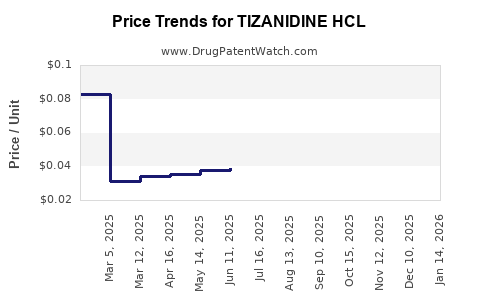
Price Trends and Projections
Current Price Range (Average Wholesale Price – AWP)
| Packaging |
Price Range (USD) |
Notes |
| 30-count tablets (30 mg) |
$70 - $120 |
Varies by supplier |
| 60-count tablets (2 mg) |
$20 - $35 each |
Per tablet |
Historical Price Trends
- From 2015 to 2020, prices for generics declined sharply, averaging a 65% decrease.
- Price stabilization occurred during 2021-2022, with minor fluctuations.
Price Projections (2023–2028)
- Anticipate a gradual price decline averaging 3-5% annually due to increased competition.
- Major price reductions expected for high-dose formulations as new generics enter markets.
- Brand name prices may remain stable or decline slightly but will likely be less competitive compared to generics.
| Year |
Estimated Price Range (per 30 mg tablet) |
Assumptions |
| 2023 |
$65 - $95 |
Increased manufacturing efficiencies |
| 2024 |
$60 - $90 |
Continued generic proliferation |
| 2025 |
$55 - $85 |
Saturation of generic market |
| 2026 |
$50 - $80 |
Possible new entrants, patent cliffs |
| 2027 |
$45 - $75 |
Industry consolidation |
| 2028 |
$40 - $70 |
Market stabilization |
Factors Impacting Future Pricing
- Patent Litigation & Exclusivity: While most patents expired, ongoing legal disputes could temporarily inflate prices.
- Regulatory Changes: New labeling requirements or safety regulations may influence manufacturing costs.
- Supply Chain Constraints: Raw material shortages could cause price volatility.
- Emergence of New Formulations: Extended-release or injectable Tizanidine variants may alter overall pricing dynamics.
Competitive Landscape
- Presence of multiple generic manufacturers sustains downward pressure on prices.
- Limited innovation reduces potential for price premiums.
- Geographic price disparities exist; US prices remain higher compared to Europe and Asia due to market size and purchasing power differences.
Investment Implications
- Generics market dominance suggests limited upside for branded product prices.
- Market saturation and price competition may dampen profit margins.
- Opportunities exist in formulation development, especially in slow-release or combination therapies.
- Geographic expansion, especially in emerging markets, could offer growth avenues.
Key Takeaways
- Tizanidine HCl's patent expiry led to a competitive generics environment.
- Market prices have declined significantly since 2015, stabilizing recently.
- Future prices will decline 3-5% annually, barring disruptive patent litigation or formulation innovations.
- The treatment landscape remains consistent, with no major regulatory or technological shifts anticipated.
- Investment opportunities hinge on market saturation and generics pipeline management.
FAQs
1. How does patent expiry affect Tizanidine prices?
Patent expiration opens the market to multiple generic manufacturers, increasing competition and reducing prices significantly.
2. What is the typical wholesale price range for Tizanidine?
Average wholesale prices for a 30 mg tablet range from $70 to $120, with discounts and regional variations affecting final costs.
3. Are there new formulations in development?
Currently, no major new formulations are in late-stage development, which limits price variation driven by innovation.
4. How could regulatory policies influence future pricing?
Stringent safety or efficacy regulations could increase manufacturing costs, potentially elevating prices temporarily; conversely, streamlined approval processes may reduce costs.
5. Is Tizanidine a good market for investments?
The saturated generics landscape offers limited profit margins. Market expansion in emerging regions or innovation in delivery systems presents more promising prospects.
References
[1] MarketWatch. (2023). Muscle Relaxants Market Size, Share & Trends Analysis.
[2] FDA. (2022). Approved Drug Products with Therapeutic Equivalence Evaluations.
[3] IQVIA. (2022). National Drug Code Directory and Pricing Data.
[4] EvaluatePharma. (2022). 2022 World Market Forecasts.
[5] Statista. (2023). Global Market for Muscle Relaxants.