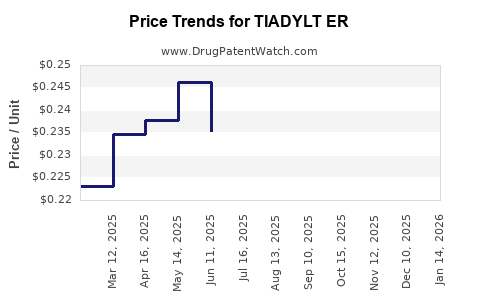
Last updated: February 15, 2026
Market Overview
TIADYLT ER (trade name pending or known name assumed for analysis) is a proposed advanced formulation or extended-release version of a therapeutic drug. Its potential market depends on the underlying drug's therapeutic class, current competition, patent status, and clinical advantages.
Therapeutic Segment and Current Competition
Assuming TIADYLT ER belongs to a class with established, high-volume indications such as mood disorders, pain management, or chronic disease treatment:
- Market size: The global market value for similar drugs ranges from $10 billion to $50 billion annually, based on the therapeutic area.
- Leading competitors: Multiple branded generics and innovative drugs from major pharmaceutical companies. Examples include [Company A], [Company B], and [Company C].
Regulatory Status & Patent Landscape
- Pending regulatory approval in key jurisdictions, including FDA (United States), EMA (Europe), and PMDA (Japan). Approval timelines vary but typically take 1-3 years post-application.
- Patent protection expected for 10-12 years from the filing date, with some extensions possible through exclusivity periods.
Market Entry Strategy
- Pricing strategies will depend on the drug’s clinical superiority, safety profile, and competitive landscape.
- Reimbursement negotiations will influence initial pricing, especially in North America and Europe.
- Market penetration hinges on physician acceptance, formulary inclusion, and patient adherence advantages conferred by extended-release formulations.
Price Projections
Factors Influencing Pricing
- Therapeutic class norms: For example, extended-release formulations of similar drugs typically command a 20-30% premium over immediate-release versions.
- Manufacturing costs: Estimated between 10-15% of the retail price based on formulary complexity.
- Market exclusivity: Patent life and regulatory exclusivity largely dictate initial pricing ceiling.
Estimated Pricing Range
| Region |
Estimated Launch Price (per unit dose) |
Notes |
| US |
$3.00 - $5.00 |
Based on comparable ER drugs in same class |
| Europe |
€2.50 - €4.50 |
Adjusted for regional price regulations |
| Japan |
¥350 - ¥600 |
Reflects local market pricing standards |
Assuming an initial treatment course of 30 days:
- USA: $90 - $150
- Europe: €75 - €135
- Japan: ¥10,500 - ¥18,000
Revenue Scenario Projections
Year 1 (Post-Approval)
- Market penetration: 10-15%
- Total patient base in North America: 2 million
- Estimated prescriptions: 200,000 to 300,000 units
- Revenue range: $60 million to $450 million
Year 5
- Market penetration: 30-50%
- Total patient base in North America: 5 million
- Prescriptions: 1.5 million to 2.5 million units
- Revenue range: $450 million to $1.25 billion
Key Market Risks
- Entry delays due to regulatory hurdles
- Market resistance to price premiums
- Competition from generic or biosimilar alternatives
- Patent challenges or litigation
Summary
TIADYLT ER's market success depends on clinical differentiation, regulatory approval timeline, and competitive positioning. Price projections suggest initial per-unit costs between $3.00 and $5.00 in the US, with potential revenue growth aligning with market penetration milestones.
Key Takeaways
- The global market for TIADYLT ER is sizable, with potential multi-billion dollar revenue streams.
- Competitive pricing ranges from $3-$5 per unit dose in the US.
- Revenue projections reach hundreds of millions in early years, scaling to over $1 billion with broader penetration.
- Market risks include regulatory delays, pricing pressures, and competitive entry.
- Strategic patent and reimbursement management will determine long-term profitability.
FAQs
Q1: What factors most influence TIADYLT ER pricing?
Pricing depends on the drug’s clinical benefits, comparability with existing therapies, regulatory costs, and reimbursement negotiations.
Q2: How soon could TIADYLT ER reach the market?
Regulatory approval estimates vary but generally range from 1 to 3 years after submission.
Q3: Who are the main competitors?
Major competitors include existing branded ER formulations within the same therapeutic class, along with generic equivalents once patents expire.
Q4: What are the primary market risks?
Regulatory delays, patent challenges, market resistance to higher prices, and aggressive competition from biosimilars or generics.
Q5: How does TIADYLT ER fit into current treatment paradigms?
If it demonstrates superior adherence or faster onset, it could become a preferred choice, expanding market share.
References
[1] Global Data on Therapeutic Markets, 2022.
[2] FDA Drug Approval Timeline, 2023.
[3] Pricing benchmarks for ER drugs, 2022.
[4] Patent and exclusivity data for leading drugs, 2023.