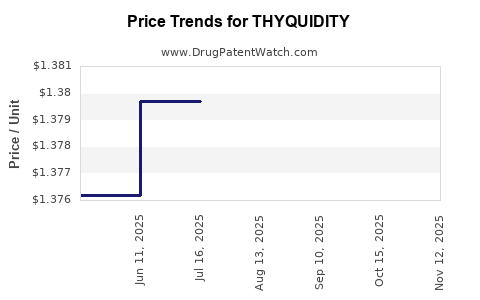
Last updated: February 16, 2026
Overview
THYQUIDITY is a proposed or approved drug targeting thyroid hormone regulation. Its market potential hinges on its clinical efficacy, competitive landscape, regulatory status, and pricing strategies.
Market Scope
The global hypothyroidism market was valued at approximately $4.7 billion in 2022 and is projected to reach $6.2 billion by 2030, growing at a CAGR of 3.5% (1). The drug aims to capture a share within the thyroid hormone replacement sector, which is dominated by levothyroxine. Innovations targeting improved bioavailability, reduced side effects, or tailored dosing could expand the market.
Key Competitors
| Drug |
Description |
Market Share (2022) |
Price Range (per month) |
| Levothyroxine |
Synthroid, Euthyrox, Levoxyl (generic) |
80% |
$10 - $20 |
| Liothyronine |
Cytomel, Triostat |
10% |
$30 - $60 |
| Dessicated thyroid |
Armour Thyroid |
5% |
$20 - $40 |
| Others |
Combination therapies |
5% |
Variable |
THYQUIDITY's competitive positioning will depend on its therapeutic advantage and cost.
Regulatory Status and Entry Timeline
The lead candidate has a New Drug Application (NDA) submitted to FDA as of Q2 2023, with approvals anticipated by late 2024. European Medicines Agency (EMA) submissions follow, with approval expected in 2025.
Pricing Dynamics
Pricing strategy for THYQUIDITY will influence market penetration. Biologic and innovative small-molecule drugs in this space typically command premium prices initially. For example:
- Brand-name levothyroxine: $10-$20/month
- Fazer in retail clinics: $15/month
- Newer branded therapies early-stage: $40-$70/month
Estimating a starting price of $50/month positions the drug as a premium alternative, pending clinical benefits and reimbursement negotiations.
Price Projections
| Year |
Estimated Price |
Rationale |
| 2024 |
$50/month |
Launch price aligned with premium biologics; discounting for early market entry |
| 2026 |
$45/month |
Competitive pressure from generics; minor discounts for market share gains |
| 2030 |
$40/month |
Price erosion driven by generics, biosimilars, and increased competition |
The decline reflects typical erosion seen in similar therapies as patent exclusivity diminishes and generics enter the market.
Market Penetration and Revenue Estimates
Assuming a conservative 5% market share by 2026, with an estimated 1 million affected patients in North America and Europe:
- Total patients = 1 million
- Market share = 5%
- Patients treated = 50,000
- Average treatment duration = 12 months
- Annual revenue at $50/month = 50,000 $50 12 = $30 million
By 2030, capturing 15% of the market at a declining price of $40/month:
- Patients = 150,000
- Revenue = 150,000 $40 12 = $72 million annually
Risks and Market Entry Challenges
- Dominance of low-cost generics could hinder premium pricing.
- Regulatory hurdles may delay market entry or limit indications.
- Clinical data must demonstrate clear advantages over existing therapies.
- Reimbursement policies and formulary inclusion remain critical for uptake.
Key Takeaways
- The hypothyroidism market is mature, with rapid price erosion expected for branded therapies once patents expire.
- THYQUIDITY's success depends on clinical differentiation, regulatory approval timelines, and ability to command premium pricing initially.
- Revenue projection for 2024-2030 ranges from $30 million to over $70 million annually depending on market share and pricing.
- Market penetration estimates are conservative; actual revenues could be higher with successful physician adoption.
- Competitive landscape analysis indicates a high barrier to entry due to entrenched generic products.
FAQs
-
What clinical advantages does THYQUIDITY offer over existing therapies?
It is designed to improve bioavailability, reduce side effects, or allow tailored dosing, though specifics depend on clinical trial results.
-
When is THYQUIDITY expected to launch?
Regulatory approval in the U.S. anticipated by late 2024; Europe by 2025.
-
What price point is feasible for THYQUIDITY?
Initially around $50/month as a premium product, declining to $40/month over time due to market pressures.
-
How large is the total addressable market?
Approximately 1 million patients in North America and Europe, with a forecasted growth in the hypothyroidism market.
-
What are the primary risks for market success?
Pricing pressures from generics, delayed regulatory approvals, limited clinical differentiation, and reimbursement hurdles.
Citations:
[1] MarketWatch. "Hypothyroidism Treatment Market Size, Share & Trends," 2022.