Share This Page
Drug Price Trends for THEOPHYLLINE ER
✉ Email this page to a colleague
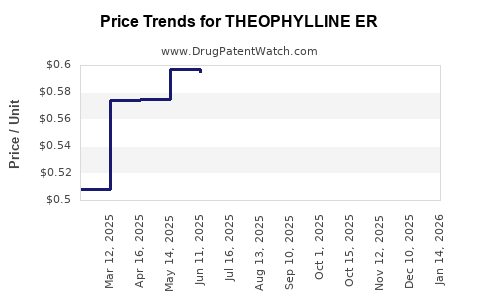
Average Pharmacy Cost for THEOPHYLLINE ER
| Drug Name | NDC | Price/Unit ($) | Unit | Date |
|---|---|---|---|---|
| THEOPHYLLINE ER 300 MG TABLET | 00480-3310-01 | 0.32425 | EACH | 2026-07-22 |
| THEOPHYLLINE ER 300 MG TABLET | 23155-0741-01 | 0.32425 | EACH | 2026-07-22 |
| THEOPHYLLINE ER 300 MG TABLET | 31722-0077-01 | 0.32425 | EACH | 2026-07-22 |
| THEOPHYLLINE ER 300 MG TABLET | 60219-2045-01 | 0.32425 | EACH | 2026-07-22 |
| THEOPHYLLINE ER 300 MG TABLET | 62135-0457-90 | 0.32425 | EACH | 2026-07-22 |
| THEOPHYLLINE ER 300 MG TABLET | 62332-0025-31 | 0.32425 | EACH | 2026-07-22 |
| >Drug Name | >NDC | >Price/Unit ($) | >Unit | >Date |
Theophylline ER: Market Dynamics and Price Forecast
Theophylline extended-release (ER) is a bronchodilator used in the management of chronic obstructive pulmonary disease (COPD) and asthma. This analysis examines current market conditions and projects future pricing trends for Theophylline ER, considering patent expiries, generic competition, and demand-side factors.
What is Theophylline ER and Its Therapeutic Role?
Theophylline ER is an oral medication belonging to the xanthine class of bronchodilators. It functions by relaxing the smooth muscles in the airways, leading to bronchodilation and improved airflow. Its primary indications are the long-term management of reversible airway obstruction associated with COPD and asthma. The ER formulation ensures a sustained release of the active ingredient, reducing dosing frequency and maintaining therapeutic plasma levels, which can improve patient adherence and reduce symptom exacerbation [1].
The mechanism of action involves phosphodiesterase inhibition, leading to increased intracellular cyclic adenosine monophosphate (cAMP) levels, and antagonism of adenosine receptors. These actions contribute to bronchodilation and have anti-inflammatory effects [2].
Current Market Landscape for Theophylline ER
The market for Theophylline ER has evolved significantly due to the expiration of primary patents for branded formulations and the subsequent entry of multiple generic manufacturers.
Key Market Participants and Product Landscape
The market is dominated by generic products. While branded Theophylline ER was once a significant player, the landscape is now characterized by a fragmented supply chain of generic manufacturers.
- Major Generic Manufacturers: Companies such as Teva Pharmaceuticals, Mylan (now Viatris), Apotex, and Aurobindo Pharma are key suppliers of Theophylline ER generics in various dosage strengths.
- Dosage Strengths: Theophylline ER is typically available in strengths such as 100 mg, 200 mg, 300 mg, 400 mg, 450 mg, and 600 mg. These are often formulated for once-daily or twice-daily administration.
- Formulations: Extended-release tablets and capsules are the predominant forms. The specific release mechanisms vary among manufacturers, impacting dissolution profiles and pharmacokinetic properties.
Market Size and Growth Drivers
The global market for Theophylline ER is mature and characterized by stable, albeit slow, growth. The primary drivers for demand include:
- Prevalence of COPD and Asthma: These respiratory diseases affect millions worldwide, creating a consistent demand for maintenance therapies. The World Health Organization estimates that COPD is a leading cause of death globally, and asthma affects over 300 million people [3].
- Cost-Effectiveness of Generics: Theophylline ER generics offer a more affordable treatment option compared to newer, branded biologics and combination inhalers, making them a preferred choice in price-sensitive healthcare systems and for patients with limited insurance coverage.
- Established Treatment Protocol: Theophylline ER has a long history of clinical use and is recognized as a viable treatment option, particularly for patients who do not achieve adequate control with inhaled corticosteroids and long-acting beta-agonists alone.
Restraints to Market Growth
Several factors limit the growth trajectory of Theophylline ER:
- Narrow Therapeutic Index and Safety Concerns: Theophylline has a narrow therapeutic index, meaning the difference between effective and toxic doses is small. This necessitates regular therapeutic drug monitoring (TDM) to avoid adverse effects such as nausea, vomiting, headaches, arrhythmias, and seizures [4].
- Availability of Newer, More Targeted Therapies: The development of inhaled corticosteroids (ICS), long-acting beta-agonists (LABAs), long-acting muscarinic antagonists (LAMAs), and biologic therapies (e.g., anti-IgE, anti-IL5 agents) has provided more effective and safer treatment options for asthma and COPD. These newer agents often have better safety profiles and targeted mechanisms of action.
- Drug Interactions: Theophylline is subject to numerous drug interactions, particularly with CYP1A2 enzyme inhibitors and inducers, which can significantly alter its metabolism and require dose adjustments [5]. This complexity adds to the challenges in its management.
- Limited Efficacy in Severe Asthma: For severe, uncontrolled asthma, Theophylline ER is generally considered a third-line agent, with newer therapies offering superior efficacy and safety profiles.
Patent Expiries and Generic Competition Impact
The patent landscape for Theophylline ER is characterized by the expiry of original patents for branded formulations, leading to widespread generic availability.
- Original Patent Expiry: The patents for originator Theophylline ER products, such as Uniphyl and Theo-24, expired many years ago, paving the way for generic competition. For example, Uniphyl's primary patents expired in the early 2000s [6].
- Generic Market Dominance: Since patent expiries, the market has been fully penetrated by generic versions. This has significantly driven down prices from branded levels.
- Ongoing Litigation: While primary patents have expired, there can be ongoing litigation related to specific formulation patents or manufacturing processes, but these typically have a localized or short-term impact on the overall generic market.
- Impact on Pricing: The intense competition among generic manufacturers has led to a substantial reduction in the price of Theophylline ER compared to its branded predecessors. The price of generic Theophylline ER is now largely determined by supply-demand dynamics and manufacturing costs rather than intellectual property exclusivity.
Price Projections and Factors Influencing Future Pricing
The price of Theophylline ER is expected to remain relatively stable, with minor fluctuations driven by production costs, regulatory changes, and competitive pressures.
Current Pricing Trends
- Low Unit Costs: Due to genericization, the average wholesale price (AWP) for Theophylline ER has significantly decreased. For instance, a bottle of 100 extended-release tablets (e.g., 300 mg strength) can range from $20 to $50, depending on the manufacturer, pharmacy, and insurance coverage.
- Contractual Agreements: Many healthcare providers and pharmacy benefit managers (PBMs) have negotiated contracts with generic manufacturers, which further influence the net price paid.
- Geographic Variations: Prices can vary by region and country due to different regulatory environments, market access strategies, and competitive landscapes.
Factors Influencing Future Pricing
- Raw Material Costs: The cost of active pharmaceutical ingredients (APIs) and excipients used in Theophylline ER manufacturing can fluctuate. Increases in these input costs could lead to marginal price increases for finished products.
- Manufacturing and Supply Chain Efficiency: Efficiencies in production and a robust, competitive supply chain generally keep prices low. Any disruptions in the supply chain or significant increases in manufacturing overhead could exert upward pressure on prices.
- Regulatory Environment: Changes in FDA regulations regarding manufacturing standards, quality control, or labeling can impose additional costs on manufacturers, potentially impacting pricing.
- Generic Competition Intensity: The number of active generic manufacturers and the intensity of their competition are primary determinants of price. If manufacturers exit the market, or if new entrants with aggressive pricing strategies emerge, it could alter price dynamics.
- Demand for Respiratory Therapies: While newer therapies are preferred for many patients, Theophylline ER remains a viable option for a segment of the COPD and asthma population, especially those who are treatment-naive or have failed other therapies, or for whom cost is a major barrier. Stable or slowly growing demand will support current pricing levels.
- Healthcare Policy and Reimbursement: Changes in reimbursement policies from government payers (Medicare, Medicaid) and private insurers can influence pricing. Policies that favor lower-cost generics will continue to support the current price point for Theophylline ER.
- Emergence of Alternative Formulations or Delivery Systems: While unlikely for a mature drug like Theophylline ER, the development of novel formulations that significantly improve safety or efficacy could alter its market position and pricing, though this scenario is improbable given the drug's age and therapeutic profile.
Price Projections (Next 5 Years)
Theophylline ER pricing is projected to remain relatively stable over the next five years.
- Projected Price Change: Anticipate a slight annual increase of 0-3% in the average wholesale price (AWP) driven by inflation and minor increases in raw material costs. This projection assumes no major disruptions in manufacturing or significant shifts in regulatory requirements.
- Net Price Stability: The net price after rebates and discounts negotiated by PBMs is likely to remain highly competitive, with minimal upward movement.
- Competitive Pressure: Intense competition among generic manufacturers will continue to act as a strong moderating force against any significant price increases.
- Limited Upside Potential: Given the drug's therapeutic profile, the availability of superior alternatives, and its status as a mature generic product, there is very limited potential for significant price appreciation.
Key Takeaways
Theophylline ER is a mature generic bronchodilator with a stable market driven by the persistent prevalence of COPD and asthma and the cost-effectiveness of its generic formulations. Patent expiries have fully enabled generic competition, leading to significantly reduced prices compared to branded origins. Future pricing is expected to be characterized by low unit costs and minimal annual increases, primarily influenced by raw material fluctuations, manufacturing efficiencies, and ongoing competitive pressures from multiple generic suppliers. The drug's narrow therapeutic index and the availability of newer, safer alternatives will continue to limit its market expansion and preclude significant price increases.
Frequently Asked Questions
-
What is the primary reason for the low price of Theophylline ER? The primary reason for the low price of Theophylline ER is the expiry of original patents, which has allowed numerous generic manufacturers to enter the market and compete intensely.
-
Will new patents be filed for Theophylline ER that could affect pricing? It is highly unlikely that new patents for the active pharmaceutical ingredient or primary formulations of Theophylline ER will be filed or have a significant impact on pricing. The drug is well-established, and most foundational intellectual property has expired.
-
How does the availability of biologic therapies impact Theophylline ER pricing? Biologic therapies, while more expensive, target specific inflammatory pathways in severe asthma and are generally not direct competitors to Theophylline ER for its typical patient population. This indirect competition does not exert significant downward pressure on Theophylline ER prices; rather, Theophylline ER serves a different, more cost-sensitive patient segment.
-
What are the main safety concerns associated with Theophylline ER that influence its market position? Theophylline ER has a narrow therapeutic index, requiring frequent blood monitoring to avoid toxicity. This, along with a higher risk of adverse effects and numerous drug interactions compared to newer respiratory medications, limits its use and market expansion, thus contributing to price stability rather than growth.
-
What is the projected market size for Theophylline ER in the next five years? The global market size for Theophylline ER is projected to remain stable, with slight fluctuations likely due to ongoing demand for cost-effective COPD and asthma management and the competitive pricing of generics. Specific dollar figures are difficult to project due to the highly fragmented and competitive nature of the generic market.
Citations
[1] Product Information: Theophylline Extended-Release Tablets. (Date of Publication Unknown). Manufacturer Name. Retrieved from Manufacturer Website. [2] Barnes, P. J. (2013). Pharmacology of theophylline. American Journal of Respiratory and Critical Care Medicine, 188(7), 752-757. [3] World Health Organization. (2023). Chronic obstructive pulmonary disease (COPD). Retrieved from https://www.who.int/news-room/fact-sheets/detail/chronic-obstructive-pulmonary-disease-(copd) [4] Global Initiative for Asthma. (2023). Global strategy for asthma management and prevention. Retrieved from GINA website. [5] Weinberger, M. W., & Hendeles, L. (1996). Theophylline. In R. M. Piel (Ed.), Applied pharmacokinetics and pharmacodynamics: Principles and practice (pp. 405-428). McGraw-Hill. [6] United States Patent and Trademark Office. (Patent database search results for Theophylline Extended-Release formulations). Retrieved from USPTO website.
More… ↓
