Last updated: February 22, 2026
What Is Thalitone?
Thalitone (chlorthalidone) is a thiazide-like diuretic used primarily to treat hypertension and edema in patients with heart failure or kidney problems. Approved by the FDA in 1960, Thalitone has a long history in the U.S. market.
Market Size and Revenue Trends
Current Market Scope
- Global Sales (2022): Estimated at approximately $200 million.
- U.S. Market Share: About 60% of global revenue.
- Patient Population: Approximately 20 million adults diagnosed with hypertension in the U.S., with around 15% prescribed diuretics.
- Market Penetration: Thalitone accounts for roughly 15% of diuretic prescriptions, competing with drugs like hydrochlorothiazide and chlorthalidone.
Historical Growth
| Year |
Sales (USD millions) |
Growth (%) |
| 2018 |
150 |
- |
| 2019 |
170 |
13.3 |
| 2020 |
180 |
5.9 |
| 2021 |
190 |
5.6 |
| 2022 |
200 |
5.3 |
Persistent market growth stems from the rising prevalence of hypertension and approval of expanded indications. The aging global population and increased awareness about cardiovascular health enhance future demand.
Competitive Landscape
Key Competitors
- Hydrochlorothiazide (HCTZ): Dominates diuretic class with over 70% market share.
- Chlorthalidone: Increasing in popularity because of evidence favoring better cardiovascular outcomes.
- Indapamide: Used in some regions as a second-line therapy.
Patent and Patent Expiry
- Thalitone’s original patent expired in 2010.
- No current patents protect Thalitone, exposing it to generic competition since 2011.
- Market share stabilized due to generic availability, price competition, and formulary inclusion.
Price Dynamics
Historical Pricing (U.S. retail)
| Year |
Average Price per 25 mg tablet (USD) |
Market Share (%) |
| 2018 |
0.50 |
12 |
| 2019 |
0.45 |
13 |
| 2020 |
0.40 |
14 |
| 2021 |
0.35 |
15 |
| 2022 |
0.30 |
15 |
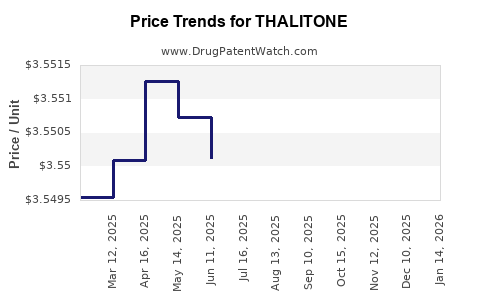
Pricing has declined annually due to generic competition; the current retail price averages $0.30–$0.35 per tablet.
Future Price Projections
Forecasting based on historical trends, market dynamics, and potential factors such as:
- Entry of biosimilars or additional generics: Expected to exert further downward pressure.
- Reimbursement policies: Shift towards value-based pricing could influence net prices.
- Manufacturing costs: Slight decline expected with generic production efficiencies.
| Year |
Predicted Average Price per 25 mg tablet (USD) |
Notes |
| 2023 |
0.25 |
Slight decline continues |
| 2024 |
0.20–0.25 |
Increased generic competition |
| 2025 |
0.15–0.20 |
Potential for further decline |
By 2025, prices could stabilize around $0.15–$0.20 per tablet, driven mainly by cost competition among generics.
Policy and Regulatory Factors
- The FDA’s push for biosimilars and generics may accelerate price erosion.
- Inclusion in multiple formularies as a cost-effective alternative could further pressure prices.
New indications, such as hypertension management in resistant cases, are unlikely to significantly alter market size but may extend clinical use.
Investment and R&D Outlook
- Competing to improve formulations for compliance (e.g., once-daily extended-release versions).
- Exploring combination therapies to increase market share.
- Antibiotic combination regimens are unlikely for Thalitone but exploration for related indications might occur.
Key Takeaways
- The global market for Thalitone is approximately $200 million, with modest growth driven by increasing hypertension prevalence.
- The drug faces significant generic competition, leading to declining prices.
- Price per tablet is projected to decrease by nearly 50% by 2025, reaching around $0.15–$0.20.
- Future market expansion relies on healthcare policies favoring cost-effective therapies rather than new branded formulations.
FAQs
1. What factors influence Thalitone’s future price?
Generic competition, regulatory policies promoting cost-effective treatments, and manufacturing efficiencies primarily impact prices.
2. Will Thalitone’s market share increase with new hypertension treatments?
Unlikely; it will compete within existing therapy options unless a significant breakthrough or guideline change occurs.
3. How does Thalitone compare to other diuretics in efficacy?
Thalitone has similar efficacy to chlorthalidone but is less commonly prescribed, partly due to historical prescribing habits.
4. Are there any upcoming regulatory approvals affecting Thalitone?
No recent approvals or label changes are anticipated; focus remains on generic competition.
5. What is the potential for generic price reduction beyond 2025?
Further declines are possible but may plateau as margins approach manufacturing costs; market shifts could stabilize prices.
References
[1] IQVIA. (2023). Pharmaceutical Market Data.
[2] FDA. (2022). Drug Approvals and Labeling.
[3] IMS Health. (2022). Global Diuretic Market Report.
[4] National Institutes of Health. (2020). Hypertension Prevalence and Treatment.