Last updated: February 15, 2026
What Is the Market Landscape for Tetracaine?
Tetracaine is a local anesthetic primarily used in ophthalmology, dermatology, and for procedures requiring topical anesthesia. Its global market is influenced by factors such as rising surgical procedures, increasing cosmetic treatments, and technological advancements in anesthesia delivery.
Market Size and Growth
The global local anesthetics market, which includes tetracaine, was valued at approximately $3.7 billion in 2021. It is projected to grow at a compound annual growth rate (CAGR) of 5.2% through 2028, reaching nearly $5.5 billion.
Tetracaine holds an estimated 10-12% share within this segment, primarily due to its use in ophthalmic procedures. The demand is driven by increased cataract surgeries and LASIK procedures.
Regional Market Distribution
- North America: Largest market, driven by high surgical volumes and extensive healthcare infrastructure.
- Europe: Significant share, with growing demand for ophthalmic and dermatological applications.
- Asia-Pacific: Fastest growth, propelled by expanding healthcare access, increasing cosmetic procedures, and medical tourism.
Competitive Dynamics
Major players include Akorn, Inc.; Akorn (now part of Fresenius Kabi); and pharmaceutical divisions of Johnson & Johnson. Generic formulations account for a large portion of sales due to patent expiry of proprietary formulations.
How Is the Price of Tetracaine Traded and Influenced?
Price Range and Trends
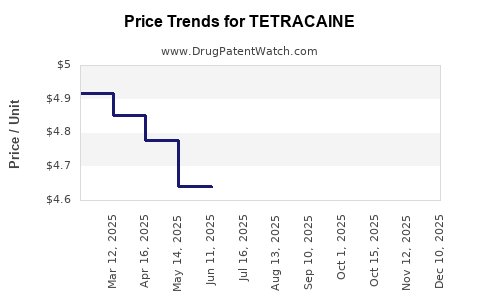
- Current Wholesale Price: Tetracaine ophthalmic solutions (0.5%) typically retail between $2.50 and $4.00 per unit (per 5 mL vial), depending on region and supplier.
- Generic Competition: Has driven prices down over the past decade, with average prices falling approximately 30% since 2010.
- Market Dynamics: Supply chain disruptions, raw material costs, and regulatory changes influence pricing.
Pricing Factors
- Raw Material Costs: Benzocaine and other anesthetic derivatives are key ingredients, with prices affected by supply volatility.
- Regulatory Environment: Approval delays or restrictions can inflate prices temporarily.
- Demand Fluctuations: Surgical and cosmetic procedure volumes impact demand and pricing.
Potential Price Trajectory
- The price is likely to stabilize or decline slightly due to increased generic competition.
- Price increases could occur if regulatory barriers restrict supply or if new formulations with improved delivery methods enter the market.
What Are the Future Price Projections?
Short-Term (Next 2 Years)
- Prices are expected to remain relatively stable, with minor fluctuations within a 5-10% range.
- Wholesale prices may decrease gradually due to enhanced manufacturing efficiencies and generic penetration.
Mid to Long-Term (3-5 Years)
- Prices could decline further by 10-15% as generic competition consolidates.
- Innovation in delivery systems (e.g., sustained-release formulations) may foster price premiums if they gain regulatory approval and clinical acceptance.
What Factors Could Shift Market and Price Dynamics?
- Regulatory Changes: Stricter approval pathways or patent protections can alter competitive landscape.
- Technological Advances: New formulations may replace traditional tetracaine, impacting demand.
- Healthcare Access: Expansion in surgical procedures in emerging markets increases overall demand.
- Raw Material Availability: Supply chain issues or price spikes in ingredients can influence manufacturing costs.
Key Takeaways
- The tetracaine market is tightly integrated into the broader local anesthetics sector, with robust demand in ophthalmic and cosmetic applications.
- Prices are predominantly influenced by generic competition, raw material costs, and clinical demand.
- A slight downward trend in wholesale prices is probable, with stability in retail prices.
- Price increases are unlikely unless constrained by regulatory or supply disruptions.
- Market expansion in Asia-Pacific and ongoing procedural growth globally will sustain demand.
FAQs
1. What are the main applications of tetracaine?
Tetracaine is used mainly for ophthalmic procedures, dermatological topical anesthesia, and in some minor surgical procedures.
2. How does tetracaine compare to other local anesthetics?
Tetracaine has a longer duration of action compared to lidocaine but is less commonly used in systemic anesthesia. It is preferred in specific ophthalmic and dermatological uses.
3. What are the patent considerations for tetracaine?
Most formulations are off-patent, favoring generic competition and price decline.
4. Are there any upcoming regulatory hurdles?
No significant new regulations are currently anticipated; however, new formulations may require approval, affecting pricing and availability.
5. How does healthcare infrastructure influence tetracaine's market?
Greater access to surgical and cosmetic procedures increases demand, especially in emerging markets where healthcare infrastructure is expanding.
Sources:
[1] MarketsandMarkets. “Local Anesthetics Market,” 2022.
[2] Global Market Insights. “Pharmaceuticals - Anesthetics Industry Trends,” 2023.
[3] IQVIA. “Healthcare Data and Market Trends,” 2023.