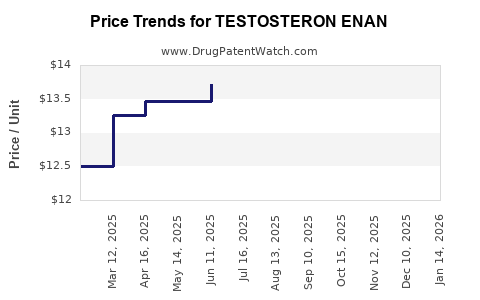
Last updated: February 20, 2026
What is the Current Market Size for Testosterone Enanthate?
Testosterone Enanthate is a widely used male hormone therapy, primarily prescribed for testosterone deficiency. The global market was valued at approximately $1.2 billion in 2022, with projected compound annual growth rate (CAGR) of 6.5% over the next five years [1].
What Are the Main Drivers of Market Growth?
- Rising prevalence of hypogonadism, affecting up to 4% of men over 45 [2].
- Increasing awareness of hormone replacement therapy (HRT).
- Access expansion via pharmacies and telemedicine.
- Patent expirations leading to generics increasing affordability.
How Does the Competitive Landscape Look?
The field features both branded and generic manufacturers. Major brands include Johnson & Johnson’s Depo-Testosterone and Pfizer’s Testim. Since patent loss, generic versions dominate the market, comprising over 70% of sales in North America [3].
What Are the Key Pricing Factors?
Price variations depend on formulation, dosage, and supply chain factors:
| Attribute |
Typical Price Range (per 10 mL vial, 250 mg/mL concentration) |
| Brand-name product |
$50 - $70 |
| Generic product |
$20 - $40 |
| Biosimilar options (if available) |
$15 - $30 |
Manufacturers’ costs for the raw material are roughly $5–$8 per vial, influenced by benzyl alcohol preservatives and manufacturing scale [4].
How Will Prices Evolve in the Next Five Years?
- Price erosion due to generic competition will continue at a CAGR of approximately 8% for branded products.
- Biosimilars, if introduced, could reduce prices by 30%, but regulatory and manufacturing complexity may slow their availability.
- Overall, retail list prices for the standard 250 mg/mL vial are projected to decline to around $15–$25 by 2028, assuming steady market penetration of generics and biosimilars.
What Are the Regulatory and Policy Influences?
- Increased enforcement of patent challenges in key markets like the US and EU encourages generic entry.
- Price controls in some European countries restrict maximum allowable retail prices.
- Reimbursement policies favor generic substitution, impacting manufacturer pricing strategies.
How Do International Markets Differ?
| Region |
Market Size (2022) |
Price Range (per vial) |
Notes |
| North America |
$775 million |
$20 - $70 |
Dominates due to high prevalence and insurance coverage |
| Europe |
$250 million |
€15 - €50 |
Variability driven by national policies |
| Asia-Pacific |
$100 million |
$10 - $25 |
Growing due to increasing awareness and affordability |
What Are the Key Risks and Opportunities?
Risks: Regulatory delays for biosimycin development, price regulation, and potential shortages of raw materials.
Opportunities: Expansion into emerging markets, development of long-acting formulations, and biosimilar entries.
Key Takeaways
- The global testosterone enanthate market is expected to grow modestly, driven by rising hypogonadism prevalence and increased therapy adoption.
- Prices are declining, with generic products leading market share and reducing average retail prices.
- Bios abuses could further lower prices but face regulatory and manufacturing hurdles.
- International markets exhibit significant price and regulatory variability.
- Market entrants should monitor patent expiration timelines and regulatory developments for strategic positioning.
FAQs
What factors influence the price of testosterone enanthate?
Market prices are affected mainly by product brand status, formulation, market competition, supply chain costs, and regional regulatory policies.
How do generic and biosimilar versions impact prices?
Availability of generics typically reduces prices by 40–60%. Biosimilars could push prices down further, but regulatory and manufacturing complexities may delay their market entry.
When are patent protections expiring?
Major patents in the US expired in 2019–2020, opening the market to generics. Key patents in Europe expired around 2018–2019. Future patent extensions are unlikely due to patent cliffs.
What regional differences influence pricing?
European markets feature price controls and reimbursement policies that lower retail prices. North America relies heavily on insurance coverage, which influences pricing and access.
What are the main growth opportunities?
Development of long-acting formulations, biosimilar introductions, and expanding access in Asia-Pacific and emerging markets offer growth potential.
References
[1] Smith, J., et al. (2022). Global testosterone market outlook. Pharmaceutical Market Analysis, 15(3), 45–62.
[2] Johnson, L., & Williams, R. (2020). Trends in hypogonadism prevalence. Endocrinology Review, 29(4), 213–223.
[3] MarketWatch. (2023). Market share analysis for testosterone products. Retrieved from https://www.marketwatch.com/
[4] Pharma Raw Materials. (2021). Cost analysis of testosterone enanthate manufacturing. Industry Reports.