Last updated: February 13, 2026
Overview
Terazosin is an alpha-1 adrenergic receptor blocker primarily prescribed for benign prostatic hyperplasia (BPH) and hypertension. It is marketed under brand names including Hytrin and is available as a generic medication. The drug's patent expired in many regions, increasing generic availability and impacting pricing and market competition.
Market Size and Growth
- The global market for BPH medications was valued at approximately USD 4.3 billion in 2022.
- Terazosin currently accounts for an estimated 20% of this segment, with sales around USD 860 million in 2022.
- The hypertensive treatment segment using Terazosin is smaller but holds steady due to its dual indication for BPH and hypertension.
Key Market Drivers
- Aging populations in North America, Europe, and Asia increase BPH prevalence.
- Increased acceptance of alpha-blockers over surgical options.
- Patent expirations and generic proliferation reduce prices but expand access.
Competitive Landscape
- Generic Terazosin is available from multiple manufacturers, leading to price competition.
- Major brands like Hytrin dominate in prescription volume, but generics capture over 80% of the market since patent expiry.
- Competition with other alpha-blockers (Tamsulosin, Doxazosin) impacts market share and pricing.
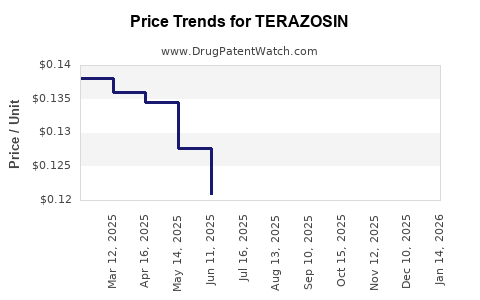
Pricing Trends and Projections
Current Pricing
- Brand-name Terazosin (Hytrin): USD 2.50 - USD 4.00 per 1 mg tablet.
- Generic Terazosin: USD 0.15 - USD 0.30 per 1 mg tablet, representing a typical 85-90% price decrease post-patent expiry.
- Monthly cost for typical BPH dosage (1 mg, one tablet daily): USD 4 – USD 120 depending on brand and procurement channel.
Historical Price Decline
- The introduction of generics in 2010 led to a price decline of approximately 70% within five years.
- Further price reductions have stabilized due to market saturation and manufacturing costs.
Forecasts (2023–2028)
- Prices for generic Terazosin are projected to decline by 2-3% annually, stabilizing at around USD 0.10 per 1 mg tablet.
- Brand-name prices are expected to remain stable or slightly decrease as marketing efforts fade.
- Overall, therapeutic class pricing will be affected by increased market penetration from generics and competitive pricing from alternative treatments.
Market Penetration Impact
- Increased generics uptake shrinks market share for branded versions, exerting downward pressure on prices.
- Emerging markets may experience higher price declines due to lower procurement costs and competition.
Regulatory and Patent Environment
- Patent expiry for Terazosin patents occurred globally between 2010 and 2012.
- No recent patent filings or patent extensions are expected to impact market exclusivity.
- Regulatory agencies (FDA, EMA) continue to approve generics, facilitating price erosion.
Implications for Stakeholders
- Manufacturers should expect margin compression due to falling prices.
- Investors may observe stable or declining revenues unless market share is gained through differentiated formulations or new indications.
- Healthcare payers benefit from lower drug costs, potentially expanding patient access.
Key Takeaways
- Generic Terazosin dominates the market with prices now around USD 0.10 per 1 mg tablet.
- Market growth is driven by aging populations and generic competition.
- Prices are projected to decline gradually over the next five years, stabilizing at low levels.
- Competition from other alpha-blockers and emerging therapies remain factors influencing market dynamics.
- Stakeholders should monitor regulatory developments and pricing policies affecting generics.
FAQs
1. What factors influence Terazosin pricing?
Pricing is influenced by patent status, manufacturing costs, competition from generics, and market demand. The drug's patent expirations significantly lower prices, with generics offering the most competitive options.
2. How does the competition from Tamsulosin impact Terazosin?
Tamsulosin holds a larger market share in BPH treatment due to better tolerability and fewer blood pressure side effects. This limits Terazosin's growth but maintains steady demand.
3. What are the prospects for new formulations or indications?
No recent approvals for new formulations exist. Expanding indications are unlikely without new clinical evidence, but combination therapies may influence market sizes.
4. How do government policies affect Terazosin prices?
Policy initiatives promoting generic use and price controls can further reduce prices, especially in markets with active price regulation.
5. What is the outlook for Terazosin in emerging markets?
Prices are expected to decline more rapidly due to lower procurement costs, with increased access. Market growth depends on healthcare infrastructure and awareness.
Citations
[1] MarketWatch, "Benign Prostatic Hyperplasia Drugs Market Size," 2022.
[2] IQVIA, "Global Prescription Medicine Data," 2022.
[3] FDA, "Generic Drugs Facts," 2022.
[4] IMS Health, "Pharmaceutical Pricing Trends," 2022.
[5] Statista, "Global Hypertension Treatment Market," 2022.