Share This Page
Drug Price Trends for TENOFOVIR DISOPROXIL FUMARATE
✉ Email this page to a colleague
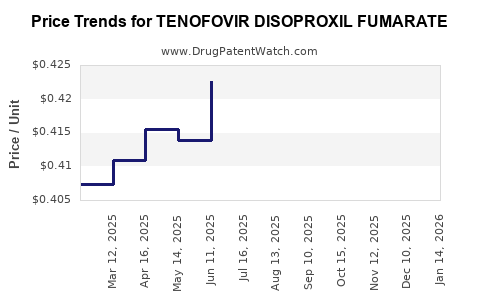
Average Pharmacy Cost for TENOFOVIR DISOPROXIL FUMARATE
| Drug Name | NDC | Price/Unit ($) | Unit | Date |
|---|---|---|---|---|
| TENOFOVIR DISOPROXIL FUMARATE 300 MG TABLET | 00904-6821-04 | 0.31639 | EACH | 2026-07-22 |
| TENOFOVIR DISOPROXIL FUMARATE 300 MG TABLET | 16714-0820-01 | 0.31639 | EACH | 2026-07-22 |
| TENOFOVIR DISOPROXIL FUMARATE 300 MG TABLET | 31722-0535-30 | 0.31639 | EACH | 2026-07-22 |
| TENOFOVIR DISOPROXIL FUMARATE 300 MG TABLET | 33342-0096-07 | 0.31639 | EACH | 2026-07-22 |
| >Drug Name | >NDC | >Price/Unit ($) | >Unit | >Date |
Tenofovir Disoproxil Fumarate Market Analysis and Price Projections
Tenofovir disoproxil fumarate (TDF) is a mature, low-cost antiretroviral with declining value in high-income markets and sustained volume in HIV treatment, HIV prevention, and hepatitis B. Generic competition has removed most of the originator pricing premium. The strongest remaining commercial opportunities are in public-health procurement, fixed-dose combinations, emerging markets, and supply agreements rather than branded monotherapy.
The base-case outlook is for continued unit-volume growth but annual price erosion of approximately 3% to 7% in established generic markets through 2030. Global revenue should remain substantial because TDF is included in high-volume combinations such as tenofovir disoproxil fumarate/emtricitabine and tenofovir disoproxil fumarate/lamivudine. Tenofovir alafenamide, or TAF, will continue taking share in selected HIV and hepatitis B segments where renal and bone safety, lower dose, and branded positioning support premium pricing.
What is the current market position of tenofovir disoproxil fumarate?
TDF is a nucleotide reverse transcriptase inhibitor used for HIV-1 treatment, HIV pre-exposure prophylaxis, and chronic hepatitis B. It is marketed as a single agent and in fixed-dose combinations.
| Product or combination | Principal use | Commercial status |
|---|---|---|
| Viread, TDF | HIV and chronic hepatitis B | Originator product; generic competition |
| Truvada, TDF/emtricitabine | HIV treatment and PrEP | Originator product; generic competition |
| Atripla, efavirenz/TDF/emtricitabine | HIV treatment | Mature product; generic competition |
| Complera/Eviplera, rilpivirine/TDF/emtricitabine | HIV treatment | Mature product; generic competition |
| Stribild, elvitegravir/cobicistat/TDF/emtricitabine | HIV treatment | Mature product; generic competition |
| TDF/lamivudine | HIV treatment and public-health programs | High-volume generic combination |
| TDF/emtricitabine | HIV treatment and PrEP | High-volume generic combination |
The commercial center of gravity has shifted from TDF monotherapy to fixed-dose combinations. WHO-recommended HIV regimens increasingly use dolutegravir with either TDF/lamivudine or TDF/emtricitabine, particularly in low- and middle-income countries.[1]
TDF remains important because it is:
- Available from many generic manufacturers.
- Included in WHO-prequalified and procurement-agency products.
- Effective against both HIV and hepatitis B.
- Compatible with large-scale tablet manufacturing.
- Supported by extensive clinical and regulatory experience.
Its main limitation is safety. TDF has greater potential for renal and bone toxicity than TAF, although the clinical relevance varies by patient, dose, duration, and concomitant therapy.[2]
How large is the tenofovir disoproxil fumarate market?
The TDF market is best measured through active pharmaceutical ingredient volume, finished-dose tablets, and combination-product revenue. Public financial filings generally do not separate TDF revenue from broader HIV and hepatitis B portfolios, making precise global revenue attribution difficult.
A practical market structure is:
| Segment | Volume outlook through 2030 | Price outlook | Commercial assessment |
|---|---|---|---|
| Generic TDF monotherapy | Declining | High erosion | Limited standalone opportunity |
| TDF/lamivudine | Stable to growing | Low and competitive | Strong public-procurement segment |
| TDF/emtricitabine | Stable to growing | Moderate erosion | HIV and PrEP demand support volume |
| TDF-based triple combinations | Declining in high-income markets | Low | Retained in cost-sensitive markets |
| Branded Viread and Truvada | Rapid decline | Premium pricing persists in limited channels | Small and shrinking share |
| TDF API | Stable to growing | Competitive | Attractive for reliable, qualified suppliers |
| TAF substitution | Growing | Premium relative to TDF | Principal long-term competitive threat |
Global HIV treatment demand supports the underlying market. UNAIDS estimated that approximately 30.7 million people were receiving antiretroviral therapy in 2023, while WHO continues to recommend tenofovir-containing regimens in multiple first-line and prevention settings.[1,3]
TDF demand is concentrated in:
- Public HIV treatment programs.
- HIV PrEP programs.
- Generic combination products.
- Hepatitis B treatment.
- Countries where TAF is not included in procurement guidelines or is considered too expensive.
What are the main demand drivers for TDF?
HIV treatment demand
TDF remains a core component of generic antiretroviral therapy. TDF/lamivudine combined with dolutegravir is widely used in first-line treatment because it offers efficacy, a high resistance barrier through dolutegravir, and low procurement cost.[1]
The main growth driver is patient enrollment in low- and middle-income countries. Mature markets are shifting toward TAF-containing or non-tenofovir regimens, but that shift is slower where public programs prioritize cost and supply continuity.
HIV pre-exposure prophylaxis
TDF/emtricitabine is an established oral PrEP regimen. Generic competition has expanded access and reduced cost, particularly through public-health tenders and international procurement programs. Long-acting injectable cabotegravir and newer prevention products create competitive pressure, but they do not eliminate near-term demand for low-cost oral PrEP.[4]
Chronic hepatitis B
TDF is a high-potency antiviral for chronic hepatitis B and has a high barrier to resistance. Generic TDF remains important in markets where Vemlidy, the TAF product for hepatitis B, is not reimbursed or is not widely available.
Public procurement
Procurement agencies favor products with:
- WHO prequalification.
- Stable long-term supply.
- Competitive tender pricing.
- Bioequivalence data.
- Regulatory approval in major reference jurisdictions.
- Consistent active pharmaceutical ingredient supply.
The procurement segment can generate high volume with low unit margins. Manufacturer economics depend on plant utilization, tender duration, freight, registration costs, and payment terms.
What are current TDF prices?
TDF pricing varies by country, product strength, pack size, procurement channel, and whether the product is sold as a single ingredient or a combination. Originator list prices are not representative of generic tender economics.
Indicative price bands
The following ranges are analytical market bands for a 30-day equivalent and should be interpreted by channel rather than as a single global price.
| Channel | TDF monotherapy | TDF/lamivudine or TDF/emtricitabine | Pricing characteristics |
|---|---|---|---|
| U.S. generic pharmacy channel | Approximately $15-$60 per month | Approximately $20-$100 per month | Formulary and pharmacy-benefit variation is significant |
| U.S. branded channel | Often several hundred dollars per month before discounts | Often several hundred dollars per month before discounts | Contract rebates can materially reduce net price |
| International donor procurement | Approximately $20-$60 per patient-year for selected high-volume products | Approximately $45-$100 per patient-year for selected combinations | Tender volume and supplier qualification drive price |
| Private markets in emerging economies | Approximately $1-$8 per month | Approximately $2-$15 per month | Retail markups and local registration affect price |
| High-income non-U.S. generic markets | Approximately $5-$40 per month | Approximately $10-$70 per month | Reimbursement and substitution rules are decisive |
Public procurement prices can be substantially below private retail prices. Clinton Health Access Initiative analyses have repeatedly shown large differences between originator and generic antiretroviral pricing, especially in high-volume low-income markets.[5]
What are the projected prices for TDF through 2030?
The base case assumes continued generic entry, stable API availability, increasing public procurement, and gradual substitution toward TAF and long-acting HIV products.
Base-case price index
| Year | TDF monotherapy price index | TDF-based combination price index | Primary market event |
|---|---|---|---|
| 2024 | 100 | 100 | Mature generic market |
| 2025 | 95-98 | 95-98 | Continued tender competition |
| 2026 | 90-95 | 90-95 | More regional suppliers |
| 2027 | 85-92 | 86-92 | TAF substitution in affluent markets |
| 2028 | 80-89 | 81-89 | Procurement consolidation |
| 2029 | 76-86 | 77-86 | Lower-cost high-volume supply |
| 2030 | 72-83 | 73-84 | Mature commodity pricing |
The base-case compound annual price decline is approximately 3% to 6% for combinations and 4% to 7% for TDF monotherapy.
Price scenarios
| Scenario | 2030 price versus 2024 | Assumptions |
|---|---|---|
| Bull case for suppliers | 90%-100% | API disruptions, fewer qualified suppliers, higher freight and compliance costs |
| Base case | 72%-84% | Normal generic competition and gradual TAF migration |
| Bear case for suppliers | 55%-70% | Aggressive tendering, additional entrants, excess manufacturing capacity |
Price erosion is likely to be slower for WHO-prequalified combinations than for unregistered standalone tablets because regulatory qualification and procurement access create entry barriers.
What patents protected Viread and TDF products?
The principal U.S. composition-of-matter protection for tenofovir disoproxil fumarate expired years ago. Originator protection centered on Gilead Sciences’ tenofovir chemistry, prodrug technology, formulations, and combination products.
| Patent subject | Commercial relevance | Current status |
|---|---|---|
| Tenofovir chemistry and prodrug | Core active ingredient protection | Expired or no longer commercially blocking in major markets |
| Viread tablet formulation | Historical product protection | Expired in the United States |
| Truvada combination | Historical TDF/emtricitabine protection | Expired or subject to generic challenges |
| Combination regimens | Product-specific protection | Generally expired or commercially weak |
| Method-of-use claims | HIV and hepatitis B treatment | Limited remaining blocking value |
| TAF formulations | Separate compound and formulation estate | More relevant to Gilead’s current franchise |
Gilead’s U.S. Viread patent listings and associated exclusivity periods have expired. Generic TDF products entered the United States after approval of abbreviated new drug applications and patent litigation involving the relevant products.[6,7]
The remaining patent risk for a new TDF entrant is more likely to involve:
- Country-specific formulation patents.
- Combination-product claims.
- Manufacturing process claims.
- Polymorph or stability claims.
- Regulatory exclusivity in jurisdictions that delay generic approval.
- Contractual restrictions in procurement or licensing arrangements.
When did TDF lose exclusivity?
TDF lost effective global exclusivity progressively rather than on one universal date. U.S. generic competition emerged after expiration or resolution of relevant Gilead patent rights, while generic entry occurred earlier or later in other jurisdictions depending on national patent law and voluntary licensing.
The practical commercial conclusion is clear: TDF is a post-exclusivity product in the United States, Europe, and most major generic markets.
FDA approval of generic TDF and TDF-based combinations established the product as a mature abbreviated new drug application category.[6] The key remaining regulatory issue is not exclusivity but approval quality, bioequivalence, manufacturing compliance, and procurement qualification.
What is the FDA regulatory status of TDF?
TDF is FDA-approved in multiple products and indications, including:
- HIV-1 infection.
- Chronic hepatitis B.
- HIV PrEP when combined with emtricitabine.
- Combination antiretroviral therapy.
FDA labeling identifies renal monitoring requirements and bone-related safety considerations. TDF products require attention to renal function, dosing in renal impairment, drug interactions, and concomitant nephrotoxic medicines.[8]
Generic manufacturers must generally demonstrate bioequivalence to the reference product. For fixed-dose combinations, the regulatory burden includes formulation compatibility, dissolution performance, stability, and analytical control of each active ingredient.
WHO prequalification is commercially important outside the United States. It can determine eligibility for Global Fund and other international procurement tenders.[1]
Which companies compete in the TDF market?
Competition is fragmented. Major participants include Gilead Sciences as the originator, large Indian generic manufacturers, multinational generic companies, and regional suppliers.
Relevant generic and combination-product suppliers have included:
- Cipla.
- Mylan, now part of Viatris.
- Aurobindo Pharma.
- Hetero.
- Laurus Labs.
- Emcure.
- Zydus Lifesciences.
- Sun Pharmaceutical Industries.
- Teva Pharmaceutical Industries.
- Aspen Pharmacare.
- Hikma Pharmaceuticals in selected generic markets.
Actual market participation varies by country, registration status, WHO prequalification, tender awards, and supply contracts. A manufacturer’s capacity to supply TDF API does not establish its ability to sell finished-dose products in regulated or donor-funded markets.
How strong is the TDF patent estate?
The TDF patent estate is weak as a barrier to ordinary generic entry. The active ingredient is mature, extensively characterized, and produced by multiple suppliers.
Patent strength assessment
| Patent category | Barrier strength | Commercial impact |
|---|---|---|
| Core TDF molecule | Low | Does not generally block entry |
| Standard immediate-release tablet | Low | Routine generic formulation |
| TDF/lamivudine combination | Low to moderate | Country-specific claims may matter |
| TDF/emtricitabine combination | Low to moderate | Product and method claims largely mature |
| Manufacturing process | Moderate in limited jurisdictions | Can affect freedom to operate |
| Stability and packaging | Low to moderate | Relevant to quality and registration |
| TAF-related technology | Moderate to strong | Separate and more valuable estate |
The strongest IP-related barrier is usually operational rather than exclusionary: validated manufacturing, regulatory history, API qualification, and procurement eligibility.
What manufacturing and supply barriers affect TDF?
TDF production is technically established, but commercial performance depends on execution.
Key barriers include:
- API source qualification.
- Control of impurities and degradation products.
- Consistent particle size and solid-state characteristics.
- Tablet dissolution and stability.
- Compliance with current good manufacturing practices.
- Capacity for high-volume tenders.
- Registration in multiple national markets.
- Supply-chain resilience for emtricitabine, lamivudine, and dolutegravir in combination products.
TDF is a low-dose, high-volume product. Small manufacturing-cost differences can materially affect tender competitiveness. Reliable supply can be more valuable than marginally lower production cost when procurement agencies impose penalties for stockouts.
How does TDF compare with TAF?
| Attribute | TDF | TAF |
|---|---|---|
| Dose | Higher | Lower |
| Renal and bone safety | Less favorable on average | Generally more favorable |
| Generic competition | Extensive | More limited, though expanding |
| Price | Low | Higher |
| Public-health use | Broad | More selective |
| HIV market position | Strong in cost-sensitive markets | Stronger in premium and safety-sensitive markets |
| Hepatitis B position | Established | Growing where reimbursement supports it |
| Long-term price pressure | High | Increasing |
TAF is the principal product-level substitute for TDF in higher-income markets. TAF’s commercial advantage is based on lower systemic tenofovir exposure, while TDF’s advantage is cost and availability. The two products will coexist because payer economics, patient risk factors, and national treatment guidelines differ.[2]
What generic launch scenarios exist for TDF?
Low-price tender launch
A manufacturer enters through WHO prequalification and competes for donor-funded tenders. This strategy offers high volume but requires low manufacturing cost and strong working capital.
Regional private-market launch
A company registers TDF in selected emerging markets and sells through distributors. Margins are higher than donor tenders, but volumes are smaller and local competition can be intense.
Combination-product launch
A manufacturer launches TDF/lamivudine, TDF/emtricitabine, or a dolutegravir-based combination. Combination products generally have better commercial prospects than TDF monotherapy because they align with treatment guidelines and procurement specifications.
API supply strategy
An API producer supplies multiple finished-dose manufacturers. This can reduce commercial risk but exposes the supplier to price competition and customer concentration.
What licensing deals and settlements affect TDF?
Gilead entered voluntary licensing and access arrangements for several HIV medicines, particularly products used in low- and middle-income countries. These agreements enabled qualified generic manufacturing and reduced patent barriers in designated territories.[9]
TDF-related commercial arrangements have included:
- Voluntary licenses for specified countries.
- Technology-transfer and supply agreements.
- Generic distribution arrangements.
- Patent settlements connected with HIV products.
- Procurement agreements with international health organizations.
The strategic importance of these arrangements is geographic. A license may permit manufacture or sale in one group of countries while excluding higher-income markets. Freedom to operate must therefore be assessed by product, jurisdiction, patent family, and license scope.
What is the revenue exposure to TDF price erosion?
Originator exposure is limited because branded TDF products are mature. Gilead’s larger HIV franchise has shifted toward newer products, including Biktarvy and TAF-based combinations.[10]
Generic manufacturers face a different exposure profile:
| Business model | Revenue sensitivity to TDF prices |
|---|---|
| TDF API supplier | High |
| TDF monotherapy manufacturer | High |
| TDF/lamivudine supplier | Moderate |
| TDF/emtricitabine supplier | Moderate |
| Dolutegravir-based combination supplier | Lower, if portfolio is diversified |
| TAF manufacturer | Indirect beneficiary of TDF substitution |
For a supplier with substantial TDF concentration, a 5% annual price decline can reduce revenue even if tablet volume increases. Volume growth must exceed price erosion to produce revenue growth.
What is the competitive outlook through 2030?
TDF will remain a high-volume essential medicine, but it will become less attractive as a standalone commercial product.
The most defensible positions are:
- WHO-prequalified fixed-dose combinations.
- Low-cost supply into large public tenders.
- Dual sourcing of TDF API.
- Strong regulatory coverage in emerging markets.
- Integrated production of TDF and companion antiretrovirals.
- Products aligned with dolutegravir-based treatment guidelines.
The principal risks are TAF substitution, increased use of long-acting HIV prevention and treatment products, continued tender price compression, and supplier consolidation. Demand will remain resilient where treatment scale-up and constrained healthcare budgets favor TDF-based regimens.
Key Takeaways
- TDF is a mature generic product with weak core patent barriers.
- The strongest demand is in public HIV treatment, PrEP, hepatitis B, and fixed-dose combinations.
- Generic prices should decline approximately 3% to 7% annually through 2030 in established markets.
- TDF-based combinations have better commercial prospects than standalone TDF.
- TAF will continue gaining share in affluent markets because of renal and bone safety advantages.
- Public procurement, WHO prequalification, manufacturing reliability, and API security are more important than residual composition patents.
- Generic manufacturers should prioritize combination products, regulatory coverage, and high-volume tender access.
- Originator revenue exposure is limited because Gilead’s HIV portfolio has moved toward newer products.
FAQs
Is tenofovir disoproxil fumarate still profitable for generic manufacturers?
Yes, but profitability depends on scale, manufacturing efficiency, and procurement access. Standalone TDF has limited margin potential, while fixed-dose combinations can support stronger volume and more durable demand.
Is TDF cheaper than TAF?
Yes. TDF is generally less expensive because it has broader generic competition, a longer manufacturing history, and greater public-procurement penetration.
Can a new company launch generic TDF in the United States?
A company can seek FDA approval through an abbreviated new drug application, provided it meets applicable patent, regulatory, bioequivalence, quality, and manufacturing requirements. The principal challenge is commercial competitiveness rather than core molecule exclusivity.
Does TDF have biosimilar competition?
No. TDF is a small-molecule medicine, not a biologic. The relevant competitors are chemically equivalent generic products, not biosimilars.
Will long-acting HIV medicines eliminate TDF demand?
No. Long-acting products may reduce oral-treatment and PrEP demand in selected populations, but TDF remains materially cheaper, widely available, and embedded in public-health treatment systems.
References
-
World Health Organization. (2024). Consolidated guidelines on HIV prevention, testing, treatment, service delivery and monitoring: Recommendations for a public health approach. Geneva, Switzerland: WHO.
-
European AIDS Clinical Society. (2023). EACS guidelines version 12.0. Brussels, Belgium: EACS.
-
UNAIDS. (2024). The urgency of now: AIDS at a crossroads. Geneva, Switzerland: Joint United Nations Programme on HIV/AIDS.
-
U.S. Food and Drug Administration. (2019). FDA approves first generic versions of Truvada for HIV-1 treatment and prevention. Silver Spring, MD: FDA.
-
Clinton Health Access Initiative. (2023). ARV market report: The state of the HIV treatment market in low- and middle-income countries. Boston, MA: CHAI.
-
U.S. Food and Drug Administration. (2024). Drugs@FDA: Viread (tenofovir disoproxil fumarate). Silver Spring, MD: FDA.
-
U.S. Food and Drug Administration. (2024). Orange Book: Approved drug products with therapeutic equivalence evaluations. Silver Spring, MD: FDA.
-
U.S. Food and Drug Administration. (2024). Viread prescribing information. Silver Spring, MD: FDA.
-
Medicines Patent Pool. (2024). Licensing and access agreements for HIV medicines. Geneva, Switzerland: MPP.
-
Gilead Sciences, Inc. (2024). 2023 annual report. Foster City, CA: Gilead Sciences.
More… ↓
