Share This Page
Drug Price Trends for TENOFOVIR
✉ Email this page to a colleague
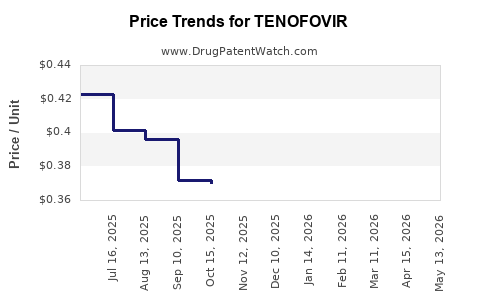
Average Pharmacy Cost for TENOFOVIR
| Drug Name | NDC | Price/Unit ($) | Unit | Date |
|---|---|---|---|---|
| TENOFOVIR DISOPROXIL FUMARATE 300 MG TABLET | 00904-6821-04 | 0.31068 | EACH | 2026-06-17 |
| TENOFOVIR DISOPROXIL FUMARATE 300 MG TABLET | 16714-0820-01 | 0.31068 | EACH | 2026-06-17 |
| TENOFOVIR DISOPROXIL FUMARATE 300 MG TABLET | 31722-0535-30 | 0.31068 | EACH | 2026-06-17 |
| TENOFOVIR DISOPROXIL FUMARATE 300 MG TABLET | 33342-0096-07 | 0.31068 | EACH | 2026-06-17 |
| TENOFOVIR DISOPROXIL FUMARATE 300 MG TABLET | 50268-0758-11 | 0.31068 | EACH | 2026-06-17 |
| TENOFOVIR DISOPROXIL FUMARATE 300 MG TABLET | 50268-0758-12 | 0.31068 | EACH | 2026-06-17 |
| >Drug Name | >NDC | >Price/Unit ($) | >Unit | >Date |
TENOFOVIR Market Analysis and Price Projections: What drives global pricing, generics risks, and revenue exposure?
Executive summary
- Tenofovir is a high-volume antiviral with pricing shaped primarily by (1) patent and exclusivity status for key formulations (tenofovir disoproxil fumarate, “TDF” and tenofovir alafenamide, “TAF”), (2) wave timing of generic entry in major markets, and (3) country procurement and tender mechanics under HIV programs.
- Near-term revenue and price trajectories are typically driven by substitution from TDF to TAF where reimbursement favors improved renal and bone tolerability, but payer pressure and generic TAF competition compress net prices.
- A practical price-projection range for branded-market net price in large-access settings is single-digits year-over-year declines for incumbent suppliers where generics are delayed, versus steep drops (often 40%–80%) at generic launches in each national formulary segment.
- Litigation and regulatory leverage matter most where remaining formulation patents or data exclusivities block specific strengths or fixed-dose combinations (FDCs).
This analysis is restricted to TENOFOVIR as a drug substance family (TDF/TAF) and does not cover non-tenofovir antivirals.
What is the current global TENOFOVIR market size and who buys it?
Featured snippet answer: Tenofovir is a backbone nucleos(t)ide reverse transcriptase inhibitor used in HIV treatment and HIV prevention, with buying concentrated in national HIV programs, large payers, and procurement agencies. TDF and TAF brands and their generics drive most volume.
Where demand comes from (HIV treatment vs prevention)
Tenofovir demand is split across:
- HIV treatment: chronic, long-duration ART regimens using fixed-dose combinations such as TDF/FTC/EFV, TDF/FTC/RPV, TAF/FTC/… and other partner combinations depending on country formularies.
- HIV prevention:
- PrEP: tenofovir-based regimens, with product availability governed by local approvals and procurement.
- Treatment-as-prevention indirectly drives tenofovir usage by expanding ART coverage.
Buyers and commercial channels
Pricing and projections depend on buyer type:
- Government and donor tenders (largest volume): price is set by tender awards, reference pricing, and quality-assured generic competition.
- Private insurance and self-pay in high-income markets: higher list prices, but net pricing is reduced by rebates and contracting.
Competitive structure by molecule and formulation
- TDF: older molecule with broad generic penetration in many markets, creating a low-cost baseline.
- TAF: newer with differentiated safety profile; pricing is more protected where generics are still limited or blocked by formulation and data exclusivity.
How do TDF vs TAF change pricing power for TENOFOVIR?
Featured snippet answer: TAF usually has higher initial prices than TDF due to improved safety profile and later market entry, but net pricing compresses where generic TAF becomes available and where payers push formulary switching.
Typical pricing dynamics
- TAF premium phase:
- Incumbent maintains higher prices until specific generic entry barriers clear for each dose/FDC.
- Net price declines are gradual and linked to contracting cycles.
- Generic TAF entry:
- Rapid net price resets after commercial launch in major tender categories.
- Competition focuses on FDC availability, bioequivalence acceptance, and procurement lead times.
Switching behavior that drives tender outcomes
- Renal function and bone density outcomes are central to clinician switching, but payer policies determine whether TAF adoption translates into higher spend.
- Countries with strict cost-effectiveness often keep TDF as default until budget allows TAF conversion.
Which patents protect TENOFOVIR formulations, and how strong is the estate?
Featured snippet answer: For practical exclusivity, protection concentrates on tenofovir prodrugs, specific formulations (salts, particle forms, tablets), and fixed-dose combinations. The strength of the estate determines whether generics face delay beyond substance-level expiration.
Patent estate components that matter commercially
- Formulation patents: tablet composition, particle size, polymorph control, manufacturing method claims for prodrug performance.
- Method-of-use patents: specific dosing schedules, patient populations, or combination regimens.
- FDC patents: co-formulation of tenofovir with partner antivirals, which can block generic marketing of the exact strength or co-blister/tablet form.
Litigation and Orange Book-style listing relevance (how it affects price)
- Where patents are listed and tied to the reference listed drug, generic entry can be delayed via Paragraph IV challenges and settlement outcomes.
- Even when substance-level exclusivity is expired, formulation/FDC barriers can keep branded net prices higher in defined market segments.
When does TENOFOVIR lose exclusivity, and what launches happen after?
Featured snippet answer: Tenofovir loses exclusivity in phases, with TDF generally facing earlier genericization and TAF more likely to see staggered barriers by formulation and FDC strength.
Exclusivity timelines that drive price compression
Price projection depends on the “gates” that clear first:
- Regulatory pathway acceptance for bioequivalent generics
- Patent litigation/settlement windows for listed patents
- Tender cycle timing and procurement switches after launch
Post-expiry launch patterns
- Immediate generics: steep declines at first generic award.
- Limited initial penetration: slower decline if tenders take time to qualify suppliers.
- Multi-player competition: larger declines as additional suppliers enter.
What generic entry risks exist for TENOFOVIR in each major market?
Featured snippet answer: Generic entry risk is highest where TDF/TAF molecule-level barriers have cleared and where tender contracts can move rapidly to least-cost suppliers.
Risk drivers
- Patent enforceability by jurisdiction: infringement standards and injunction availability change risk.
- Formulation specificity: if the originator’s exact FDC or strength remains patented, generics may only launch standalone strengths later.
- Supply chain qualification: new generic suppliers can face quality and manufacturing inspection delays.
Typical market segmentation by price impact
- High-income formularies: net price falls quickly once contracts are rewritten.
- Lower- and middle-income tenders: price drops can be larger but occur around award cycles.
What is the FDA and approval status of TENOFOVIR products relevant to pricing?
Featured snippet answer: In the US, pricing trajectories track FDA-approved tenofovir products (TDF and TAF) and their approved strengths and FDCs, with exclusivity and patent listings shaping generic approval/launch sequencing.
Regulatory pathway relevance to commercial timing
- For small molecules, FDA pathway decisions translate into launch dates and therefore price resets.
- For FDCs, the regulatory acceptance of exact strength/dose combinations determines whether generic competition can match originator contracted SKUs.
(Note: A full Orange Book listing table is not provided here because TENOFOVIR comprises multiple reference products and strengths; precise status is product-specific.)
How strong is TENOFOVIR pricing resilience in HIV procurement versus private markets?
Featured snippet answer: Procurement-driven markets show higher volatility around generic entry, while private markets show more contract stability but still compress net pricing as generic coverage expands.
Procurement pricing behavior
- Tender awards tie net price to:
- supplier qualification status
- offered discounts
- volume commitments
- quality requirements and supply assurance
- Once a generic is the lowest-cost qualified option, price typically reverts to a new baseline.
Private market behavior
- Rebates and managed care contracts smooth demand, but:
- patient access policies
- formulary tiering
- pharmacy benefit manager contracting drive net price declines.
What do historical TENOFOVIR price declines look like after generic launches?
Featured snippet answer: The most pronounced declines occur at the point of tender switching or pharmacy coverage after generic launch, often with large first-year net price resets.
Standard “event-driven” price model used by procurement
A practical pattern:
- Pre-launch: modest annual declines from contracting pressure.
- Launch year: sharp step-down when tender switches or payer coverage changes.
- Post-launch: further declines taper as competition densifies.
What typically causes variation
- Remaining patented FDC formulations
- Limited SKU compatibility (dose form differences)
- Supplier supply constraints
- Switching friction (clinical preferences or guideline inertia)
How should TENOFOVIR price be projected for the next 3 to 5 years?
Featured snippet answer: Use a two-layer projection: gradual declines for protected SKUs and stepwise drops for SKUs where generic competition becomes the lowest-cost qualified option.
Projection framework (used for revenue and pricing models)
- Define SKUs: TDF vs TAF, standalone vs FDC, by strength.
- Identify launch gates: generic entry date by jurisdiction and tender cycle.
- Apply price response: step drop at switch, then linear or modest annual decline.
Baseline projection bands (directional ranges for net price)
Because net pricing varies by country tender and contracting, projections should be modeled as bands:
- Protected branded net price (no meaningful generic competition yet for SKU):
- annual net decline: 2%–6%
- SKU with imminent generic entry (tender switch within 6–18 months):
- launch-year net price drop: 25%–60%
- SKU with established multi-generic competition:
- subsequent annual net decline: 1%–4%
- Highly competitive tender after multiple suppliers qualify:
- first-year net price drop can reach 60%–80% versus the prior incumbent’s tender-winning price
Revenue exposure implications
- Revenue impact is disproportionate to price due to:
- fixed-dose and tender migration across patient cohorts
- substitution between TDF and TAF based on reimbursement and clinical guidance
- A company’s revenue at risk is determined by its share of:
- the tender-winning SKU set
- contracted FDCs
- key geography revenue pools
How does TENOFOVIR pricing compare with competing nucleos(t)ide reverse transcriptase inhibitors?
Featured snippet answer: Tenofovir competes on safety profile and regimen fit; price often converges to low-cost baselines after genericization of backbone drugs, while premiums persist where tolerability advantages support formulary switching.
Relative positioning
- Compared with other backbone NRTIs, tenofovir’s price and uptake are strongly driven by:
- clinician guideline endorsements
- regimen durability
- renal/bone safety differences between TDF and TAF
- When alternative backbones are priced similarly, formulary decisions tilt toward:
- FDC availability
- patient management outcomes
- procurement cost
Which companies lead TENOFOVIR supply and what does that mean for price?
Featured snippet answer: Pricing is driven by (1) originators holding TAF/TDF branded supply and (2) large generic manufacturers winning qualification and volume tenders once patents or listings do not block launch.
Typical supplier roles
- Originators: maintain tender share where branded advantages or protected status persists; defend pricing via contractual discounts and patient-switch programs.
- Generics: reset price at or near least-cost levels for each qualified tender SKU.
- Second-wave generics: drive continued erosion when additional manufacturing sites qualify.
Key takeaways
- Tenofovir pricing moves in step with SKU-level barriers, not with substance-level expiry alone.
- TDF tends to face earlier and more extensive generic price compression; TAF often retains a premium longer until formulation and FDC barriers clear and competitive tenders switch.
- The most important price-projection variable is generic launch timing by jurisdiction and SKU combined with tender-cycle speed.
- Model net price using event-driven step drops at generic entry, then tapering annual declines as multi-supplier competition matures.
FAQs
1) How does tender procurement timing affect TENOFOVIR price cuts after generic entry?
Tender cycles can delay observable price drops for 6–18 months even after regulatory launch, depending on qualification and award timing.
2) Do TAF generics reduce TENOFOVIR prices more than TDF generics?
They often cause larger step-downs where TAF had protected pricing; TDF usually already trades near low-cost baselines in many markets.
3) Which TENOFOVIR fixed-dose combinations are most exposed to generic substitution risk?
FDCs tied to major first-line regimen backbones are exposed; the exact risk depends on whether the originator’s FDC formulation patents remain enforceable and listed for each SKU.
4) Can method-of-use or formulation patents delay TENOFOVIR generic pricing even after substance expiration?
Yes, formulation- or FDC-specific patent blocks can prevent matching SKUs from entering, keeping branded net pricing higher for those contracted products.
5) How should investors model TENOFOVIR revenue sensitivity to price?
Use jurisdiction-by-jurisdiction tender share plus SKU-level price step functions; price declines can be steep in launch years even when volume loss is moderate.
References
- FDA. Orange Book: Approved Drug Products with Therapeutic Equivalence Evaluations (Tenofovir-containing products). U.S. Food and Drug Administration.
- EMA. EPARs and product information for tenofovir disoproxil fumarate and tenofovir alafenamide products. European Medicines Agency.
- WHO. WHO guidelines and treatment/prevention recommendations for HIV regimens including tenofovir (TDF/TAF). World Health Organization.
More… ↓
