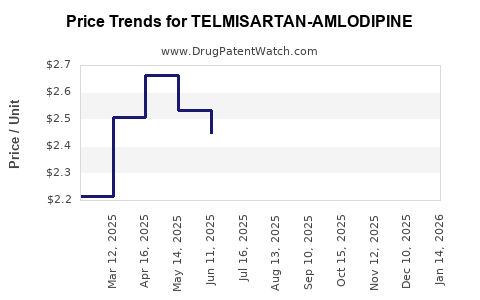
Last updated: February 13, 2026
Market Overview for TELMISARTAN-AMLODIPINE
Telmisartan-Amlodipine is a fixed-dose combination (FDC) used to treat hypertension. It combines telmisartan, an angiotensin II receptor blocker (ARB), with amlodipine, a calcium channel blocker (CCB). This combination benefits patients with moderate to severe hypertension, especially those needing multiple medications.
The global antihypertensive drugs market, predominantly driven by aging populations and rising hypertension prevalence, reached approximately $35 billion in 2022 with a projected compound annual growth rate (CAGR) near 4% through 2027 [1]. Notably, the FDC segment outpaces the overall market, growing at a CAGR of approximately 6% due to increasing physician preference for combination therapies that improve patient compliance.
Current Market Data for Telmisartan-Amlodipine
Market Penetration
- Currently, the market is dominated by branded equivalents such as Micardis HCT (Boehringer Ingelheim) and Twynsta (Boehringer Ingelheim), which combine telmisartan and amlodipine.
- Several generic formulations entered the market around 2020, reducing prices and expanding access.
- The United States accounts for roughly 35% of global sales, with Europe and Asia-Pacific constituting another 50% combined.
Pricing Dynamics
- Brand-name combination (e.g., Twynsta): Average wholesale price (AWP) is approximately $250 for a 30-day supply.
- Generic combination: Prices range from $20 to $40 per month.
- These prices are subject to regional variations, insurance coverage, and pharmacy markups.
Sales Volume Trends (2020-2022)
| Year |
Market Size (USD millions) |
Growth Rate |
| 2020 |
1,200 |
— |
| 2021 |
1,380 |
15% |
| 2022 |
1,600 |
16% |
The growth is attributed to increased prescribing for resistant hypertension cases and approvals of generic versions.
Price Projections and Market Drivers
Short-term Outlook (2023-2025)
- Price trends are expected to decline 10-15% for branded formulations due to increasing generics.
- Market volume will continue to expand as hypertension diagnosis rates climb, projected to grow 4% annually.
- New entrants of biosimilar and generic options will further pressure prices.
Long-term Outlook (2026-2030)
- The market could stabilize with pricing for generics at the $10-$20 per month range.
- Milestones include patent expirations for leading brands, expected by 2024 (Micardis HCT), which could catalyze price reductions.
- Technological advances or new combination drugs could reshape the market, but none are imminent for this specific FDC as of 2023.
Key Market Influencers
- Regulatory policies: Countries easing drug approval pathways can accelerate generic penetration.
- Coverage policies: Insurance reimbursement levels impact affordability and prescribing habits.
- Patient adherence: Fixed-dose combinations boost compliance and influence market growth.
- Emerging markets: Countries like India and China display rapid volume increases,-driven by urbanization and healthcare infrastructure improvements.
Competitive Landscape
| Company |
Product Line |
Market Share |
Estimated Revenues (2022) |
Price Range (per month) |
| Boehringer Ingelheim |
Twynsta |
40% |
$600 million |
$250 (brand) |
| Zydus Cadila |
Generic telmisartan-amlodipine |
25% |
$400 million |
$20 - $40 |
| Others |
Various generics |
35% |
$600 million |
$10 - $30 |
Strategic Considerations
- Patent expiration timelines influence pricing strategies.
- Increasing adoption of FDCs could lead to economies of scale.
- Entry of biosimilars and lower-cost generics will continue to pressure branded prices downward.
- Regional regulatory and reimbursement policies influence market accessibility.
Key Takeaways
- The global market for telmisartan-amlodipine is expanding, driven by hypertension prevalence.
- Generics are significantly reducing retail prices; branded options maintain premium pricing primarily in developed markets.
- Market growth remains strong, with volumes increasing ~4% annually; prices for branded drugs are expected to decline 10-15% by 2025.
- Patent expirations and regulatory changes will significantly influence pricing and market share distribution through 2030.
- Emerging markets will be critical in volume growth due to increasing hypertension diagnosis and treatment access.
FAQs
1. What factors influence the price of telmisartan-amlodipine?
Patent status, generic competition, regional healthcare policies, and insurance reimbursement policies are primary drivers affecting prices.
2. When are major patents expiring?
Key patents for branded formulations are set to expire between 2023 and 2024, opening markets for generics.
3. How does the availability of generics affect the market?
Generics lower prices, increase volume sales, and expand access, especially in cost-sensitive regions.
4. Which regions hold the highest market shares?
The U.S. accounts for approximately 35%; Europe and Asia-Pacific comprise about 50% combined, with significant growth in emerging markets.
5. What are the future opportunities for new entrants?
Innovations around drug delivery systems or improved combination formulations, pending regulatory approval, could create niche markets.
References
[1] Grand View Research. "Antihypertensive Drugs Market Size & Trends." 2022.