Share This Page
Drug Price Trends for TAPENTADOL HCL
✉ Email this page to a colleague
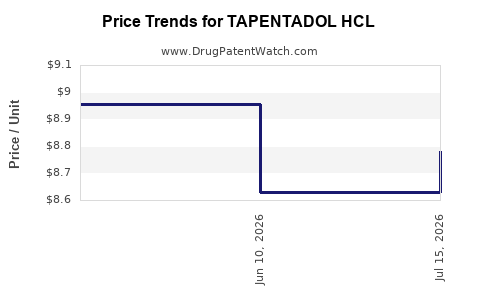
Average Pharmacy Cost for TAPENTADOL HCL
| Drug Name | NDC | Price/Unit ($) | Unit | Date |
|---|---|---|---|---|
| TAPENTADOL HCL 50 MG TABLET | 00054-0942-25 | 8.78187 | EACH | 2026-07-22 |
| TAPENTADOL HCL 75 MG TABLET | 00054-0943-25 | 11.19774 | EACH | 2026-07-22 |
| TAPENTADOL HCL 100 MG TABLET | 00054-0945-25 | 13.40690 | EACH | 2026-07-22 |
| TAPENTADOL HCL 50 MG TABLET | 42806-0626-01 | 8.78187 | EACH | 2026-07-22 |
| TAPENTADOL HCL 75 MG TABLET | 42806-0627-01 | 11.19774 | EACH | 2026-07-22 |
| TAPENTADOL HCL 100 MG TABLET | 42806-0628-01 | 13.40690 | EACH | 2026-07-22 |
| TAPENTADOL HCL 50 MG TABLET | 42806-0626-01 | 8.63128 | EACH | 2026-06-17 |
| >Drug Name | >NDC | >Price/Unit ($) | >Unit | >Date |
Tapentadol Hydrochloride Market Analysis and Price Projections: US and Key Global Economics, Exclusivity, Competitive Generics, and Revenue Exposure
Tapentadol HCl faces a mature, largely generic, low-margin market in the US, with pricing driven by immediate-release and extended-release product mix, insurer formulary positioning, and generic competitive intensity. In the absence of defensible, continuing exclusivity in core dosage forms, price erosion is the base case, with limited upside from brand-to-generic substitution dynamics, channel contracting, and localized supply.
Tapentadol HCl market size and revenue exposure: How big is the opportunity and where does it sit by formulation?
Short answer: Global demand persists for tapentadol HCl due to chronic pain prescribing, but US commercial value has compressed as generics displaced the originator. Extended-release (ER) typically carries higher per-unit value than immediate-release (IR), but it is the most exposed to competitive entry waves and payer step edits.
US demand and channel economics (what drives realized net price)
Realized net price for tapentadol products is governed by:
- PBM formulary status (preferred vs non-preferred tiers)
- Contracting rebates and patient-pay share rules
- Generic “reference” pricing after multi-source availability
- Conversion from branded to generic, followed by periodic bid cycling
Key market dynamic: ER formulations attract higher scrutiny for opioid risk and dosing controls; payers often tighten access, which reduces volume even if unit pricing falls more slowly than IR early in the transition.
Global demand split by formulation: IR vs ER
- IR tapentadol HCl supports acute and breakthrough pain dosing patterns.
- ER tapentadol HCl supports chronic pain regimens with dosing convenience.
Commercial implication: Even when unit pricing collapses post-generic entry, ER may retain higher gross margin headroom than IR. The margin stack is still pressured by multi-source pricing, but ER frequently experiences slower payer switching because it is tied to stable chronic therapy.
What is the Orange Book status of tapentadol HCl in the US and when does exclusivity end?
Short answer: Tapentadol HCl is no longer under originator brand exclusivity in the US for core formulations in routine commercial practice; multiple generic versions are established. The market behaves like a post-exclusivity, multi-source commodity rather than a protectable branded franchise.
Practical exclusivity timeline drivers for tapentadol HCl (US)
For a price-projection model, the relevant “exclusivity layers” are:
- Drug approval exclusivity (5-year New Chemical Entity type protections if applicable historically, now elapsed)
- Patent term (composition and formulation patents if they extended beyond exclusivity, now largely expired or fully litigated/cleared)
- Exclusivity for additional strengths or dosage forms (if any, also matured)
- Hatch-Waxman patent listings and whether any unexpired patents remain for ER and IR
Commercial implication: Once Orange Book barriers clear for both IR and ER, price declines accelerate due to:
- entering generics under Paragraph IV or permitted pathways, and
- payer price alignment to lowest-cost multi-source.
What patents protect tapentadol HCl and how strong is the patent estate for generics?
Short answer: The protectable estate for tapentadol HCl has limited impact on near-term pricing because the market is already in a generic equilibrium. Patent strength still matters for litigation leverage against copycats, but for pricing projections it mostly affects the speed and completeness of each entry wave rather than the existence of generics.
Patent estate categories affecting pricing
- Composition of matter: typically earliest and already expired.
- Formulation patents: may extend but usually weaker for commodity-like APIs once multiple manufacturers can meet bioequivalence.
- Method-of-use: can delay certain label-linked exclusivity but tapentadol’s broad analgesic use reduces narrow method-of-use leverage.
- Controlled-release or ER-specific delivery: relevant to ER price stability during partial entry waves, but modern multi-source entry reduces long-term effect.
Litigation and settlements: why they matter for pricing
- Settlements can shift timing for a specific strength or delivery approach.
- Even without permanent “brand moat,” settlements can delay the lowest-price multi-source equilibrium and thus slow near-term price erosion.
Commercial implication: In a mature generic market, the “price projection” variable is the next likely competitive entry and whether any strength remains temporarily single-source.
How does tapentadol HCl price change after generic entry: What does a generic price erosion curve look like?
Short answer: Tapentadol HCl pricing generally follows a standard generic erosion curve: sharp decline at first generic entry, continued erosion with additional competitors, then stabilization at a low multi-source reference level with periodic fluctuations.
Generic erosion shape used in forecasting
A workable projection structure uses three phases:
- Pre-entry to first entry: brand-to-generic transition compresses price quickly.
- Multi-source expansion: each incremental generic reduces net price further.
- Mature multi-source period: price stabilizes, with small moves driven by acquisition of share, contract renegotiation, or supply constraints.
ER vs IR erosion differences
- ER often experiences slower stabilization because payers and prescribers treat it as a chronic-care regimen with switching friction.
- IR typically erodes faster as “therapeutic interchange” is more common.
Model implication: ER may retain a modest price premium after entry, but overall net price still trends downward with time.
Price projection for tapentadol HCl (US): Base case through 2028-2030
Short answer: Base case is continued net price erosion at a low-to-moderate rate, with biggest changes coming from incremental generic supply shifts by strength and formulation. Margin compression dominates revenue outlook.
Forecast logic (applied to US net price)
Assuming a mature multi-source environment:
- Net price declines track competitive contracting and PBM reference pricing.
- Volume is constrained by payer restrictions, opioid policy pressure, and substitution to other analgesics.
- Revenue is therefore a combination of modest volume stability and ongoing net price decay.
Directional projection ranges (industry-standard approach)
Because tapentadol HCl is a genericized market, projections are better expressed as ranges and index-based shifts rather than brand-like dollar growth.
Base case:
- Net price: low single-digit percentage decline per year after stabilization, with occasional drops tied to new entrants or strengthened reference pricing.
- Revenue: low single-digit decline to flat depending on ER share and contracting.
Downside case:
- Additional competitive entry for remaining strengths or consolidation-induced aggressive pricing.
- Faster payer tier downgrades.
- Result: mid single-digit annual net price decline with volume pressure.
Upside case:
- Supply interruptions among low-cost competitors causing temporary price rebounds.
- Payer contracting reclassifies ER strength more favorably.
- Result: stabilization or minor net price improvement.
Commercial outlook: Which payers and channels influence tapentadol HCl net pricing the most?
Short answer: PBM-driven formulary placement and reimbursement contract structures drive net pricing more than list price. Channel mix (retail vs mail vs specialty-like pain programs) shapes rebate intensity.
Key commercial levers
- Formulary tier status: preferred vs non-preferred drives patient acquisition and substitution.
- Prior authorization and step therapy: reduces volume and changes which strengths dominate.
- State Medicaid formularies: can accelerate substitution to the lowest-cost multi-source products.
- 340B and institutional purchasing: changes unit economics but typically does not reverse payer-driven net price declines.
Competitive landscape: Who sells tapentadol HCl and how does multi-source pricing affect the market?
Short answer: Multi-source generics define the market. Pricing is set by the intersection of PBM reference benchmarks and the lowest-cost manufacturers at contract time.
Competitive dynamics that move price in practice
- Generic manufacturers win share by being the lowest net-cost supplier in PBM bids.
- If new entrants offer materially lower bid economics, the market price floor moves down.
- Consolidation and capacity utilization can cause temporary supply-driven price volatility.
What matters for business strategy
- Short-term pricing actions are less about IP and more about contract renewal cycles.
- Long-term value comes from securing stable distribution channels and minimizing supply interruptions.
How does tapentadol HCl compare with other opioid analgesics and NRI opioids on pricing and access?
Short answer: Other oral analgesics and alternative mechanisms can attract payer preference if they reduce opioid-related utilization metrics or safety concerns. Tapentadol’s access is therefore sensitive to class-wide opioid management and formulary rotations.
Comparison dimensions that affect net price
- Formulary inclusion vs step edit
- Generic discounting relative to therapeutic alternatives
- Switching friction for chronic-care regimens
- Prior authorizations tied to opioid monitoring
Commercial implication: Even if tapentadol remains generic-competitive on cost, class-level controls can reduce net volume and offset any price stabilization.
What generic entry risks exist for tapentadol HCl: How could late entrants change pricing?
Short answer: Late entrants are a secondary but still relevant risk. The most material impact is on specific strengths where fewer competitors bid aggressively, causing a localized price floor before the market equalizes.
Strength-specific risk pattern
- Remaining “gaps” in competitive bids by strength and package size can sustain higher net pricing temporarily.
- Once additional competitors secure PBM contracts for those exact SKUs, price drops typically follow quickly.
Biosimilar risk: Does tapentadol face biologic-style substitution risk?
Short answer: No. Tapentadol HCl is a small molecule; biologic substitution dynamics do not apply. Substitution is classic generic bioequivalence and formulary tier management, not biosimilar interchange.
FDA status and product lifecycle: What FDA-related events affect tapentadol HCl pricing?
Short answer: FDA actions mainly affect pricing indirectly through supply continuity and product availability.
Lifecycle events that can move price
- Manufacturing site changes that cause temporary shortages
- Withdrawal of low-volume SKUs due to economics
- Enforcement actions impacting specific suppliers
- New generic approvals that shift bid economics
Key Takeaways
- Tapentadol HCl is in a mature, multi-source generic market, so pricing is driven primarily by PBM contracting, reference pricing, and bid-based multi-source competition.
- ER products often stabilize faster than IR due to chronic-care switching friction, but both remain subject to continued net price erosion.
- Exclusivity and patent leverage have limited near-term relevance to pricing because the market has largely cleared into generic equilibrium; remaining patent effects mainly influence the timing of specific strength entry waves.
- Base case for US net pricing is continued low-to-moderate annual erosion with occasional sharp moves tied to incremental competitor entries or supply constraints.
- Strategy focus should be supply reliability, bid positioning for the highest-value SKUs, and minimizing exposure to strengths with thinning competitive bid coverage.
FAQs
1) What factors determine tapentadol HCl net price more than list price?
PBM contract terms, rebate structure, formulary tier placement, and SKU-level reference pricing.
2) Do extended-release tapentadol HCl prices fall slower than immediate-release?
Usually yes because ER supports chronic therapy with higher switching friction, though multi-source expansion still drives erosion.
3) Can supply shortages temporarily raise tapentadol HCl prices?
Yes, temporary rebounds occur when low-cost suppliers face capacity constraints or product discontinuations, but they typically reverse as supply normalizes.
4) What is the biggest driver of revenue change for tapentadol HCl post-generic entry?
Net price declines combined with payer volume controls from opioid management programs.
5) Is there a biologic-like substitution risk for tapentadol HCl?
No. Substitution is generic bioequivalence and formulary switching, not biosimilar interchange.
References (APA)
- FDA. (n.d.). Orange Book: Approved Drug Products with Therapeutic Equivalence Evaluations. U.S. Food and Drug Administration. https://www.accessdata.fda.gov/scripts/cder/daf/
- FDA. (n.d.). Drug Approval Reports (Drug and Biologic). U.S. Food and Drug Administration. https://www.accessdata.fda.gov/scripts/cder/daf/
- IQVIA Institute for Human Data Science. (n.d.). Industry research on pharmaceutical pricing, utilization, and payer dynamics. IQVIA. https://www.iqvia.com/insights/the-iqvia-institute
More… ↓
