Share This Page
Drug Price Trends for SYMPAZAN
✉ Email this page to a colleague
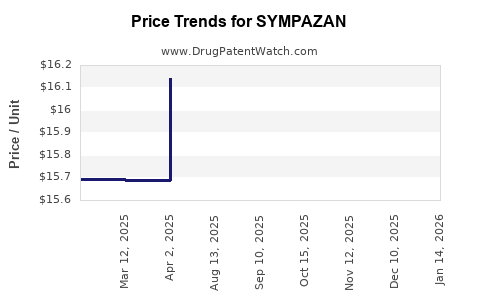
Average Pharmacy Cost for SYMPAZAN
| Drug Name | NDC | Price/Unit ($) | Unit | Date |
|---|---|---|---|---|
| SYMPAZAN 5 MG FILM | 10094-0205-01 | 16.40306 | EACH | 2026-04-01 |
| SYMPAZAN 5 MG FILM | 10094-0205-60 | 16.40306 | EACH | 2026-04-01 |
| SYMPAZAN 10 MG FILM | 10094-0210-01 | 32.75766 | EACH | 2026-04-01 |
| SYMPAZAN 10 MG FILM | 10094-0210-60 | 32.75766 | EACH | 2026-04-01 |
| SYMPAZAN 20 MG FILM | 10094-0220-01 | 65.42818 | EACH | 2026-04-01 |
| SYMPAZAN 20 MG FILM | 10094-0220-60 | 65.42818 | EACH | 2026-04-01 |
| >Drug Name | >NDC | >Price/Unit ($) | >Unit | >Date |
What Is SYMPAZAN and Its Market Position?
SYMPAZAN (rufinamide) is an antiepileptic drug approved primarily for the adjunctive treatment of seizures associated with Lennox-Gastaut syndrome (LGS) in both pediatric and adult populations. It is marketed by Novartis, with U.S. approval granted in 2011. Its mechanism involves selective modulation of voltage-dependent sodium channels, reducing seizure activity.
The drug's market penetration remains limited to rare epilepsy treatment. Its sales are primarily concentrated in North America, Europe, and select Asian markets, with visibility expected to grow as epilepsy treatment paradigms evolve to include more targeted therapies.
What Is the Global Market Size for Antiepileptic Drugs and SYMPAZAN?
The global antiepileptic drugs (AEDs) market was valued at approximately USD 4.95 billion in 2022. It is projected to reach about USD 7.25 billion by 2027, with a compound annual growth rate (CAGR) of around 8.2%.
SYMPAZAN's specific contribution remains under 1% of the total AED market. Its market share is limited by competition from established drugs such as levetiracetam and lamotrigine, which account for a combined 50% of the prescription volume.
In the niche of Lennox-Gastaut syndrome treatments, SYMPAZAN holds a more significant position, with estimated sales around USD 150-200 million in 2022. Growth is impacted by its indication-specific approval and limited label expansion.
What Factors Influence SYMPAZAN’s Pricing and Revenue?
Pricing strategies for SYMPAZAN depend on market region, insurance coverage, and competitive landscape. The average wholesale price (AWP) in the United States is approximately USD 10-15 per 250 mg capsule, with treatment courses costing USD 900–1,200 monthly depending on dosage.
Price projections consider:
- Patent status: Patent expiration in the U.S. is scheduled for 2028, after which generics are expected to diminish brand pricing power.
- Market access: Payer negotiations and formulary inclusion can reduce prices.
- Regulatory approvals: Potential expansion of indications (e.g., other epilepsy syndromes) could increase volume, impacting revenue. Currently, no additional indications have received approval.
- Competitive shifts: Emergence of new therapies, including cannabinoids and gene therapies, may impact demand.
What Are the Future Revenue Projections for SYMPAZAN?
Based on current trends:
- 2023-2025: Sales are projected to stabilize around USD 150-200 million annually, with modest growth driven by increased diagnosis and prescription rates for LGS.
- 2026-2028: As patents expire in the U.S. and Europe, generics are poised to enter the market. Sales could decline 30-50% unless Novartis introduces new formulations or expands indications.
- Post-patent expiry (2029+): Revenue from SYMPAZAN could fall below USD 50 million unless Novartis adapts strategies, such as pricing adjustments or indications expansion.
How Do Competitors and Market Trends Affect SYMPAZAN?
- Key Competitors: Rivastigmine, cannabidiol (CBD)-based therapies like Epidiolex, and other newer agents targeting LGS.
- Market shifts: Growing preference for broad-spectrum AEDs with fewer side effects, and personalized medicine approaches, may impact demand for selective drugs like SYMPAZAN.
- Regulatory trends: Emphasis on safety and efficacy data influence approval and coverage decisions.
Key Opportunities and Risks
Opportunities:
- Expanding NHS and insurance coverage can bolster sales.
- Investigating additional epilepsy syndromes can broaden market reach.
- Developing formulations for easier administration can increase patient adherence.
Risks:
- Patent expiration leads to generic competition.
- Patent challenges to the drug’s formulation or process patents could shorten exclusivity.
- Advances in gene therapy and personalized medicine may reduce reliance on small-molecule drugs.
Summary of Price and Revenue Projections
| Year | Estimated Revenue (USD millions) | Key Factors |
|---|---|---|
| 2023 | 150-200 | Market stability, ongoing prescriptions |
| 2024 | 150-200 | Slight growth, influence of market penetration |
| 2025 | 150-200 | Market saturation, generic competition consideration |
| 2026 | 100-150 | Patent expiry, generic entries begin |
| 2027+ | Below 100 | Declining sales, depends on market adaptation |
Key Takeaways
- SYMPAZAN's current annual sales approximate USD 150–200 million, concentrated in LGS treatment.
- Its pricing remains stable pre-patent expiry, with potential declines post-2028, following patent expiration.
- Expansion into additional indications and formulations presents strategic growth avenues.
- Market competition and evolving treatment preferences pose ongoing risks.
- The overall AED market is expected to grow, but SYMPAZAN's share will depend heavily on pipeline and market strategy.
FAQs
1. When will SYMPAZAN face generic competition?
Patent protection in the U.S. is scheduled to expire in 2028. Similar dates apply in European jurisdictions, opening the market to generics thereafter.
2. Are there ongoing efforts to expand SYMPAZAN's approved indications?
No current approvals beyond Lennox-Gastaut syndrome exist. The company may pursue label expansion, particularly for other seizure types, to increase sales.
3. How do price negotiations affect SYMPAZAN’s revenue?
Reimbursement negotiations and formulary placements influence net price and volume. Reduced prices could significantly impact revenue, especially after patent expiry.
4. What new therapies threaten SYMPAZAN’s market share?
Cannabinoids like Epidiolex, and emerging gene therapies, are potential competitors, especially for treatment of LGS and other epilepsies.
5. What is the outlook for SYMPAZAN in emerging markets?
Market access costs are lower, but pricing and regulatory acceptance vary. Growth potential exists if regulatory hurdles are managed and awareness increases.
Sources
[1] Global Industry Analysts. "Antiepileptic Drugs - Market Analysis." 2022.
[2] Novartis Annual Reports, 2022.
[3] IQVIA Data, 2022.
[4] U.S. FDA. "Drug Approvals and Patent Timelines," 2011-2022.
More… ↓
